


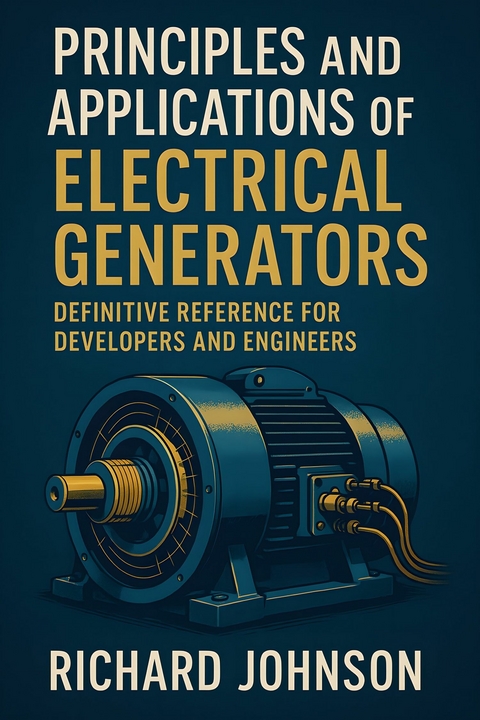
Principles and Applications of Electrical Generators (eBook)
250 Seiten
HiTeX Press (Verlag)
978-0-00-106461-4 (ISBN)
'Principles and Applications of Electrical Generators'
'Principles and Applications of Electrical Generators' is an authoritative and comprehensive exploration of the science and technology underpinning modern electrical generation. Beginning with a rigorous treatment of electromagnetic theory as applied to rotating machines, the book guides readers through core principles-such as Maxwell's equations, Faraday's law, and magnetic circuit optimization-before advancing to the intricate behaviors that shape generator performance. With in-depth analyses of transient phenomena, flux distribution, and energy conversion, this text lays a robust theoretical foundation for students, engineers, and researchers dedicated to understanding and designing efficient generator systems.
The book excels in bridging theoretical knowledge with practical design and application. Extensive chapters detail the construction, operation, and comparative performance of a wide array of generator types-from direct current and synchronous AC machines to cutting-edge brushless, permanent magnet, hybrid, and nano-scale generators. Practical engineering concerns are addressed through sections on electromagnetic design optimization, sophisticated winding techniques, cooling and insulation systems, and the application of finite element modeling. Beyond design, readers are equipped with expertise in generator control, protection, condition monitoring, and integration with advanced power electronics and smart grid infrastructures.
Amidst a backdrop of transformative changes in global power systems, this volume looks ahead to the future of electrical generation. Topics such as digital twin applications, hardware-in-the-loop testing, integration with renewable and distributed resources, and the realities of cyber-physical security are presented alongside in-depth coverage of reliability engineering, international standards, and sustainability practices. 'Principles and Applications of Electrical Generators' serves as an essential resource-connecting deep technical insight with the emerging challenges and innovations shaping the next generation of energy systems.
Chapter 2
Generator Types and Topology
Generators come in astonishing diversity—each type engineered to solve unique challenges, maximize efficiency, or unlock new applications. In this chapter, we journey across the spectrum of generator designs, from the workhorse machines powering industry to the miniature marvels enabling portable and micro-scale energy. Discover how topology and construction shape performance, and how hybrid innovations are redefining what’s possible in electrical generation.
2.1 Direct Current (DC) Generators: Varieties and Construction
Direct current (DC) generators are electromechanical devices designed to convert mechanical energy into electrical energy, providing a steady DC output suitable for a wide spectrum of industrial and traction applications. Their operational variety principally arises from differing methods used to excite the magnetic field, which in turn influences voltage regulation, reliability, and appropriate use cases. The primary classifications-shunt, series, and compound generators-are distinguished by the configuration of their field windings relative to the armature and the resulting performance characteristics.
The shunt generator connects the field winding in parallel (or shunt) with the armature winding. Its field winding consists of numerous turns of fine wire with relatively high resistance, ensuring a constant field current that remains nearly independent of load current. Internally, the magnetic field is established by these shunt field coils mounted on the stator poles, while the armature comprises a laminated core wrapped with conductors, rotating within the magnetic field. The principal operating trait of this arrangement is a relatively stable terminal voltage across varying load conditions due to the constancy of the field flux.
From a construction standpoint, the shunt field coils are insulated and rigidly fixed on the pole faces to ensure optimal flux distribution, and their higher resistance necessitates the use of a stable voltage source derived from the generator’s own output or an auxiliary source during startup. The armature windings are usually lap-connected for low-voltage, high-current applications or wave-connected to support high-voltage, low-current outputs. The brush assembly, comprising carbon brushes and a commutator segmented appropriately for DC conversion, maintains electrical connection with the rotating armature.
In contrast, the series generator configures its field winding in series with the armature. The series field winding consists of a few turns of a heavy-gauge wire, characterized by very low resistance but capable of carrying the full armature current. This closed-loop connection results in the field flux being directly proportional to the load current, causing the terminal voltage to vary significantly with the load. When the load current increases, so does the field strength and thus the generated voltage, typically producing a rising voltage characteristic under load.
Structurally, the series field coils surround the pole cores and are mounted in a manner allowing the magnetic flux generated by the load current to maximize the armature reaction effect. However, the series configuration has inherent limitations in voltage regulation and is generally unsuitable for applications requiring stable voltage. Its primary reliability concern stems from the high current flowing through the field winding, which must endure considerable thermal and mechanical stress.
The compound generator integrates both shunt and series fields, furnishing a hybrid excitation scheme designed to combine the benefits of stable voltage regulation and increased load capacity. Compound generators have two sets of field windings on each pole: a shunt field connected in parallel with the armature and a series field connected in series with the load current. There exist two subtypes: cumulatively compounded, where the fields aid each other, and differentially compounded, where the series field opposes the shunt field.
In the cumulative configuration, the series winding augments the flux at higher loads, counteracting the natural voltage drop due to armature reaction and increased load current, thus maintaining a nearly constant or slightly rising voltage output. The internally complex assembly necessitates careful winding placement and insulation considerations to avoid magnetic saturation and ensure consistent flux distribution. The shunt coils provide baseline excitation, while series coils dynamically respond to load changes, yielding superior voltage regulation characteristics compared to either shunt or series types alone.
From the perspective of applications and reliability, shunt generators serve well in scenarios demanding a steady voltage supply, such as battery charging and excitation of other machines. Series generators find utility in applications with naturally varying load conditions, such as traction motors, where the rising voltage characteristic can be beneficial. Compound generators are preferred in heavy industrial settings involving variable loads but requiring voltage stability, including arc welding and supply to mixed load conditions.
The physical construction across all types prioritizes the integrity of the magnetic circuit, efficient commutation, and thermal management. Armature cores employ high-grade silicon steel laminations to reduce eddy current losses. The brush-commutator assembly design is critical for minimizing sparking and wear. Field coils are wound with insulated copper conductors, optimized for thermal dissipation and mechanical robustness. Detailed attention to pole face contours and interpole (commutating poles) installation further refines performance by mitigating armature reaction effects during commutation.
Voltage regulation, a crucial metric in DC generator performance, varies significantly across these types. The shunt generator achieves moderate voltage regulation, typically in the range of 5–10% under full load, due to the largely constant excitation current. Series generators exhibit poor voltage regulation with variations potentially exceeding 30%, making them unsuitable for sensitive loads. Compound generators can be engineered to achieve regulation as tight as 1–2%, providing a near-constant voltage irrespective of the load-distinctly enhancing operational reliability and system performance.
In summary, the variety of DC generators-shunt, series, and compound-depends fundamentally on their distinct construction and field excitation methods, directly influencing voltage behavior under load and suitability for specific applications. Mastery of their internal design details, operating principles, and resultant voltage regulation characteristics enables tailoring generator selection to precise industrial requirements, maximizing efficiency and operational dependability.
2.2 Synchronous AC Generators: Salient-Pole and Cylindrical-Rotor
Synchronous generators are fundamental components in modern electric power systems, transforming mechanical input into alternating electrical output at synchronous speed. The core architecture of these machines primarily bifurcates into two distinct rotor designs: salient-pole and cylindrical-rotor types. Each design presents unique structural characteristics that significantly affect the magnetic field distribution, operational efficiency, excitation techniques, and overall suitability for various power generation applications.
The salient-pole rotor is characterized by projecting poles that extend radially outward from the rotor core. These poles carry concentrated field windings and are typically constructed from laminated steel to minimize eddy current losses. This rotor type is predominant in low-speed applications, especially hydroelectric generators where rotational speeds are inherently low due to turbine mechanical constraints. The salient-pole design facilitates a large diameter rotor with a relatively low number of poles, enabling compatibility with frequency standards (e.g., 50 or 60 Hz) at lower rotational velocities.
Magnetic field behavior in salient-pole machines is inherently anisotropic due to the non-uniform air gap between the stator and rotor. The salient poles introduce a salient (or salient-pole) effect, where the magnetic reluctance varies significantly along the direct axis (d-axis) aligned with the pole center and the quadrature axis (q-axis) perpendicular to it. This variation influences the synchronous reactance differently along these axes, yielding distinct reactance components known as direct-axis synchronous reactance (Xd) and quadrature-axis synchronous reactance (Xq). This anisotropy must be carefully considered for accurate machine modeling, stability analysis, and assessment of transient performance. It also affects the voltage regulation and fault response characteristics of the generator.
Conversely, the cylindrical-rotor type features a uniform cylindrical rotor core...
| Erscheint lt. Verlag | 9.6.2025 |
|---|---|
| Sprache | englisch |
| Themenwelt | Mathematik / Informatik ► Informatik ► Programmiersprachen / -werkzeuge |
| ISBN-10 | 0-00-106461-4 / 0001064614 |
| ISBN-13 | 978-0-00-106461-4 / 9780001064614 |
| Informationen gemäß Produktsicherheitsverordnung (GPSR) | |
| Haben Sie eine Frage zum Produkt? |
 EPUB (Adobe DRM)
Größe: 1,2 MB
Kopierschutz: Adobe-DRM
Adobe-DRM ist ein Kopierschutz, der das eBook vor Mißbrauch schützen soll. Dabei wird das eBook bereits beim Download auf Ihre persönliche Adobe-ID autorisiert. Lesen können Sie das eBook dann nur auf den Geräten, welche ebenfalls auf Ihre Adobe-ID registriert sind.
Details zum Adobe-DRM
Dateiformat: EPUB (Electronic Publication)
EPUB ist ein offener Standard für eBooks und eignet sich besonders zur Darstellung von Belletristik und Sachbüchern. Der Fließtext wird dynamisch an die Display- und Schriftgröße angepasst. Auch für mobile Lesegeräte ist EPUB daher gut geeignet.
Systemvoraussetzungen:
PC/Mac: Mit einem PC oder Mac können Sie dieses eBook lesen. Sie benötigen eine
eReader: Dieses eBook kann mit (fast) allen eBook-Readern gelesen werden. Mit dem amazon-Kindle ist es aber nicht kompatibel.
Smartphone/Tablet: Egal ob Apple oder Android, dieses eBook können Sie lesen. Sie benötigen eine
Geräteliste und zusätzliche Hinweise
Buying eBooks from abroad
For tax law reasons we can sell eBooks just within Germany and Switzerland. Regrettably we cannot fulfill eBook-orders from other countries.
aus dem Bereich


