


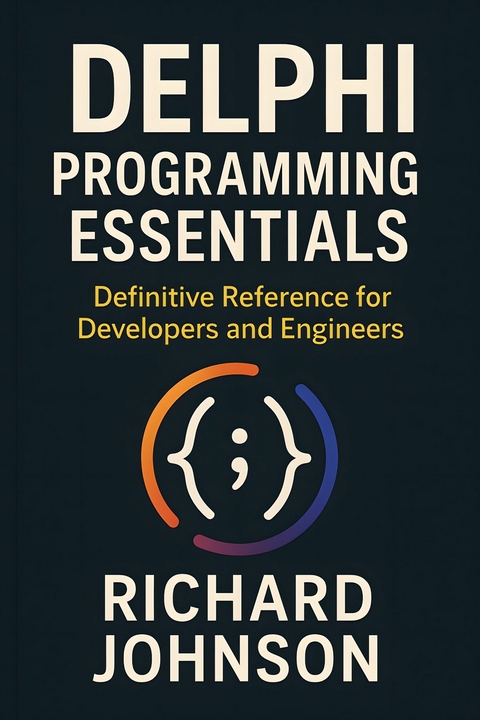
Delphi Programming Essentials (eBook)
250 Seiten
HiTeX Press (Verlag)
978-0-00-106452-2 (ISBN)
'Delphi Programming Essentials'
Delve into the heart of modern software development with 'Delphi Programming Essentials,' an authoritative guide for experienced developers and software architects seeking mastery of the Delphi platform. This comprehensive volume begins with an in-depth exploration of Delphi's core language fundamentals, unraveling its Pascal-based syntax, advanced memory management paradigms, and robust modularization strategies. Readers will uncover the intricacies of Delphi's powerful type system and learn best practices for error handling, complex program flows, and modular development, establishing a foundation for crafting efficient, maintainable applications.
Building upon this foundation, the book transitions into advanced object-oriented design with Delphi, emphasizing sophisticated constructs such as metaprogramming, generics, and anonymous methods. It details the creation of modular, reusable components and explores the depths of both the Visual Component Library (VCL) and FireMonkey (FMX) frameworks, providing guidance for scalable, cross-platform application development. Comprehensive chapters on data access, multitier architectures, and real-time network communication empower professionals to architect enterprise-grade systems with efficiency, security, and resilience at their core.
Recognizing the demands of today's fast-evolving technology landscape, 'Delphi Programming Essentials' also covers concurrent programming, rigorous testing, cross-platform deployment, and secure coding practices. Practical advice on cloud integration, deployment strategies, and continuous delivery is accompanied by expert discussions on maintainability, refactoring, and compliance. Whether modernizing legacy systems or building state-of-the-art Delphi applications from the ground up, this book is the essential reference for achieving high-quality, sustainable Delphi solutions in today's competitive environment.
Chapter 2
Object-Oriented Programming with Delphi
Delphi’s object-oriented strengths transcend tradition, enabling developers to architect elegant, modular, and high-performance software. This chapter unlocks advanced techniques—from deep class hierarchies and flexible interfaces to powerful runtime introspection—teaching you to mold the language’s OOP features into solutions that are both robust and adaptable. Unleash the full potential of Delphi’s object model and elevate your applications to new heights of sophistication.
2.1 Class Architecture and Object Model
Delphi’s class system is the foundation upon which its object-oriented capabilities are built, providing a rich and flexible framework to model complex application domains. At the core of this system lies the concept of the class, which serves not only as a blueprint for object instantiation but also as a runtime entity with metadata, facilitating advanced patterns such as reflection, dynamic creation, and extensibility mechanisms.
A Delphi class internally comprises two main components: the VMT (Virtual Method Table), which supports dynamic dispatch of methods, and a metaclass structure, enabling operations on class types as first-class objects. This duality is critical for Delphi’s rich type information and dynamic behavior. Metaclasses, created as descendants of TClass, embody the runtime representation of classes themselves, allowing patterns like factory creation and class registration to be implemented seamlessly.
Inheritance in Delphi is strictly single and supports both implementation inheritance and polymorphism. Each class implicitly inherits from a base TObject, which provides fundamental methods such as Create, Destroy, ClassName, and ClassType. These inherited behaviors establish a consistent object lifecycle and introspection model across all user-defined types. The inheritance mechanism is designed to facilitate extensibility, enabling developers to override virtual methods to extend or modify behavior without altering the original class code.
Delphi further enriches inheritance with class helpers, a unique feature that allows the extension of existing classes (including RTL and VCL classes) without modifying their source. Class helpers operate as lightweight intermediaries, offering new methods scoped to the helper’s visibility. They adhere to strict conflict resolution rules-only a single helper is active for any given class within a compilation unit, ensuring predictability. This capability is instrumental for inserting cross-cutting behaviors or adapting third-party classes in a non-intrusive manner.
A nuanced understanding of Delphi’s object lifecycle management reveals sophisticated mechanisms beyond simple construction and destruction sequences. Delphi encourages explicit implementation of constructors and destructors with virtual dispatch to ensure that initialization and cleanup properly cascade through the inheritance chain. Moreover, the introduction of class operators enables more flexible instantiation patterns, such as factory methods or cloning semantics. The management of object references is traditionally manual, but Delphi’s supporting frameworks, like Automatic Reference Counting (ARC) on mobile platforms, illustrate extended lifecycle management strategies that coexist with the classic model.
Designing extensible and maintainable class hierarchies in Delphi relies on thoughtful application of these architectural elements. A robust class design leverages inheritance sparingly and strategically, favoring composition and interfaces when appropriate to reduce coupling and support polymorphic behavior without deep inheritance chains. Choosing when and how to utilize virtual methods, abstract classes, and overridden constructors directly impacts the flexibility and clarity of the resulting hierarchy.
Consider the example of designing a component framework. The base component class, inheriting from TObject, defines a minimal interface for lifecycle events and common functionality such as notification and persistence. Derived classes then extend this interface with domain-specific behaviors, using overridden virtual methods to customize initialization, rendering, or event handling stages. Employing class helpers provides an avenue to augment components with additional capabilities, such as logging or debugging utilities, without affecting the core inheritance structure.
To illustrate the metaclass and class helper concepts succinctly, the following code snippet defines a base TAnimal class with virtual behavior, a derived TDog class overriding that behavior, and a helper for TAnimal introducing a new method:
type
TAnimal = class
public
procedure Speak; virtual;
class procedure Factory; virtual;
end;
TDog = class(TAnimal)
public
procedure Speak; override;
end;
TAnimalHelper = class helper for TAnimal
procedure Eat;
end;
procedure TAnimal.Speak;
begin
WriteLn(’An animal makes a sound.’);
end;
procedure TDog.Speak;
begin
WriteLn(’The dog barks.’);
end;
class procedure TAnimal.Factory;
var
AnimalClass: TClass;
Animal: TAnimal;
begin
// Create instance dynamically using metaclass
AnimalClass := TDog;
Animal := TAnimal(AnimalClass.Create);
try
Animal.Speak;
// Uses the helper method
(Animal as TAnimal).Eat;
finally
Animal.Free;
end;
end;
procedure TAnimalHelper.Eat;
begin
WriteLn(’Eating food.’);
end;
When the Factory method executes, the output is:
The dog barks.
Eating food.
This code encapsulates the interplay between classes, metaclasses, virtual methods, and class helpers: the metaclass TClass enables runtime type creation; virtual methods allow polymorphic behavior; the helper extends the API without altering inheritance, all while maintaining strict lifecycle management through Create and Free.
Delphi’s class and object model emphasizes clarity, runtime flexibility, and maintainability by integrating classical object-oriented principles with innovative language constructs. Mastery of metaclasses, inheritance strategies, class helpers, and lifecycle semantics empowers developers to architect complex, extensible systems that stand the test of evolving requirements and platform changes.
2.2 Interfaces, Delegation, and Abstraction
Delphi’s interface constructs provide a robust foundation for implementing true abstraction and decoupling in software design. Unlike class inheritance, interfaces define contracts without implementation details, enabling modular and maintainable architectures where components interact through well-defined boundaries.
An interface in Delphi is declared using the interface keyword, followed by method signatures without implementation. For example, a simple interface for a data provider might be declared as:
type
IDataProvider = interface
[’{A7F7B9E3-0F6C-4A6F-B2A3-2C8DFFED1F01}’]
function GetData: string;
end;
...
| Erscheint lt. Verlag | 6.6.2025 |
|---|---|
| Sprache | englisch |
| Themenwelt | Mathematik / Informatik ► Informatik ► Programmiersprachen / -werkzeuge |
| ISBN-10 | 0-00-106452-5 / 0001064525 |
| ISBN-13 | 978-0-00-106452-2 / 9780001064522 |
| Informationen gemäß Produktsicherheitsverordnung (GPSR) | |
| Haben Sie eine Frage zum Produkt? |
 EPUB (Adobe DRM)
Größe: 573 KB
Kopierschutz: Adobe-DRM
Adobe-DRM ist ein Kopierschutz, der das eBook vor Mißbrauch schützen soll. Dabei wird das eBook bereits beim Download auf Ihre persönliche Adobe-ID autorisiert. Lesen können Sie das eBook dann nur auf den Geräten, welche ebenfalls auf Ihre Adobe-ID registriert sind.
Details zum Adobe-DRM
Dateiformat: EPUB (Electronic Publication)
EPUB ist ein offener Standard für eBooks und eignet sich besonders zur Darstellung von Belletristik und Sachbüchern. Der Fließtext wird dynamisch an die Display- und Schriftgröße angepasst. Auch für mobile Lesegeräte ist EPUB daher gut geeignet.
Systemvoraussetzungen:
PC/Mac: Mit einem PC oder Mac können Sie dieses eBook lesen. Sie benötigen eine
eReader: Dieses eBook kann mit (fast) allen eBook-Readern gelesen werden. Mit dem amazon-Kindle ist es aber nicht kompatibel.
Smartphone/Tablet: Egal ob Apple oder Android, dieses eBook können Sie lesen. Sie benötigen eine
Geräteliste und zusätzliche Hinweise
Buying eBooks from abroad
For tax law reasons we can sell eBooks just within Germany and Switzerland. Regrettably we cannot fulfill eBook-orders from other countries.
aus dem Bereich


