


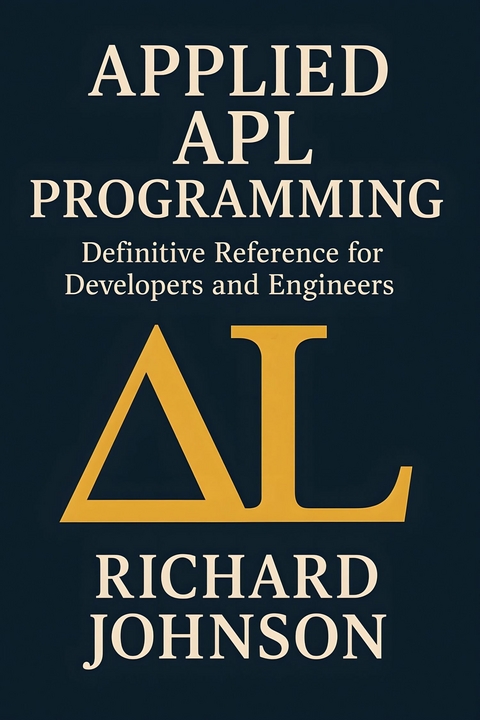
Applied APL Programming (eBook)
250 Seiten
HiTeX Press (Verlag)
978-0-00-106450-8 (ISBN)
'Applied APL Programming'
'Applied APL Programming' is an in-depth guide that illuminates the expressive power and unique philosophy of the APL language. Beginning with a thorough exploration of APL's symbol-rich syntax and array-oriented paradigm, the book grounds readers in both the foundational and modern aspects of the language, including its evolving ecosystem and development tooling. Readers will gain a nuanced understanding of APL data structures-from simple arrays to deeply nested constructs-and learn how the workspace model fosters an efficient and flexible programming environment.
The book systematically builds essential skills in array manipulation, function definition, and higher-order programming using APL's distinctive operators and tacit style. Advanced topics such as boxed arrays, associative structures, and algorithmic problem solving are presented with practical examples that bridge theory and application. Comprehensive chapters on real-world scenarios cover domains like statistical computing, signal processing, optimization, and simulations, providing a toolkit for tackling technical challenges across industries.
Beyond coding, 'Applied APL Programming' addresses the full software development lifecycle, including best practices for code quality, testing, refactoring, deployment, and scalability in multi-core environments. Integration with external systems, database access, and leveraging modern APIs are covered in depth, positioning APL as a contemporary, interoperable language. Closing with a survey of the vibrant APL community, open-source projects, and the language's ongoing influence on the wider world of programming, this book serves as an indispensable resource for both aspiring and experienced APL practitioners.
Chapter 1
APL Language Foundations
Dive into the heart of APL’s distinctiveness, where cryptic symbols meet profound computational power. This chapter unveils the expressive syntax and foundational features that set APL apart from traditional languages. You’ll journey through the language’s origins, its modern incarnations, and the innovative workspace and tooling that empower today’s array programmers to think—and code—differently.
1.1 APL Symbol Set and Syntax
APL (A Programming Language) is distinguished by its use of a dense, symbolic alphabet that diverges from traditional alphanumeric character sets found in most programming languages. This symbolic repertoire, combined with an unusually concise syntax, permits the expression of complex algorithms and data transformations in remarkably compact forms. The resulting notational framework emphasizes brevity and expressiveness, although it imposes specific challenges on readability and cognitive processing that are pivotal to understanding APL’s design philosophy.
The foundational characteristic of APL’s symbol set is the use of a wide array of nonstandard glyphs drawn from a specially designed character set, rather than relying primarily on ASCII-based letters and digits. This set includes monadic (single-operand) and dyadic (two-operand) operators, as well as special function symbols and structural notations. Each symbol corresponds to an atomic operation or function with a precise behavioral interpretation. For example, the symbol × represents multiplication as a dyadic operator, but when used monadically it denotes the reciprocal function. Such overloading is typical and extends to many symbols, allowing a powerful density of meaning within a single character.
APL’s syntax is minimalist and heavily reliant on tacit (point-free) programming constructs alongside explicit arguments, minimizing the need for verbose keywords, delimiters, and statements. The language eschews the concept of statement terminators as seen in conventional languages; instead, expressions form a two-dimensional notation where juxtaposition and operator precedence govern evaluation order. This layout supports not only linear but also matrix-shaped code fragments, reflecting the language’s fundamental orientation toward array computing.
Operators in APL fall into distinct classes, including primitive functions, operators (higher-order functions that modify or combine other functions), and special forms. Many primitive functions are “scalar-to-array” or “array-to-array” operations, and their symbols directly evoke the mathematical or computational operation they express. Familiar mathematical operators × (multiplication), − (subtraction), + (addition), and ÷ (division) are augmented by less conventional symbols such as ρ (reshape), ι (index generator), and δ (difference), each performing a vector or array transformation rather than scalar computation alone.
The “shape” operator ρ merits particular emphasis as a hallmark example of APL’s succinct expressiveness. When provided with a numeric vector argument, ρ morphs the shape of another array to conform to those dimensions, facilitating complex array manipulations with minimal notation. For instance, the expression
reshapes a one-dimensional vector of 12 elements into a 3×4 matrix. This concise expression replaces verbose looping or index calculations common in other languages.
The notation also supports an elegant set of reduction and scan operators such as / (fold or reduce), / (scan or prefix reduction), and their respective variants. Reduction applies a dyadic function repeatedly across an array’s elements to produce a single scalar or a reduced array, while scan computes intermediate results cumulatively. For example, summing an array can be expressed as
which reads as the “sum reduce” of the array. This fluency in expressing aggregation gestures directly toward the mathematical abstraction of operations on collections, unencumbered by iterative control-flow constructs.
APL’s unique two-dimensional syntax also supports the combination of operators into derived forms through function composition and operator chaining. A distinct set of derived operators can modify the behavior or arguments of primitive functions, enabling sophisticated functional programming idioms. The composition operator, notated as a circle ∘, permits chaining multiple functions without explicit intermediate variables, enabling dense pipelines of array transformations. An example might be
which combines addition and multiplication into a new derived operator prior to reduction.
One of the more subtle features of APL’s symbol-driven approach is the implicit context sensitivity embedded in operator interpretation. The same symbol can behave differently depending on whether it acts monadically or dyadically, the rank of its arguments (scalar, vector, matrix), and the evaluation environment. This capability greatly expands expressive power but demands careful attention to the mental model governing operand shapes and operator precedence.
Reading and writing APL code thus requires a conceptual leap from traditional, more verbose languages. The mental model centers on viewing programs as transformations on arrays through a compact symbolic vocabulary, akin to manipulating mathematical expressions. Each symbol conveys a rich semantic payload; its combination with others forms a lattice of compositional meanings rather than a linear sequence of instructions. The reader must constantly track operand ranks, function valences, argument roles, and associated array dimensions.
With respect to clarity and brevity, APL’s approach is dual-natured. On one hand, the language’s terseness drastically reduces program length, often by an order of magnitude compared to equivalent C or Java routines. Complex algorithms involving matrix manipulations, reductions, and data reshaping can be stated in line-length expressions that mask the underlying intricacies typically spread over many lines. This brevity is invaluable when prototyping or expressing dense mathematical logic compactly.
Conversely, the dense symbol set frequently challenges clarity, especially for those unfamiliar with the notation. The pictographic nature of many operators, while strongly expressive by design, can obscure meaning without extensive familiarity. Institutions and corporations that historically leveraged APL often invested substantially in training and tooling to mitigate the steep learning curve. Nevertheless, within expert circles, the notation becomes a concise shared language for conceptualizing array operations that transcends typical programming verbosity.
Pragmatically, modern APL interpreters and development environments employ interactive features such as inline function explanations, symbolic palettes, and direct manipulation aids to reduce cognitive load. The syntax’s compactness enables rapid experimentation and immediate transformation feedback, aligning with the exploratory nature of numerical and data-centric computing. The mental overhead incurred is counterbalanced by productivity gains in specialized domains.
Mastery of APL’s unique alphabet unlocks a powerful paradigm for dense, expressive programmatic expression within the domain of computational mathematics and data processing.
1.2 APL Data Types and Structures
APL’s distinctiveness and expressive power largely stem from its elegant handling of data types and structures. Its core building blocks are designed to facilitate the representation and manipulation of complex multidimensional and nested data with minimal syntactic overhead. This section delineates these fundamental constructs—scalars, numeric and character arrays, nested arrays, and boxed data—while emphasizing their interplay in enabling compact, yet powerful data representations.
At the foundation lies the scalar, the simplest APL data entity. A scalar is an array with rank zero and exactly one element. Unlike many languages where scalars are treated distinctly from arrays, in APL, scalars are a special case of arrays; this uniformity simplifies operations by uniformly allowing array primitives to act on any rank data. Scalars can be numbers (integers, floating-point, complex), characters, or symbols, each corresponding to specific primitive data types understood by the interpreter.
Building on scalars, the array is a fundamental concept embodying collections of homogeneous data elements organized in one or more dimensions. Arrays are the default data structure in APL, and all non-scalar data must be arrays. Numeric arrays contain elements such as integers,...
| Erscheint lt. Verlag | 4.6.2025 |
|---|---|
| Sprache | englisch |
| Themenwelt | Mathematik / Informatik ► Informatik ► Programmiersprachen / -werkzeuge |
| ISBN-10 | 0-00-106450-9 / 0001064509 |
| ISBN-13 | 978-0-00-106450-8 / 9780001064508 |
| Informationen gemäß Produktsicherheitsverordnung (GPSR) | |
| Haben Sie eine Frage zum Produkt? |
 EPUB (Adobe DRM)
Größe: 1,1 MB
Kopierschutz: Adobe-DRM
Adobe-DRM ist ein Kopierschutz, der das eBook vor Mißbrauch schützen soll. Dabei wird das eBook bereits beim Download auf Ihre persönliche Adobe-ID autorisiert. Lesen können Sie das eBook dann nur auf den Geräten, welche ebenfalls auf Ihre Adobe-ID registriert sind.
Details zum Adobe-DRM
Dateiformat: EPUB (Electronic Publication)
EPUB ist ein offener Standard für eBooks und eignet sich besonders zur Darstellung von Belletristik und Sachbüchern. Der Fließtext wird dynamisch an die Display- und Schriftgröße angepasst. Auch für mobile Lesegeräte ist EPUB daher gut geeignet.
Systemvoraussetzungen:
PC/Mac: Mit einem PC oder Mac können Sie dieses eBook lesen. Sie benötigen eine
eReader: Dieses eBook kann mit (fast) allen eBook-Readern gelesen werden. Mit dem amazon-Kindle ist es aber nicht kompatibel.
Smartphone/Tablet: Egal ob Apple oder Android, dieses eBook können Sie lesen. Sie benötigen eine
Geräteliste und zusätzliche Hinweise
Buying eBooks from abroad
For tax law reasons we can sell eBooks just within Germany and Switzerland. Regrettably we cannot fulfill eBook-orders from other countries.
aus dem Bereich


