


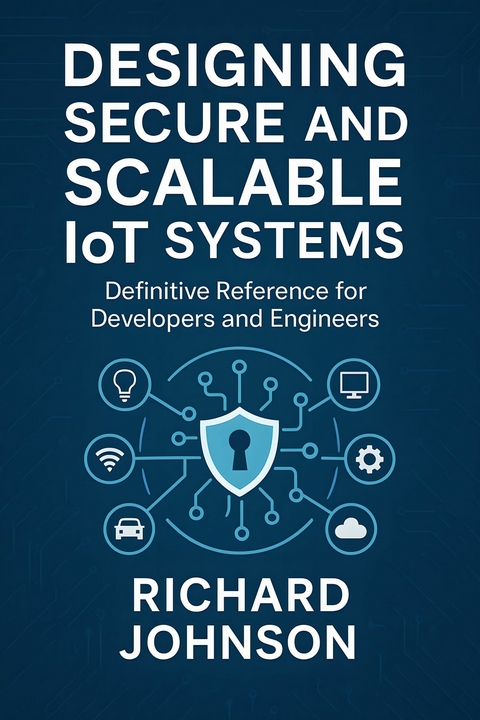
Designing Secure and Scalable IoT Systems (eBook)
250 Seiten
HiTeX Press (Verlag)
978-0-00-106446-1 (ISBN)
'Designing Secure and Scalable IoT Systems'
'Designing Secure and Scalable IoT Systems' is a comprehensive guidebook for architects, engineers, and technology leaders seeking to build robust Internet of Things (IoT) applications that meet demanding standards of security, performance, and manageability. Spanning foundational principles through advanced topics, this book examines contemporary IoT architectures, modular system decomposition, and coordination across edge, fog, and cloud environments. It explores event-driven and resilient design patterns, emphasizing scalable data and control plane separation to ensure reliability in rapidly evolving, distributed ecosystems.
Central to this work is an in-depth treatment of IoT security fundamentals, including threat modeling, device authentication, lightweight cryptography, secure provisioning, and end-to-end communication protocols. The book rigorously addresses privacy-by-design methodologies, intrusion detection, secure firmware management, and regulatory compliance, equipping readers to anticipate and defend against modern threats while balancing innovation and trust. Advanced security challenges are explored, with insights into zero trust models, quantum-resistant cryptography, anomaly detection, and privacy engineering for compliance with global standards such as GDPR.
Beyond security, the book covers every facet of scalable IoT operations - from network design and data management to device lifecycle orchestration, cloud-native deployment, and operational excellence. Readers will find practical strategies for self-healing networks, federated learning, blockchain integration, and sustainable operation at scale. Concluding with emerging trends like decentralized AI, next-generation connectivity, and ethical impact analysis, 'Designing Secure and Scalable IoT Systems' serves as an indispensable reference for navigating the complexities and opportunities of next-generation IoT deployments.
Chapter 2
Security Fundamentals in IoT
What makes IoT systems such inviting targets for attackers, and how can we build defenses that keep pace with a rapidly expanding surface area? In this chapter, we unpack the essential security concepts, threat models, and concrete mechanisms that form the bedrock of trustworthy IoT platforms. Discover how effective security begins at design—and how to harden every layer, from silicon to cloud.
2.1 IoT Threat Modeling and Risk Assessment
Internet of Things (IoT) environments present a distinctive landscape for security analysis due to their inherent complexity, heterogeneity, and resource-constrained nature. The proliferation of interconnected devices expands the attack surface exponentially, necessitating a systematic approach to identifying vulnerabilities and quantifying associated risks. Precision in threat modeling and risk assessment equips architects to allocate resources prudently, reinforcing critical points within an IoT system.
Key Attack Surfaces in IoT Environments
Attack surfaces in IoT extend beyond traditional ICT boundaries, implicating layers from physical devices to cloud services and user interfaces. The primary domains include:
- Device Hardware and Firmware: Physical tampering or exploitation of embedded firmware vulnerabilities remain paramount. Attack vectors often include side-channel attacks, firmware backdoors, and unauthorized code injection.
- Communication Protocols: IoT devices leverage wireless protocols (e.g., Zigbee, MQTT, CoAP, Bluetooth LE), each with distinct security postures and weaknesses that attackers can exploit through man-in-the-middle (MITM) attacks, replay attacks, or protocol manipulation.
- Cloud and Backend Services: Centralized platforms and APIs underpin data aggregation and control, thus exposing the system to risks such as improper authentication, authorization bypass, and data leakage.
- User Interfaces and Applications: Mobile apps, web portals, and user dashboards create entry points vulnerable to injection attacks, session hijacking, and social engineering exploits.
- Supply Chain Risks: Components’ provenance and firmware integrity can be compromised even prior to deployment, presenting stealthy threats through counterfeit or compromised parts.
The complexity of interconnected layers complicates identification of all exploitable avenues, requiring an encompassing model that integrates physical, network, software, and human factors.
Fundamentals of IoT Threat Modeling
Threat modeling frameworks facilitate structured analysis of possible adversarial actions. The endeavor begins with precise system characterization:
- Asset Identification: Enumerate critical assets, including data confidentiality, device availability, and operational integrity.
- Actor Definition: List potential threat agents—ranging from external cybercriminals and insider threats to nation-state actors—alongside their capabilities and motivations.
- Entry Points and Interfaces: Map all pathways through which an attacker might access the system.
- Trust Boundaries: Delineate zones of differing trust levels to highlight transitions requiring stringent controls.
Techniques such as Data Flow Diagrams (DFDs) and Attack Trees serve to visualize and decompose the attack vectors. For example, an attack tree on firmware integrity may branch into supply chain compromise, unauthorized updates, and cryptographic key extraction.
Quantifying Risk: Likelihood and Impact Assessment
Risk is conventionally characterized as a function of the likelihood of a threat materializing and the consequent impact. The dual axes provide a framework to prioritize mitigation efforts effectively.
Estimating Likelihood Factors influencing likelihood in IoT systems include:
- Exposure Level: Devices with open wireless interfaces or publicly accessible APIs exhibit elevated attack probability.
- Exploit Difficulty: Complexity and availability of exploits affect chances of successful compromise.
- Presence of Vulnerabilities: Known or zero-day vulnerabilities increase susceptibility.
- Existing Controls: Authentication, encryption, and anomaly detection mechanisms modulate likelihood downwards.
Likelihood can be expressed qualitatively (e.g., rare, unlikely, possible, likely, almost certain) or quantitatively via probabilistic models when data permits.
Assessing Impact Impact manifests in diverse IoT contexts, combining technical, operational, and business repercussions:
- Data Exposure: Loss of confidentiality may leak sensitive private or operational information.
- Service Disruption: Denial-of-service conditions impair functionality, risking safety in critical settings.
- Physical Damage and Safety: Compromises that influence actuators may cause direct harm or asset damage.
- Reputational and Compliance Penalties: Regulatory noncompliance fosters legal and financial consequences.
Impact scales are similarly classified from negligible to catastrophic based on severity and downstream effects.
Formal Risk Assessment Methodologies
Structured approaches ensure consistency and comprehensiveness in assessing IoT risks. Prominent methodologies adapted for IoT include:
- STRIDE: Categorizes threats as Spoofing, Tampering, Repudiation, Information disclosure, Denial of service, and Elevation of privilege. STRIDE systematically addresses each category against identified assets and trust boundaries.
- DREAD: A quantitative model assessing Damage potential, Reproducibility, Exploitability, Affected users, and Discoverability, producing a composite risk score.
- Attack Trees: Formal tree structures detailing attack vectors with associated probabilities and impacts on leaves, supporting calculation of overall risk metrics.
- NIST SP 800-30: Presents qualitative and quantitative risk assessment guidelines, widely adopted for critical infrastructure incorporating IoT.
Integrating these methodologies involves mapping IoT-specific assets and interfaces into threat taxonomies, then scoring and aggregating risks to yield prioritized treatment plans.
Illustrative Risk Assessment Workflow
A procedural example delineates typical steps for IoT risk assessment:
1. Identify critical devices and data flows within the IoT ecosystem.
2. Construct Data Flow Diagrams annotating trust zones and interfaces.
3. Apply STRIDE to enumerate potential threats per component.
4. Build Attack Trees mapping threat realization paths.
5. Determine likelihood and impact values for each attack scenario using DREAD metrics or expert judgment.
6. Compute quantitative risk scores:
Risk Score = Likelihood × Impact
7. Rank risks and prioritize architectural and operational controls accordingly.
8. Reassess post-implementation to validate residual risk levels.
Application of Threat Modeling Data in Architectural Design
The insights from threat and risk analyses inform several design principles:
- Least Privilege: Restrict device and service permissions to minimum required to limit exploitation scope.
- Defense in Depth: Layered security mechanisms reduce single points of failure.
- Fail-Safe Defaults: Systems default to secure states minimizing impact of compromise.
- Robust Authentication and Key Management: Identity assurance and cryptographic protections guard against spoofing and tampering.
- Continuous Monitoring and Incident Response: Early detection through anomaly analysis mitigates lingering threats.
Effective threat modeling thus transitions seamlessly into secure system architecture, guiding technology selection and operational policies aligned with quantified risk posture.
...
| Erscheint lt. Verlag | 3.6.2025 |
|---|---|
| Sprache | englisch |
| Themenwelt | Mathematik / Informatik ► Informatik ► Programmiersprachen / -werkzeuge |
| ISBN-10 | 0-00-106446-0 / 0001064460 |
| ISBN-13 | 978-0-00-106446-1 / 9780001064461 |
| Informationen gemäß Produktsicherheitsverordnung (GPSR) | |
| Haben Sie eine Frage zum Produkt? |
 EPUB (Adobe DRM)
Größe: 984 KB
Kopierschutz: Adobe-DRM
Adobe-DRM ist ein Kopierschutz, der das eBook vor Mißbrauch schützen soll. Dabei wird das eBook bereits beim Download auf Ihre persönliche Adobe-ID autorisiert. Lesen können Sie das eBook dann nur auf den Geräten, welche ebenfalls auf Ihre Adobe-ID registriert sind.
Details zum Adobe-DRM
Dateiformat: EPUB (Electronic Publication)
EPUB ist ein offener Standard für eBooks und eignet sich besonders zur Darstellung von Belletristik und Sachbüchern. Der Fließtext wird dynamisch an die Display- und Schriftgröße angepasst. Auch für mobile Lesegeräte ist EPUB daher gut geeignet.
Systemvoraussetzungen:
PC/Mac: Mit einem PC oder Mac können Sie dieses eBook lesen. Sie benötigen eine
eReader: Dieses eBook kann mit (fast) allen eBook-Readern gelesen werden. Mit dem amazon-Kindle ist es aber nicht kompatibel.
Smartphone/Tablet: Egal ob Apple oder Android, dieses eBook können Sie lesen. Sie benötigen eine
Geräteliste und zusätzliche Hinweise
Buying eBooks from abroad
For tax law reasons we can sell eBooks just within Germany and Switzerland. Regrettably we cannot fulfill eBook-orders from other countries.
aus dem Bereich


