


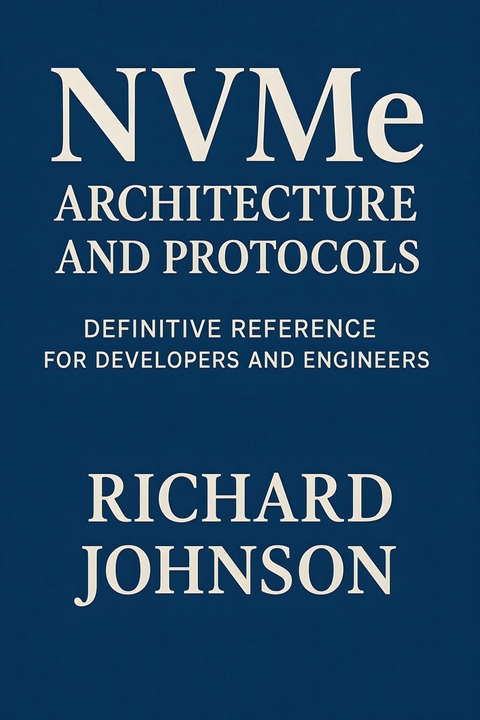
NVMe Architecture and Protocols (eBook)
250 Seiten
HiTeX Press (Verlag)
978-0-00-106445-4 (ISBN)
'NVMe Architecture and Protocols'
'NVMe Architecture and Protocols' offers a comprehensive exploration of Non-Volatile Memory Express (NVMe) technologies, tailored for engineers, architects, and technical professionals navigating the rapidly evolving landscape of high-performance storage. Beginning with the foundations of NVMe's inception, the book meticulously charts the evolution from legacy protocols to NVMe's revolutionary approach-detailing the motivations, design philosophies, and ecosystem transformations that have positioned NVMe as the protocol of choice for modern data-intensive applications. Through clear comparisons, targeted use cases, and insights into new feature developments, readers gain a thorough understanding of NVMe's transformative impact on storage efficiency and scalability.
Delving deeper, the book demystifies the interplay between hardware and system architecture, unpacking topics such as PCI Express integration, queuing strategies, memory access mechanisms, and power management. Comprehensive chapters address the full breadth of NVMe protocol fundamentals, including command models, submission and completion queue management, asynchronous event handling, and robust error recovery. Advanced sections illuminate extensions like Zoned Namespaces, key-value stores, end-to-end data protection, and persistent memory support, as well as the groundbreaking expansion of NVMe over Fabrics (NVMe-oF), which brings high-speed NVMe capabilities to distributed and cloud environments through protocols like RDMA, TCP, and Fibre Channel.
The book's holistic approach extends to the software stack and operational realities, from device drivers and firmware to virtualization and performance tuning. Critical themes of security, reliability, and data integrity are addressed in concert with quality of service and fault tolerance, providing actionable guidance for deploying, monitoring, and securing NVMe in production environments. Looking toward the future, 'NVMe Architecture and Protocols' evaluates next-generation standards, integration with emerging memory technologies, and the protocol's adaptation for AI, edge, IoT, and composable infrastructure-making this an indispensable resource for those building the next generation of storage solutions.
Chapter 2
NVMe Hardware and System Architecture
How does NVMe achieve such astonishing speed and scalability, and what’s happening beneath the surface when you send a storage command? This chapter unveils the inner workings of NVMe-enabled systems, tracing the flow of data through hosts, controllers, and cutting-edge silicon. Explore the hardware and architectural breakthroughs that set NVMe apart—from lightning-fast PCIe lanes to intricate queuing mechanisms—equipping you to understand, design, and optimize state-of-the-art NVMe deployments.
2.1 Host and Device Architecture
The Non-Volatile Memory Express (NVMe) specification establishes a modern, high-performance interface designed to exploit the low latency and parallelism of solid-state storage media attached via the PCI Express (PCIe) bus. The architecture of NVMe storage solutions reflects a division of responsibilities between three primary entities: the host, the NVMe controller, and the storage device. Understanding the detailed structure and interaction among these components is essential for optimizing system performance and scalability across both client and enterprise storage deployments.
NVMe Host: Role and Responsibilities
The host embodies the initiator of storage commands and serves as the primary manager of data flow, interfacing with NVMe devices through a hardware and software stack compliant with PCIe and NVMe specifications. It is responsible for command submission, completion processing, and overall coordination of data movement.
Key functions of the host include:
- Queue Management: NVMe introduces multiple I/O submission and completion queues, each capable of operating independently and concurrently. The host allocates and maintains these queues in memory, issuing commands and polling or receiving interrupts for completed operations.
- Command Formation and Submission: Commands are structured as 64-byte entries in submission queues, encapsulating operation codes, namespace identifiers, and data buffer pointers. The host populates submission queues with these commands and informs the NVMe controller of new requests via doorbell registers.
- Interrupt Handling: Upon completion of commands, the NVMe controller notifies the host through interrupts or polling mechanisms. The host processes completion queues to finalize operations and dispatch responses.
- Controller and Namespace Management: The host is responsible for discovering, enumerating, and configuring NVMe controllers and associated namespaces. This includes retrieving controller capabilities, health information, and setting operational parameters through administrative commands.
- Error Handling and Recovery: While the NVMe controller handles low-level error detection, the host implements recovery strategies including command retries, error logging, and failover procedures in multi-controller topologies.
The host system’s NVMe driver software constructs the abstraction layer that bridges high-level I/O request submission from the operating system or hypervisor to the low-level PCIe-based NVMe controller interface. This software stack takes advantage of NVMe’s parallelism by creating multiple submission and completion queues mapped to CPU cores or threads, thereby maximizing utilization of multi-core processor systems.
NVMe Controller Architecture and Functionality
The NVMe controller functions as the intermediary between the host and the physical storage media. It typically resides within the storage device, either as a discrete integrated circuit or embedded within an SSD module. The controller interprets and executes commands submitted by the host, manages data traffic to and from non-volatile memory, and implements device-specific logic for performance optimization and reliability.
Principal components within the NVMe controller include:
- Command Scheduler and Parser: The controller maintains in-device submission and completion queue heads and tails, parsing incoming commands from host-allocated queues. It schedules commands for execution, supporting multiple simultaneous queues to leverage internal parallelism.
- DMA Engine: Direct Memory Access (DMA) engines manage data transfers between host memory and the controller’s buffer memory or directly to the NAND flash or other non-volatile memory media, minimizing CPU intervention and maximizing throughput.
- Memory Management Unit (MMU): Virtual-to-physical address translations and protection domain implementations may be present to isolate host processes and enable features such as virtualization and multi-tenant access control.
- Flash Translation Layer (FTL) or Equivalent: To abstract the physical characteristics of NAND flash such as erase block size and wear-leveling requirements, the controller executes logical-to-physical address mapping and garbage collection operations.
- Error Correction and Data Integrity: Error Correcting Codes (ECC), cyclic redundancy checks (CRC), and end-to-end data protection mechanisms are implemented within the controller to safeguard against data corruption.
- Power Management and Thermal Control: Controllers incorporate logic to monitor device temperature, regulate power consumption, and adjust performance states dynamically to prevent thermal throttling.
The NVMe specification defines a set of administrative commands for configuration and diagnostics that the controller processes, in addition to the broader range of I/O commands required to read, write, or flush data to non-volatile storage. Controllers ensure command atomicity, enforce data ordering rules, and handle asynchronous events such as firmware updates and error reporting.
Storage Device: Physical Media and Protocol Abstraction
The NVMe storage device encapsulates the physical persistent memory media and integrates the NVMe controller within a single enclosure presented over PCIe. The physical layer typically consists of NAND flash chips or emerging non-volatile memory technologies such as 3D XPoint or NAND alternatives, arranged with parallelism considerations for performance scaling.
Storage devices maintain internal subsystems to:
- Manage Physical Media: The device firmware conducts wear leveling, bad block management, and media health monitoring, abstracted away from the host.
- Provide Namespace Structures: Logical entities called namespaces map logical block addresses to physical locations in the memory media. These namespaces can be partitioned for different applications or virtual machines, each appearing as an independent storage volume to the host.
- Support Enhanced Features: Advanced storage devices implement features such as end-to-end data protection, power loss protection, security encryption engines, and telemetry capabilities.
The design of NVMe storage devices deliberately isolates device-internal management functions from host operations, enabling modular improvements and vendor differentiation without disrupting the standardized host interface.
Interaction Model and Responsibility Partitioning
The architecture delineates crisp boundaries between host and device responsibilities to optimize performance, reduce complexity, and enable scalability. The host focuses on command management, queuing, initialization, and high-level error management. The controller handles execution details, media management, and low-level error detection and correction.
Command queues represent the primary communication channels, established and managed by the host. Each queue pair consists of a submission queue (commands from host to device) and a completion queue (device acknowledgments). This queue-centric approach supports highly parallelized execution, allowing the host and device to independently progress command processing asynchronously.
Synchronization between host and controller occurs through mechanisms such as doorbell registers and interrupt generation, minimizing latency and CPU overhead.
Subsystem Topologies in Client and Enterprise Systems
NVMe subsystem architecture scales from simple, single-controller, single-namespace devices typical in client systems to complex multi-controller, multi-namespace deployments used in enterprise storage arrays and data center environments.
Client Systems
In personal computing platforms, NVMe devices are often single controllers integrated within M.2 or U.2 form factor SSDs. The...
| Erscheint lt. Verlag | 1.6.2025 |
|---|---|
| Sprache | englisch |
| Themenwelt | Mathematik / Informatik ► Informatik ► Programmiersprachen / -werkzeuge |
| ISBN-10 | 0-00-106445-2 / 0001064452 |
| ISBN-13 | 978-0-00-106445-4 / 9780001064454 |
| Informationen gemäß Produktsicherheitsverordnung (GPSR) | |
| Haben Sie eine Frage zum Produkt? |
 EPUB (Adobe DRM)
Größe: 837 KB
Kopierschutz: Adobe-DRM
Adobe-DRM ist ein Kopierschutz, der das eBook vor Mißbrauch schützen soll. Dabei wird das eBook bereits beim Download auf Ihre persönliche Adobe-ID autorisiert. Lesen können Sie das eBook dann nur auf den Geräten, welche ebenfalls auf Ihre Adobe-ID registriert sind.
Details zum Adobe-DRM
Dateiformat: EPUB (Electronic Publication)
EPUB ist ein offener Standard für eBooks und eignet sich besonders zur Darstellung von Belletristik und Sachbüchern. Der Fließtext wird dynamisch an die Display- und Schriftgröße angepasst. Auch für mobile Lesegeräte ist EPUB daher gut geeignet.
Systemvoraussetzungen:
PC/Mac: Mit einem PC oder Mac können Sie dieses eBook lesen. Sie benötigen eine
eReader: Dieses eBook kann mit (fast) allen eBook-Readern gelesen werden. Mit dem amazon-Kindle ist es aber nicht kompatibel.
Smartphone/Tablet: Egal ob Apple oder Android, dieses eBook können Sie lesen. Sie benötigen eine
Geräteliste und zusätzliche Hinweise
Buying eBooks from abroad
For tax law reasons we can sell eBooks just within Germany and Switzerland. Regrettably we cannot fulfill eBook-orders from other countries.
aus dem Bereich


