


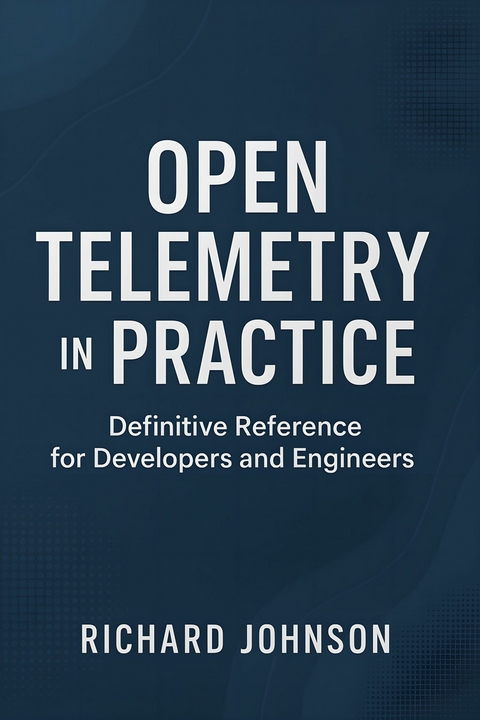
OpenTelemetry in Practice (eBook)
250 Seiten
HiTeX Press (Verlag)
978-0-00-106437-9 (ISBN)
'OpenTelemetry in Practice'
OpenTelemetry in Practice offers a comprehensive, hands-on exploration of modern observability through the OpenTelemetry project, the vendor-neutral standard powering trace, metric, and log telemetry across today's distributed systems. Beginning with a robust foundation, the book journeys through the history, architecture, and multi-language ecosystem of OpenTelemetry, unpacking its critical role within the Cloud Native Computing Foundation (CNCF) and its seamless integration into cloud-native workflows. Readers will discover not only the core components-including APIs, SDKs, and the powerful Collector-but also how OpenTelemetry interlinks with the broader landscape of cloud-native tools and platforms.
With practical emphasis, the book delves into advanced instrumentation techniques for tracing, metrics, and logging, exploring manual and automatic instrumentation, context propagation across languages, performance optimization, and robust integration strategies for both greenfield and legacy environments. In-depth chapters meticulously guide practitioners through distributed tracing, metric collection, and log processing, illuminating patterns for trace correlation, sampling strategies, service-level indicator analysis, and sophisticated root cause diagnostics. The design and operational best practices for the OpenTelemetry Collector, including development of custom processors and exporters, ensure readers gain production-grade expertise for managing large-scale, heterogeneous telemetry pipelines.
Beyond technical mastery, OpenTelemetry in Practice addresses enterprise adoption, governance, and emerging trends such as eBPF telemetry, machine learning-driven analytics, edge and IoT adaptations, and compliance for regulated industries. The book advocates for building mature observability cultures within organizations and equips readers with the knowledge to not only implement OpenTelemetry but also to contribute to its thriving open-source ecosystem. Whether you're an engineer, architect, SRE, or leader driving cloud-native transformations, this authoritative guide empowers you to achieve resilient, insightful, and future-ready observability practices.
Chapter 1
Foundations of OpenTelemetry
What does it really mean to observe complex, ever-evolving systems in the cloud-native era? This chapter uncovers the driving forces behind the modern observability movement, demystifies OpenTelemetry as the pivotal standard, and equips readers with baseline concepts and architectural insights needed for mastering robust, cross-platform telemetry pipelines.
1.1 The Observability Landscape
The evolution from traditional monitoring practices to comprehensive observability paradigms marks a fundamental shift in how complex computing systems are managed and understood. Initially, traditional monitoring focused predominantly on predefined system metrics and logs to ascertain the health and performance of individual components. This approach, while effective for monolithic architectures with relatively static resource boundaries, struggles with the complexities introduced by modern distributed systems. The transition to holistic observability has been driven by the necessity to acquire deep insights across dynamic, multi-layered environments, enabling more predictive and adaptive operational capabilities.
Traditional monitoring largely operates on a reactive basis, relying on dashboards and alerting mechanisms configured around known states and thresholds. Metrics such as CPU utilization, memory consumption, or request rates provide signals about the operational status of discrete services or infrastructure elements. Similarly, logs capture events and errors within specific components, assisting in root cause analysis post-failure. However, these methods are inherently limited by their dependence on predetermined instrumentation and lack context across service boundaries. As systems scale horizontally with distributed microservices, container orchestrations, and ephemeral instances, the visibility afforded by isolated metrics and siloed logs becomes insufficient.
Distributed systems introduce a number of technical challenges that strain conventional monitoring approaches. The inherent partial failure modes, asynchronous communication, and complex service dependencies obscure the precise state and behavior of the system as a whole. Furthermore, dynamic service discovery, scaling, and frequent deployment cycles result in an ever-changing topology that is difficult to track or model with static instrumentation. Tracing transactions through multiple services is essential to understand propagation delays and error cascades, but traditional tools rarely provide integrated, end-to-end perspectives. These challenges necessitate a methodology capable of synthesizing diverse telemetry signals into a unified, interpreted representation of system health and behavior.
Observability, originally a control theory concept describing a system’s internal state inferable from its outputs, has been adapted to software engineering to emphasize comprehensive, context-rich insight. It encompasses three principal pillars: metrics, logs, and traces, unified and correlated in a manner that exposes system internals fluently and in real time. Metrics deliver quantitative summarizations of system performance and resource utilization; logs offer detailed event records that capture discrete changes and anomalies; traces map the lifecycle of individual requests or transactions as they propagate through distributed components. Integrating these telemetry data types fosters a multidimensional view necessary to detect subtle, systemic issues and optimize user experience proactively.
Achieving effective observability in distributed environments entails multiple strategic goals.
- Complete instrumentation coverage, facilitating visibility into every critical path and component, regardless of scale or technology stack. This requires uniform data collection standards and frameworks that can adapt to heterogeneity and evolution in deployments. The observability system must tolerate high cardinality and high-frequency data streams without introducing prohibitive overhead or bottlenecks.
- Semantic context enrichment, enabling automatic correlation of disparate data types and sources through consistent identifiers and metadata.
- Scalability and resilience in storage, processing, and query capabilities, to handle the sheer volume and velocity of telemetry generated by microservices and cloud-native applications.
- Accessible actionable insights through powerful analytic tools capable of anomaly detection, causality inference, and predictive analytics.
The benefits emerging from a robust observability foundation go beyond mere fault detection to include accelerated incident resolution, capacity planning accuracy, and enhanced security posture. By providing a holistic view of the system’s operations and anomalies, observability empowers engineers and operators to move from reactive firefighting to proactive system management. Complex interdependencies and performance bottlenecks become transparent, facilitating informed architectural decisions and continuous improvement. Additionally, trace-based analysis elucidates user journey impacts, aligning operational metrics with business outcomes. In essence, observability transforms telemetry from fragmented signals into comprehensible narratives that drive reliability engineering and operational excellence.
This rich observability ecosystem has spurred the creation and adoption of numerous open standards, protocols, and tools designed to standardize data collection and interoperability. Prior to these efforts, fragmented vendor-specific solutions impeded seamless integration across components and infrastructures. The realization that telemetry data must be decoupled from individual platforms and that observability should function as a first-class, cross-cutting concern inspired the development of unified frameworks. Such frameworks emphasize vendor-neutral APIs and SDKs, promoting portability and future-proofing investments while allowing organizations to tailor observability stacks according to evolving requirements.
OpenTelemetry emerged at the intersection of this transformation as a comprehensive, open-source observability framework offering specifications, APIs, and agents that facilitate standardized collection and export of metrics, logs, and traces. It provides language-native SDKs along with instrumentation libraries and collector services that unify telemetry pipelines with minimal friction. OpenTelemetry addresses the aforementioned core challenges by enabling consistent semantic conventions, automatic context propagation, and extensible data models. Its design supports pluggable backends and adapters, fostering ecosystem collaboration and innovation. By abstracting away implementation details, OpenTelemetry allows developers and operators to concentrate on deriving insight rather than integration complexities.
The observability landscape, shaped by the shift toward distributed, dynamic infrastructures, underscores the critical importance of cohesive telemetry strategies. It reveals that maintaining system health and performance in contemporary architectures demands more than aggregated metrics or isolated logs; it requires a comprehensive, correlated view across all levels of operation. The transition from traditional monitoring to observability underlines a fundamental shift in operational philosophy-one that integrates diverse data signals, emphasizes context and causality, and leverages scalable, standardized frameworks to unlock actionable intelligence. This paradigm has laid the indispensable groundwork for tooling such as OpenTelemetry, which crystallizes the principles and practices necessary to manage next-generation software systems effectively.
1.2 Core Concepts of Telemetry
Telemetry forms the foundation of modern observability by capturing and conveying data that describes the internal state and behavior of distributed systems. The core signals of telemetry—traces, metrics, and logs—form complementary representations that together enable a holistic understanding of system performance, reliability, and user experience. A precise comprehension of these signals, their semantics, and interrelationships is essential to architecting effective observability solutions.
Metrics are numerical measurements that quantify system attributes over a specified interval. They provide aggregated, time-series data typically drawn from counters, gauges, or histograms. Counters represent continuously increasing values, such as the total number of requests received by a server. Gauges measure instantaneous values that can arbitrarily go up or down, for instance, CPU utilization or memory consumption. Histograms capture distributions by segmenting values into predefined buckets, enabling analysis of latency percentiles or response size frequencies.
The primary characteristic of metrics is their high dimensionality and low cardinality, which facilitates efficient storage, real-time querying, and alerting. Metrics are well-suited to detecting trends, anomalies, and threshold violations but inherently lack detailed context about individual events. Their semantically summarized nature enables wide applicability in...
| Erscheint lt. Verlag | 28.5.2025 |
|---|---|
| Sprache | englisch |
| Themenwelt | Mathematik / Informatik ► Informatik ► Programmiersprachen / -werkzeuge |
| ISBN-10 | 0-00-106437-1 / 0001064371 |
| ISBN-13 | 978-0-00-106437-9 / 9780001064379 |
| Informationen gemäß Produktsicherheitsverordnung (GPSR) | |
| Haben Sie eine Frage zum Produkt? |
 EPUB (Adobe DRM)
Größe: 728 KB
Kopierschutz: Adobe-DRM
Adobe-DRM ist ein Kopierschutz, der das eBook vor Mißbrauch schützen soll. Dabei wird das eBook bereits beim Download auf Ihre persönliche Adobe-ID autorisiert. Lesen können Sie das eBook dann nur auf den Geräten, welche ebenfalls auf Ihre Adobe-ID registriert sind.
Details zum Adobe-DRM
Dateiformat: EPUB (Electronic Publication)
EPUB ist ein offener Standard für eBooks und eignet sich besonders zur Darstellung von Belletristik und Sachbüchern. Der Fließtext wird dynamisch an die Display- und Schriftgröße angepasst. Auch für mobile Lesegeräte ist EPUB daher gut geeignet.
Systemvoraussetzungen:
PC/Mac: Mit einem PC oder Mac können Sie dieses eBook lesen. Sie benötigen eine
eReader: Dieses eBook kann mit (fast) allen eBook-Readern gelesen werden. Mit dem amazon-Kindle ist es aber nicht kompatibel.
Smartphone/Tablet: Egal ob Apple oder Android, dieses eBook können Sie lesen. Sie benötigen eine
Geräteliste und zusätzliche Hinweise
Buying eBooks from abroad
For tax law reasons we can sell eBooks just within Germany and Switzerland. Regrettably we cannot fulfill eBook-orders from other countries.
aus dem Bereich


