


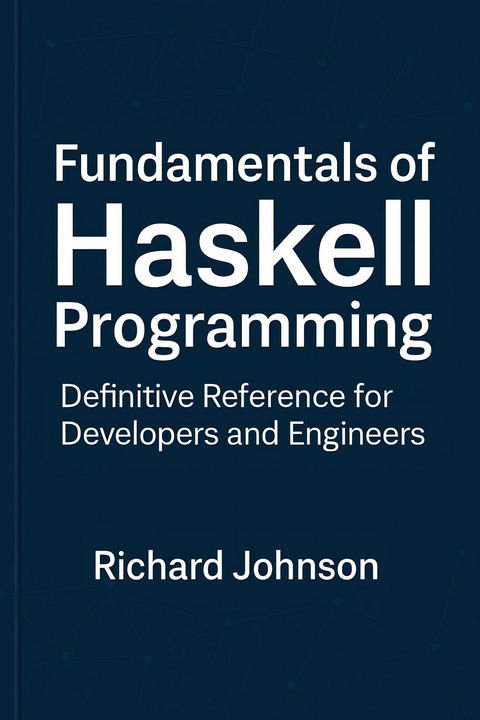
Fundamentals of Haskell Programming (eBook)
250 Seiten
HiTeX Press (Verlag)
978-0-00-106433-1 (ISBN)
'Fundamentals of Haskell Programming'
'Fundamentals of Haskell Programming' offers a comprehensive journey through every essential concept, language construct, and modern practice in Haskell, the premier pure functional programming language. Designed for both newcomers and seasoned developers, this volume expertly introduces the theoretical foundations and core paradigms of functional programming, illuminating Haskell's distinctive syntax, powerful type system, and unique evaluation mechanisms. Readers will learn how Haskell's elegant architecture-rooted in mathematical logic and abstraction-enables expressive, correct, and maintainable software.
The book dives deep into advanced topics such as polymorphism, algebraic data types, type classes, and type-level programming, providing clear explanations and practical guidance for leveraging Haskell's renowned type safety and expressive power. Dedicated chapters unravel the mysteries of lazy evaluation, infinite data structures, and core abstractions such as monads, applicatives, and functors, showing how to elegantly manage side effects, concurrency, and asynchronous operations within a pure functional framework. Through thoughtful coverage of recursion, pattern matching, functional design, and modular architectures, the text empowers readers to build robust, declarative codebases suitable for real-world use.
Beyond language fundamentals, the book explores advanced data structures, performance optimization, concurrency primitives, and foreign function integration, equipping developers with tools for scalable, high-performance software. Comprehensive guidance on tooling, testing, documentation, and modern development workflows ensures readers can bridge the gap between Haskell's theoretical power and practical application. The final chapters look ahead to meta-programming, DSL design, refinement types, and emerging trends, making this an indispensable resource for anyone seeking to master Haskell and functional programming at large.
Chapter 1
Haskell Foundations and Core Language Concepts
Haskell stands apart as a language born from rigorous academic roots and a drive to rethink how we design and reason about software. In this chapter, you’ll uncover not only the origins of Haskell within the panorama of computer science, but also the creative elegance behind its core constructs. Together, we’ll journey through Haskell’s distinctive style—laying a strong foundation in syntax, modules, evaluation, and the type system—which will empower you to write code that’s both expressive and robust from the very first line.
1.1 Historical Context and Functional Paradigms
The origins of Haskell are deeply rooted in the rich lineage of theoretical computer science and the progressive evolution of functional programming paradigms. Its development emerged from a growing recognition in the early 1980s of the need for a standardized, purely functional programming language that could serve both as a vehicle for research and as a practical tool for software construction. Prior to Haskell, functional programming languages existed mainly as research tools and prototypes, often differing widely in syntax, semantics, and design philosophies. The landscape thus called for a unifying language that would consolidate the strengths of existing approaches while addressing contemporary concerns in programming language theory and practice.
The conceptual foundations of Haskell can be traced to the pioneering work of Alonzo Church on the lambda calculus in the 1930s, which established the mathematical basis for functions as first-class entities and the formal treatment of computability. Lambda calculus provided a minimalistic yet expressive formalism for defining functions without mutable state or side effects. Functional programming languages such as Lisp, introduced by John McCarthy in 1958, and later ML (Meta Language), Cortland in the 1970s and 1980s, reflected the influence of lambda calculus but were not purely functional in the strict mathematical sense. ML, for example, introduced the notion of strong static typing and type inference, which directly influenced Haskell’s own type system.
During the late 1970s and early 1980s, several experimental functional languages surfaced, including Miranda, a language developed by David Turner. Miranda was notable for its clean syntax, lazy evaluation strategy, and static typing inferred automatically through a type system grounded in Hindley–Milner inference. These attributes established Miranda as a de facto standard for teaching and exploring functional paradigms, although it was proprietary and thus limited in distribution and influence within the research community.
The name “Haskell” honors Haskell Curry, an American mathematician and logician whose work on combinatory logic significantly influenced the theoretical underpinnings of functional programming. Combinatory logic abstracts computation away from variables and substitutions, offering a framework that complements lambda calculus and supports reasoning about higher-order functions—key concepts central to Haskell’s design.
The initiative to create Haskell was formalized in 1987 at a meeting involving researchers from several institutions, tasked with designing a language that embodied the most promising concepts from the existing body of functional languages while encouraging innovation in language design and compiler technologies. This collaborative endeavor attracted prominent figures such as Simon Peyton Jones, Philip Wadler, Paul Hudak, and John Hughes, among others. Their collective contributions shaped the language’s defining principles: purity of functions, strong static typing with type inference, lazy (non-strict) evaluation, and a rich algebraic data type system enabling expressive and concise program definitions.
The emphasis on purity—functions without side effects—was motivated by the desire to enhance program correctness, equational reasoning, and modularity. By ensuring that functions always produce the same output for the same input, Haskell facilitates mathematical reasoning about programs akin to proving properties in formal logic, thereby advancing program verification techniques. This purity is enforced through the type system and the use of monads, an abstraction introduced in Haskell to isolate side effects such as input/output and state changes, thereby preserving referential transparency at the language core.
Immutability is a direct consequence of purity and is central to functional programming’s model of computation. Data objects in Haskell, once created, are not modified, which eliminates a class of programming errors related to mutable state, concurrency, and shared memory. This approach contrasts significantly with imperative programming paradigms, where mutable state and side effects are pervasive but complicate reasoning and parallelism.
Strong typing in Haskell goes beyond merely classifying data; it enforces constraints that permit the compiler to detect inconsistencies and errors at compile time, reducing runtime failures. The implementation of Hindley–Milner type inference allows explicit type annotations to be optional without sacrificing static type safety, contributing to both code succinctness and programmer productivity. Additionally, Haskell’s type system supports parametric polymorphism, enabling generic programming where functions and data structures operate uniformly across a variety of types without sacrificing safety.
Lazy evaluation, or non-strict semantics, is another hallmark innovation in Haskell’s design. Instead of evaluating expressions at the moment of definition, computation is deferred until the results are required. This approach can lead to significant performance benefits by avoiding unnecessary calculations and enabling the creation of infinite data structures. Critically, lazy evaluation also aligns well with modularity-the ability to build programs from reusable components without prematurely committing to evaluation order.
The language definition evolved through several versions, with Haskell 1.0 introduced in 1990 as the initial standard. Subsequent revisions incorporated new features and refined semantics, facilitating its adoption both within academia and industry. The language’s modularity and formal specifications attracted extensive compiler and library development, with the Glasgow Haskell Compiler (GHC) emerging as the prominent implementation, prized for its robust optimizations, extensive extensions, and alignment with evolving academic research.
Fundamentally, the academic collaborations that defined Haskell reflect an era wherein language design was deeply intertwined with theoretical advances. The integration of algebraic data types, pattern matching, and higher-order functions exemplifies this synthesis of theory and practice. Algebraic data types provide a mechanism to define composite, yet strongly typed data, facilitating clear and verifiable program structures. Pattern matching extends this capability by allowing direct deconstruction of data structures in function definitions, enabling expressive and readable code.
Haskell’s principles have had a lasting influence on both programming language theory and practice, echoing in the design of languages such as Scala, F#, and Rust, which incorporate functional features alongside imperative elements. The language’s emphasis on purity and types has also shaped modern approaches to software correctness and concurrency, making Haskell a critical reference point in discussions of language design aimed at reliability and mathematical rigor.
This rich synthesis of theoretical foundations, practical concerns, and collaborative innovation not only established Haskell’s core principles but also positioned it as a key contributor to the broader evolution of programming paradigms. The language stands as a testament to how carefully articulated theoretical insights can foster new directions in programming language design, enabling software that is both elegant and robust.
1.2 Syntax, Layout, and Modules
Haskell’s syntax is notable for its reliance on indentation and layout rules, which are integral to the language’s design philosophy. The syntax enforces a block-structured style that replaces many explicit delimiters found in other languages, such as braces and semicolons, with whitespace conventions. This section articulates the implications of these indentation rules, the common declaration patterns, and the modular organization that underpin the clarity and maintainability characteristic of idiomatic Haskell projects.
Haskell’s lexical structure uses what is often called the layout rule or offside rule, which governs how blocks of code are parsed based on column alignment. This approach reduces syntactic noise and promotes an aesthetically clean source, but requires precision in whitespace usage.
The layout rule is applied primarily when parsing blocks of declarations or expressions following keywords such as...
| Erscheint lt. Verlag | 27.5.2025 |
|---|---|
| Sprache | englisch |
| Themenwelt | Mathematik / Informatik ► Informatik ► Programmiersprachen / -werkzeuge |
| ISBN-10 | 0-00-106433-9 / 0001064339 |
| ISBN-13 | 978-0-00-106433-1 / 9780001064331 |
| Informationen gemäß Produktsicherheitsverordnung (GPSR) | |
| Haben Sie eine Frage zum Produkt? |
 EPUB (Adobe DRM)
Größe: 954 KB
Kopierschutz: Adobe-DRM
Adobe-DRM ist ein Kopierschutz, der das eBook vor Mißbrauch schützen soll. Dabei wird das eBook bereits beim Download auf Ihre persönliche Adobe-ID autorisiert. Lesen können Sie das eBook dann nur auf den Geräten, welche ebenfalls auf Ihre Adobe-ID registriert sind.
Details zum Adobe-DRM
Dateiformat: EPUB (Electronic Publication)
EPUB ist ein offener Standard für eBooks und eignet sich besonders zur Darstellung von Belletristik und Sachbüchern. Der Fließtext wird dynamisch an die Display- und Schriftgröße angepasst. Auch für mobile Lesegeräte ist EPUB daher gut geeignet.
Systemvoraussetzungen:
PC/Mac: Mit einem PC oder Mac können Sie dieses eBook lesen. Sie benötigen eine
eReader: Dieses eBook kann mit (fast) allen eBook-Readern gelesen werden. Mit dem amazon-Kindle ist es aber nicht kompatibel.
Smartphone/Tablet: Egal ob Apple oder Android, dieses eBook können Sie lesen. Sie benötigen eine
Geräteliste und zusätzliche Hinweise
Buying eBooks from abroad
For tax law reasons we can sell eBooks just within Germany and Switzerland. Regrettably we cannot fulfill eBook-orders from other countries.
aus dem Bereich


