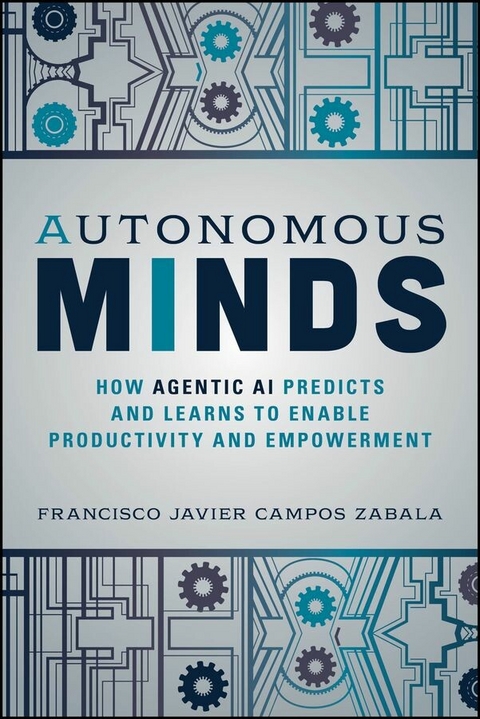
Autonomous Minds (eBook)
594 Seiten
Wiley (Verlag)
978-1-394-35011-7 (ISBN)
A book that combines a technical explanation of agentic AI with the latest practical applications
In Autonomous Minds: How Agentic AI Predicts and Learns to Enable Productivity and Empowerment, technology leader Francisco Javier Campos Zabala delivers a comprehensive, first principles analysis of AI agents and their potentially transformative impact on society, business, and individual lives. The book helps non-technical readers make sense of the technological complexity of artificial intelligence and explains its current practical applications.
Campos Zabala offers a clear and accessible explanation of these new technologies, walking you through practical frameworks for implementing AI agents in business and personal contexts.
Inside the book:
- Expert insights from leading researchers and practitioners in AI
- Accessible introductions to the fundamentals of agentic AI, as well as advanced applications
- Hands-on guidance for professionals attempting to adapt to AI-driven change
Perfect for managers, executives, and other business leaders, Autonomous Minds is an essential guide for all professionals doing their best to make sense of new agentic AI technologies.
FRANCISCO JAVIER CAMPOS ZABALA is a technology leader with deep experience delivering innovative tech transformations in adtech, telco, financial services, and healthcare. He has more than 28 years' experience in strategy, product, analytics, and technology consulting.
A book that combines a technical explanation of agentic AI with the latest practical applications In Autonomous Minds: How Agentic AI Predicts and Learns to Enable Productivity and Empowerment, technology leader Francisco Javier Campos Zabala delivers a comprehensive, first principles analysis of AI agents and their potentially transformative impact on society, business, and individual lives. The book helps non-technical readers make sense of the technological complexity of artificial intelligence and explains its current practical applications. Campos Zabala offers a clear and accessible explanation of these new technologies, walking you through practical frameworks for implementing AI agents in business and personal contexts. Inside the book: Expert insights from leading researchers and practitioners in AI Accessible introductions to the fundamentals of agentic AI, as well as advanced applications Hands-on guidance for professionals attempting to adapt to AI-driven change Perfect for managers, executives, and other business leaders, Autonomous Minds is an essential guide for all professionals doing their best to make sense of new agentic AI technologies.
Introduction
“The future is already here—it’s just not evenly distributed.”
—William Gibson
YOUR GUIDE TO THE AI AGENT REVOLUTION
Imagine a world where your most tedious tasks vanish, where creative collaboration reaches new heights, and where complex problem-solving becomes exponentially more efficient. This isn’t a futuristic fantasy taken from a science fiction book; it’s the unfolding reality of the AI agent revolution. You’ve probably already glimpsed its potential—a smart assistant that proactively manages your day, software that anticipates your needs before you even articulate them, or even teams of autonomous systems coordinating complex operations with seamless precision. These are not just incremental improvements on existing technology; they represent a fundamental shift in how we interact with and leverage artificial intelligence. This book serves as your essential guide to understanding this profound revolution, not just as a passive observer on the sidelines but as a knowledgeable and informed participant fully prepared to navigate and actively shape its future course.
From AI Winter to Agentic Spring: A Personal Journey
My fascination with machines and autonomy began long before I encountered the complexities of AI. As a child, I was captivated by the Japanese anime series Mazinger Z—a show that, depending on where you grew up, might sound obscure, but for me, it was a portal to imagining a future where humans and machines collaborated as equals. Premiering in 1972, Mazinger Z introduced the revolutionary concept of a human-piloted giant robot, controlled from a cockpit embedded in its head. Koji Kabuto, the hot-blooded teenage protagonist, fought mechanical beasts and other colossal robots created by the villainous Dr. Hell. To my young mind, Mazinger Z wasn’t just a weapon; it was an extension of human will—a metaphor for how technology could amplify our agency. The series’ blend of mechanical ingenuity and moral stakes—where heroes faced loss and sacrifice—taught me that machines could be both awe-inspiring and deeply human.
This early obsession with robotic autonomy took a more tangible form when, in my early teens, I acquired a Sinclair ZX Spectrum (see Figure 1). The Spectrum, with its rubber keys and 48KB of RAM, became my first canvas for exploring programmed “agency.” I devoured books like Spectrum Machine Language for the Absolute Beginner, learning to write simple code that made the machine perform tasks—from solving math problems to crude text-based games. The thrill of commanding the computer to execute my instructions felt like a miniature version of piloting Mazinger Z: I was no longer just a spectator but a creator, shaping outcomes through logic and creativity. This hands-on experience ignited my passion for automation—the idea that machines could act for us, not just because of us.
FIGURE 1 Sinclair Spectrum ZX1
Bill Bertram / Wikimedia commons / CC BY SA 2.5
By the time I entered university to study robotics, these childhood and adolescent influences had crystallized into a career path. Yet the field I encountered in the mid-1990s was far from the dynamic, agentic future I’d imagined. The “AI winter” was a sobering reality: progress was fragmented, systems were brittle (very!), and the grand visions of autonomous machines felt perpetually out of reach. Early neural networks and expert systems were like Mazinger Z’s Mechanical Beasts—powerful in isolation but lacking the cohesion to form a true “symphony” of intelligence. My work during this period often felt like reassembling the scattered limbs of those childhood robots: incremental advances in sensor calibration, motor control, and rule-based logic, but no unifying conductor.
Looking back, the parallels between my journey and the evolution of AI are striking. Just as Koji Kabuto’s battles required both raw power and strategic ingenuity, modern agentic systems demand a fusion of specialized tools (machine learning, symbolic reasoning) and holistic design. The ZX Spectrum taught me that even limited machines could achieve remarkable things with the right instructions—a lesson that resonates today as we layer autonomy atop narrow AI. My childhood fascination with giant robots, once dismissed as fantasy, now feels prophetic: we are inching closer to a world where machines act not just as tools but as partners, their “symphonic” potential finally within reach.
As I said, my own journey in artificial intelligence began in the mid-1990s, during what the field dubbed an “AI winter.” Fresh from completing my robotics degree, I entered a landscape where earlier enthusiasm had frozen over, promised breakthroughs remained distant, and existing AI systems showed stark limitations. Those early years taught me that progress in AI rarely follows a straight line. Like a scientist tracking glacial movement, I witnessed the field’s slow advances, its periods of apparent stillness, and those rare moments when the ice suddenly shifted, revealing new possibilities beneath. AI remained largely compartmentalized—a collection of extremely specialized tools excelling at specific tasks but lacking broader understanding or autonomy. The analogy of an orchestra comes to mind: we had incredibly talented individual musicians, each mastering their instrument, but the creation of truly symphonic experiences still required constant direction and a meticulously written score.
However, the last decade has been unlike any other. The pace of progress has not just accelerated; it feels exponential. In 2022, after contributing to the Bank of England and Financial Conduct Authority’s AI Public-Private Forum (AIPP), I recognized a significant gap between the theoretical capabilities of AI and its practical implementation in most enterprises. This observation led me to write Grow Your Business with AI,2 focusing on bridging that divide with the tools and techniques available at the time. But then came 2023, and with it, a seismic shift. The arrival of large language models (LLMs) with capabilities parallel to GPT-4 fundamentally altered the landscape. For the first time, I experienced AI that could not just process information but understand context, reason with a degree of sophistication, and, crucially, act autonomously when embedded within an agent architecture. It was like witnessing those individual musicians suddenly gain the ability to not only play their parts flawlessly but also understand the entire composition, anticipate the conductor’s intentions, and even improvise with remarkable creativity.
The Genesis of This Book: Bridging the Understanding Gap
This profound shift is the very reason I felt compelled to write this book. The “AI winter” taught me patience, the rise of machine learning taught me its power, but the emergence of agentic AI ignited a new sense of urgency. I saw a familiar pattern emerging: a groundbreaking technology with the potential to reshape our world yet surrounded by both breathless hype and understandable confusion. Many perceive the next leap in AI as hinging on achieving artificial general intelligence (AGI)—a hypothetical point where machines possess human-level intelligence across all domains. While the pursuit of AGI is a fascinating endeavor, this book argues that a revolution is already underway, driven by AI agents, and it doesn’t require reaching some distant, undefined future of AGI to have a transformative impact.
The critical gap in understanding that I personally observed wasn’t merely a technical divide between cutting-edge AI technology and its effective integration into mainstream business operations; it was a much broader societal gap between the genuinely breathtaking transformative potential of practical agentic AI systems and the general public’s overall comprehension, awareness, and informed understanding of this rapidly evolving field. I witnessed firsthand in my own research and applied projects how these newly emergent AI systems, when thoughtfully designed and strategically implemented as intelligent agents with defined goals and autonomous decision-making capabilities, could effectively tackle increasingly complex, open-ended tasks and dynamic real-world challenges with a level of adaptability, proactive reasoning, and independent action that was simply unimaginable with previous generations of traditional AI systems. This transformative shift is fundamentally not about simply replacing human workers across industries with automated robots or sentient machines; it is far more constructively about strategically augmenting and expanding core human capabilities, nurturing powerful new paradigms of synergistic partnerships and collaborative workflows between human professionals and increasingly intelligent machines, and ultimately empowering both individual professionals and large-scale organizations to achieve significantly more, innovate faster, and create greater value than ever before in the history of human endeavor.
Furthermore, recognizing the immense power of these emerging technologies, I’ve also joined a group of dedicated researchers at the Cambridge AI Safety Hub.3 Our work focuses on developing practical tools and frameworks to ensure the safe and beneficial development of AI agents. As I will elaborate on in Chapter 9, the alignment of these powerful systems with human values is a critical area of focus, and...
| Erscheint lt. Verlag | 7.10.2025 |
|---|---|
| Sprache | englisch |
| Themenwelt | Mathematik / Informatik ► Informatik ► Theorie / Studium |
| Schlagworte | Agentic ai applications • agentic ai book • agentic ai models • agentic ai research • agentic ai tools • ai agent frameworks • ai agent principles • AI agents • ai agent tools • AI business tools • ai-enabled business • AI Models • AI Tools • autonomous ai |
| ISBN-10 | 1-394-35011-2 / 1394350112 |
| ISBN-13 | 978-1-394-35011-7 / 9781394350117 |
| Informationen gemäß Produktsicherheitsverordnung (GPSR) | |
| Haben Sie eine Frage zum Produkt? |
 EPUB (Adobe DRM)
Kopierschutz: Adobe-DRM
Adobe-DRM ist ein Kopierschutz, der das eBook vor Mißbrauch schützen soll. Dabei wird das eBook bereits beim Download auf Ihre persönliche Adobe-ID autorisiert. Lesen können Sie das eBook dann nur auf den Geräten, welche ebenfalls auf Ihre Adobe-ID registriert sind.
Details zum Adobe-DRM
Dateiformat: EPUB (Electronic Publication)
EPUB ist ein offener Standard für eBooks und eignet sich besonders zur Darstellung von Belletristik und Sachbüchern. Der Fließtext wird dynamisch an die Display- und Schriftgröße angepasst. Auch für mobile Lesegeräte ist EPUB daher gut geeignet.
Systemvoraussetzungen:
PC/Mac: Mit einem PC oder Mac können Sie dieses eBook lesen. Sie benötigen eine
eReader: Dieses eBook kann mit (fast) allen eBook-Readern gelesen werden. Mit dem amazon-Kindle ist es aber nicht kompatibel.
Smartphone/Tablet: Egal ob Apple oder Android, dieses eBook können Sie lesen. Sie benötigen eine
Geräteliste und zusätzliche Hinweise
Buying eBooks from abroad
For tax law reasons we can sell eBooks just within Germany and Switzerland. Regrettably we cannot fulfill eBook-orders from other countries.
aus dem Bereich