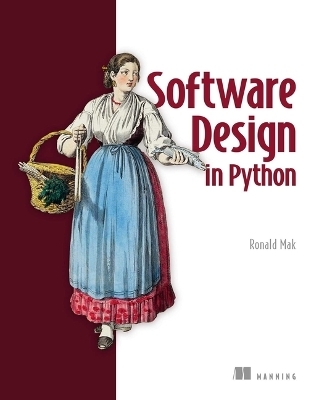
Software Design in Python
Manning Publications (Verlag)
978-1-63343-949-8 (ISBN)
- Noch nicht erschienen (ca. Mai 2026)
- Versandkostenfrei
- Auch auf Rechnung
- Artikel merken
Your Python projects work, yet scaling and maintenance still feel risky. Bug fixes spiral and new features break code you wrote last week. Professional design principles stop churn and keep teams moving with confidence. This book shows proven patterns, clearly explained in plain, modern Python. See messy “before” code refactored into clean, extendable, production-ready modules. Write software that your future self, and your colleagues, will actually love.
Iterative requirement analysis: Translate vague needs into precise, testable class responsibilities.
Cohesion and coupling metrics: Keep modules focused while collaborating through stable, predictable interfaces.
Decorator pattern usage: Enhance behavior without subclass explosions or tangled conditional logic.
SOLID principles walkthrough: Spot smells early and refactor confidently before technical debt snowballs.
Pythonic pattern catalog: Apply strategy, observer, factory, and more using idiomatic language constructs.
Conversation sidebars: Get quick answers to common design questions right when you need them.
Software Design for Python Programmers guides you with real-world, field-tested advice. Each chapter starts with flawed “before” code, then iteratively improves it using proven principles. Diagrams, talking-head sidebars, and refactoring checkpoints make every concept stick.
Finish able to craft maintainable architectures, write extensible classes, and communicate design choices with authority. Your codebase becomes an asset, not a liability.
Ideal for Python developers comfortable with syntax who crave professional-grade software design skills.
Ronald Mak is a former NASA senior scientist and professor known for translating complex design into practical skills. With decades leading aerospace and financial software projects, Ronald brings clarity, warmth, and real-world lessons to every page. He distills proven object-oriented principles into Python examples that help readers write maintainable, scalable code.
PART 1: INTRODUCTION
1 THE PATH TO WELL-DESIGNED SOFTWARE
2 ITERATE TO ACHIEVE GOOD DESIGN
PART 2: DESIGN THE RIGHT APPLICATION
3 GET REQUIREMENTS TO BUILD THE RIGHT APPLICATION
4 GOOD CLASS DESIGN TO BUILD THE APPLICATION RIGHT
PART 3: DESIGN THE APPLICATION RIGHT
5 HIDE CLASS IMPLEMENTATIONS
6 DON'T SURPRISE YOUR USERS
7 DESIGN SUBCLASSES RIGHT
PART 4: DESIGN PATTERNS SOLVE APPLICATION ARCHITECTURE PROBLEMS
8 THE TEMPLATE METHOD AND STRATEGY DESIGN PATTERNS
9 THE FACTORY METHOD AND THE ABSTRACT FACTORY DESIGN PATTERNS
10 THE ADAPTER AND FAÇADE DESIGN PATTERNS
11 THE ITERATOR AND VISITOR DESIGN PATTERNS
12 THE OBSERVER DESIGN PATTERN
13 THE STATE DESIGN PATTERN
14 THE SINGLETON, COMPOSITE, AND DECORATOR DESIGN PATTERNS
PART 5: ADDITIONAL DESIGN TECHNIQUES
15 DESIGNING SOLUTIONS WITH RECURSION AND BACKTRACKING
16 DESIGNING MULTITHREADED PROGRAMS
| Erscheint lt. Verlag | 31.5.2026 |
|---|---|
| Verlagsort | New York |
| Sprache | englisch |
| Themenwelt | Mathematik / Informatik ► Informatik ► Programmiersprachen / -werkzeuge |
| Informatik ► Software Entwicklung ► Objektorientierung | |
| Mathematik / Informatik ► Informatik ► Theorie / Studium | |
| ISBN-10 | 1-63343-949-6 / 1633439496 |
| ISBN-13 | 978-1-63343-949-8 / 9781633439498 |
| Zustand | Neuware |
| Informationen gemäß Produktsicherheitsverordnung (GPSR) | |
| Haben Sie eine Frage zum Produkt? |
aus dem Bereich