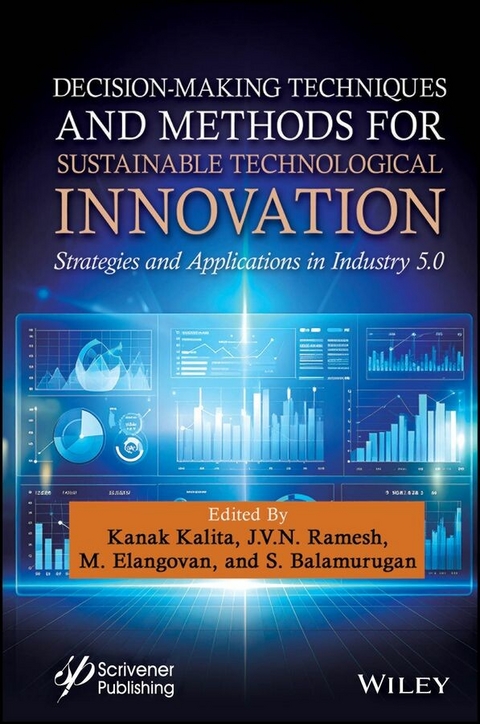
Decision-Making Techniques and Methods for Sustainable Technological Innovation (eBook)
385 Seiten
Wiley-Scrivener (Verlag)
978-1-394-24258-0 (ISBN)
This book is an essential guide for anyone looking to drive sustainable technological innovation, providing a comprehensive toolkit of decision-making methods and real-world applications to effectively manage technology in the era of Industry 5.0.
Sustainable technological innovation is critical for building a more sustainable future. As the world faces increasing environmental challenges, there is a pressing need for new and innovative technologies that can reduce resource consumption, mitigate environmental impacts, and promote sustainable development. This book focuses on the vital role of decision-making processes in achieving sustainability through technological innovation in the context of Industry 5.0. By delving into various decision-making methods and approaches employed to facilitate sustainable technological innovation across essential industries such as manufacturing, agriculture, and energy, the book will present both theoretical and applied research on managing technology, including decision-making connected to Industry 4.0 and 5.0, artificial intelligence, and other revolutionary techniques.
The book covers a wide range of topics, including multiple attribute decision theory, multiple objective decision-making, patent mining, big data analytics, and other decision-making methods and techniques, and features case studies and reviews that highlight real-world applications of sustainable technological innovation in different industries. The exploration of various decision-making methods and approaches for sustainable technological innovation makes this book an essential guide for those looking toward a sustainable Industry 5.0.
Readers will find the book:
- Emphasizes the role of decision-making processes in enabling sustainable technological innovation, providing a unique perspective on the subject;
- Covers a wide range of topics related to decision-making for sustainable technological innovation, including decision theory, multiple attribute and objective decision-making, patent mining, big data analytics, and case studies;
- Provides real-world examples and case studies that demonstrate the effectiveness of decision-making processes in promoting sustainable technological innovation across various industries;
- Features the latest research and developments in the field, ensuring that readers are up-to-date on the most current thinking on decision-making for sustainable technological innovation.
Audience
Researchers, practitioners, and students in the fields of computer science, data science, engineering, and mathematics, specifically interested in decision analytics and machine learning algorithms.
Kanak Kalita, PhD is an associate professor in the Department of Mechanical Engineering, Rajalakshmi Institute of Technology, Chennai, India. He has authored over 75 research articles, edited eight books, and given over 20 expert lectures. His research interests include machine learning, fuzzy decision making, metamodeling, process optimization, the finite element method, and composites.
J.V.N. Ramesh, PhD is an assistant professor in the Department of Computer Science and Engineering at Koneru Lakshmaiah University with over 18 years of teaching experience. He published several papers in national and international conferences and journals, as well as six textbooks. His research interests include wireless sensor networks, computer networks, deep learning, machine learning, and artificial intelligence.
M. Elangovan, PhD is currently working as a visiting professor at the Applied Science Research Centre, Applied Science Private University, Amman, Jordan. He has published over 90 articles in international journals and conferences and completed a number of consultancy projects. His research focuses on hydrodynamics, design, underwater marine vehicles, and industrial robots.
S. Balamurugan, PhD is the Director of Research and Development at Intelligent Research Consultancy Services. He has published 45 books, over 200 articles in international journals and conferences, and 35 patents. His research interests include artificial intelligence, soft computing, augmented reality, Internet of Things, big data analytics, cloud computing, and wearable computing.
This book is an essential guide for anyone looking to drive sustainable technological innovation, providing a comprehensive toolkit of decision-making methods and real-world applications to effectively manage technology in the era of Industry 5.0. Sustainable technological innovation is critical for building a more sustainable future. As the world faces increasing environmental challenges, there is a pressing need for new and innovative technologies that can reduce resource consumption, mitigate environmental impacts, and promote sustainable development. This book focuses on the vital role of decision-making processes in achieving sustainability through technological innovation in the context of Industry 5.0. By delving into various decision-making methods and approaches employed to facilitate sustainable technological innovation across essential industries such as manufacturing, agriculture, and energy, the book will present both theoretical and applied research on managing technology, including decision-making connected to Industry 4.0 and 5.0, artificial intelligence, and other revolutionary techniques. The book covers a wide range of topics, including multiple attribute decision theory, multiple objective decision-making, patent mining, big data analytics, and other decision-making methods and techniques, and features case studies and reviews that highlight real-world applications of sustainable technological innovation in different industries. The exploration of various decision-making methods and approaches for sustainable technological innovation makes this book an essential guide for those looking toward a sustainable Industry 5.0. Readers will find the book: Emphasizes the role of decision-making processes in enabling sustainable technological innovation, providing a unique perspective on the subject; Covers a wide range of topics related to decision-making for sustainable technological innovation, including decision theory, multiple attribute and objective decision-making, patent mining, big data analytics, and case studies; Provides real-world examples and case studies that demonstrate the effectiveness of decision-making processes in promoting sustainable technological innovation across various industries; Features the latest research and developments in the field, ensuring that readers are up-to-date on the most current thinking on decision-making for sustainable technological innovation. Audience Researchers, practitioners, and students in the fields of computer science, data science, engineering, and mathematics, specifically interested in decision analytics and machine learning algorithms.
1
Green Technology Planning in Developing Countries: An Innovative Decision-Making Framework
Vamsidhar Talasila1, Chandrashekhar Goswami2 and Muniyandy Elangovan3,4*
1Department of Computer Science and Engineering, Koneru Lakshmaiah Education Foundation, Vaddeswaram, Guntur, India
2Faculty of Computing and Informatics, Sir Padampat Singhania University, Udaipur, Rajasthan, India
3Department of Biosciences, Saveetha School of Engineering, Saveetha Institute of Medical and Technical Sciences, Chennai, India
4Applied Science Research Center, Applied Science Private University, Amman, Jordan
Abstract
Green technologies are crucial for formulating and creating national environmental and sustainability plans. Development and implementation of approaches for accelerating green technologies in emerging economies are possible as a result of an increasing focus on GT approaches in strategic decision-making. As a result, this research creates comprehensive strategy structure research on SWOT (strengths, weaknesses, opportunities, and threats) analysis for successful planning of the green technology (GT) industry. The SWOT analysis examines both internal and outside factors as well as related aspects that are crucial for Pakistan development of GT. To calculate the weights of the 21 subfactors, the Grey analytical structured model approach is then used. Finally, 18 approaches created for sustainable GT planning are prioritized using the Grey techniques for order performance by similarity to ideal solution. The possibility for high agricultural output, decreased foreign investment because of security and terrorist concerns, declining costs of GTs, and the chance to establish a good reputation are crucial various components for comprehensive GT planning, according to the findings. On the other hand, it has been found that the best approaches involve enhancing national security to draw international direct investment, lowering taxes, duties on the import of GT, relaxing regulations for regional businesses going through a transition, and developing plans and initiatives that encourage green innovations in the agricultural sector. The systematic, complete structure for sustainable GT development in Pakistan is being proposed for the first time in this research. Our work closes a gap in the process of preparing and carrying out strategic plans and offers policymakers solutions to deal with roadblocks to adopting GT strategy.
Keywords: Decision-making framework, GT, SWOT, Grey analytical structured model (GASM)
1.1 Introduction
Innovative green technology (GT) is becoming more and more necessary due to the dual restrictions on resources and the environment. Green industrial design may enhance environmental quality, encourage sustainable economic development, and translate technical innovation into GT innovation [1]. GT is a sort of invention that may benefit both the consumers and businesses while also significantly reducing negative environmental impacts. It encompasses technological innovation in areas such as environmental management, waste reduction, waste recycling, and the creation of eco-friendly goods. Due to the rising concern about the status of the environment, innovative GT has consistently attracted attention as a crucial component of green innovation [2]. Environmental regulation has the potential to support the green transformation of the economy via two channels: the creation of environmentally friendly technologies and the upgrading of industrial structures. On the other hand, the functions that different degrees of economic growth have in determining the impacts of environmental legislation are often neglected [3]. Sustainable development goals may be attained on a regional and global level due in large part to GT. Additionally, it promotes social advancement and lessens the negative effects of economic growth on the environment. GT has a bright future in fostering economic success in underdeveloped nations. However, the adoption of GT within a particular nation may be impacted by interconnecting environmental as well as social variables [4]. However, it is also accurate that governments, particularly those in developing countries, must continue to work toward promoting economic growth and raising living standards. This is furthermore in addition to the readily apparent fact that diminishing greenhouse gas emissions is important for the longterm sustainability of the global economy [5]. GT planning is a complex process that involves assessing a variety of factors such as technological feasibility, economic viability, environmental impact, and social acceptability. To facilitate this process, an innovative decision-making framework can be used to evaluate the potential benefits and risks associated with different GT options [6]. This framework involves several stages, starting with the identification of key stakeholders and their objectives, followed by the development of a set of criteria to assess the suitability of different GT options. These criteria should be based on a variety of factors, including environmental impact, social and economic benefits, and technological feasibility.
The rest of the essay is structured as follows: related works are discussed in Section 1.2, the suggested approach is explained in Section 1.3, the results and discussion are presented in Section 1.4, and the paper is concluded in Section 1.5.
1.2 Related Works
The four areas in the research [7] of IoT (Internet of Things) applications in agriculture include cattle breeding, environment-controlled planting, open-field planting, aquaculture, and aquaponics. It is advised that the emphasis on deploying agricultural IoT systems be broadened beyond the growing cycle to the life cycle of agricultural products. With the deployment of GTs in mind, operational recognition indications are examined from the standpoint of extended life cycle theory. Fuzzy analytic hierarchy process with triangular fuzzy evaluation is applied to the identifying system following the principles and logic of the suggested recognition system, and a workable computing process is developed [8]. The paper [9] was designed using the DMAIC (define, measure, analyze, improve, and control) technique, and the implementation of the GLS (Green Lean Six Sigma) was suggested based on theoretical components. It was discovered that the integration of GLS is complemented by enablers, a toolkit, and implementation techniques. The suggested architecture offers a route for GLS implementation via wise project selection.
The study by Andenæs and colleagues [10] identified and discussed the main building technical issues related to blue–green roofing and to provide a framework for risk management. Research data on blue–green roof faults and their causes have been gathered via literature and document analyses, qualitative interviews, and expert meetings. The current study [11] covers a few key sources of bioactive phenol compounds as well as cutting-edge extraction methods. The approaches make use of supercritical, microwave, and ultrasound technologies. The review will also emphasize how to best extract phenolic bioactives from plant-based materials using response surface methodology, a statistical approach. The research [12, 13] provided an integrated GT framework to address a vacuum in the existing body of literature by highlighting the most important characteristics of GTs applicable to Pakistan. The article [13, 14] built a multilayer index system for green building influencing elements and introduced the green financial supporting factor. The WINGS (weighted influence nonlinear gauge system) model is improved with the use of a radial basis function neural network (RBF-WINGS model), which also determines the direct strength– influence matrix. For the assessment of green rating (GR) schemes of current planning bodies (PBs), the research suggests a TOPSIS (technique for order performance by similarity to ideal solution) decision approach based on a cloud model that can get beyond the ambiguity and complexity of scheme selection. The methodology and preparation procedures are explained, and the definitions of the quantitative concepts and parameters are provided [14, 15]. In the study [15–17], the Malmquist index and data envelopment analysis are used to determine how effective GT innovation is in strategically growing sectors.
1.3 Proposed Methodology
In this section, we discuss in detail an innovative decision-making framework for GT planning to facilitate growth in developing countries. GT planning involves the identification of opportunities and approaches to facilitate the development and adoption of GT in developing countries. This includes assessing the current state of technology, identifying areas where GT can be most effective, and developing policies and programs to support its implementation.
By using an innovative decision-making framework, GT planning can be a more effective and efficient process, helping to facilitate the growth of sustainable and environmentally friendly technologies in developing countries.
1.3.1 SWOT, G-TOPSIS and Integrated GASM Methods
In this research, GT approaches are evaluated and prioritized for greater sustainable development in developing countries using SWOT (strengths, weaknesses, opportunities, and threats) analysis, GASM (Grey analytical structured model), and G-TOPSIS (Grey group TOPSIS) technique, which...
| Erscheint lt. Verlag | 2.10.2025 |
|---|---|
| Reihe/Serie | Industry 5.0 Transformation Applications |
| Sprache | englisch |
| Themenwelt | Mathematik / Informatik ► Informatik ► Theorie / Studium |
| ISBN-10 | 1-394-24258-1 / 1394242581 |
| ISBN-13 | 978-1-394-24258-0 / 9781394242580 |
| Informationen gemäß Produktsicherheitsverordnung (GPSR) | |
| Haben Sie eine Frage zum Produkt? |
 EPUB (Adobe DRM)
Kopierschutz: Adobe-DRM
Adobe-DRM ist ein Kopierschutz, der das eBook vor Mißbrauch schützen soll. Dabei wird das eBook bereits beim Download auf Ihre persönliche Adobe-ID autorisiert. Lesen können Sie das eBook dann nur auf den Geräten, welche ebenfalls auf Ihre Adobe-ID registriert sind.
Details zum Adobe-DRM
Dateiformat: EPUB (Electronic Publication)
EPUB ist ein offener Standard für eBooks und eignet sich besonders zur Darstellung von Belletristik und Sachbüchern. Der Fließtext wird dynamisch an die Display- und Schriftgröße angepasst. Auch für mobile Lesegeräte ist EPUB daher gut geeignet.
Systemvoraussetzungen:
PC/Mac: Mit einem PC oder Mac können Sie dieses eBook lesen. Sie benötigen eine
eReader: Dieses eBook kann mit (fast) allen eBook-Readern gelesen werden. Mit dem amazon-Kindle ist es aber nicht kompatibel.
Smartphone/Tablet: Egal ob Apple oder Android, dieses eBook können Sie lesen. Sie benötigen eine
Geräteliste und zusätzliche Hinweise
Buying eBooks from abroad
For tax law reasons we can sell eBooks just within Germany and Switzerland. Regrettably we cannot fulfill eBook-orders from other countries.
aus dem Bereich