


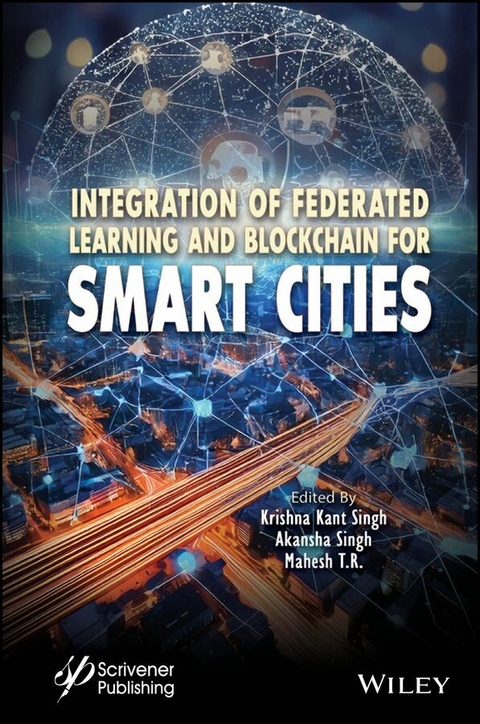
Integration of Federated Learning and Blockchain for Smart Cities (eBook)
1013 Seiten
Wiley (Verlag)
978-1-394-16774-6 (ISBN)

Stay ahead of the curve in urban innovation with this essential guide that provides a comprehensive roadmap for federated learning and blockchain to build secure, intelligent, and efficient smart city ecosystems.
As cities grow smarter, the demand for secure, decentralized, and privacy-preserving technologies is greater than ever. This book explores how federated learning and blockchain are transforming urban landscapes by enabling intelligent, secure, and efficient systems. By combining the power of decentralized machine learning with the transparency and security of blockchain, this book provides a roadmap for tackling challenges in urban mobility, energy management, public safety, and healthcare, delving into theoretical frameworks, architectural designs, security considerations, and real-world case studies to illustrate the impact of these technologies. This book serves as a comprehensive guide for researchers, industry professionals, and policymakers seeking to understand, implement, and innovate within smart city ecosystems.
Readers will find the volume:
- Explores the synergy between federated learning and blockchain, offering cutting-edge solutions for smart city challenges;
- Addresses critical issues of data privacy, decentralized AI, and secure digital infrastructure in urban environments;
- Features practical case studies on smart transportation, energy management, healthcare, and governance;
- Provides a forward-looking perspective on how emerging technologies will shape the cities of tomorrow.
Audience
Academics, researchers, industry professionals, and policymakers working in the fields of artificial intelligence, machine learning, blockchain, IoT, cybersecurity, smart city planning, and urban technology development.
Krishna Kant Singh, PhD is the Director at the Delhi Technical Campus, Greater Noida, India. He has authored 25 books and over 160 research papers in international journals. He is an associate editor of IEEE Transactions on Computational Social Systems, and Senior editor of IEEE Access. His research interests include machine vision, remote sensing, deep learning, and generative AI.
Akansha Singh, PhD is a professor in the School of Computer Science, Engineering, and Technology at Bennett University, Greater Noida, India, with over 18 years of teaching and research experience. She has published over 100 research papers and authored over 30 books in advanced areas of computer science. Her expertise spans image processing, deep learning, machine learning, remote sensing, and IoT, with a strong focus on AI-driven solutions for healthcare and environmental sustainability.
Mahesh T.R., PhD is the Program Head of the Department of Computer Science and Engineering in the School of Engineering and Technology, at Jain (Deemed-to-be University), Bengaluru, India. He has published over 180 research articles in international and edited several books. His research interests include image processing, machine learning, deep learning, artificial intelligence, IoT, and data science.
Stay ahead of the curve in urban innovation with this essential guide that provides a comprehensive roadmap for federated learning and blockchain to build secure, intelligent, and efficient smart city ecosystems. As cities grow smarter, the demand for secure, decentralized, and privacy-preserving technologies is greater than ever. This book explores how federated learning and blockchain are transforming urban landscapes by enabling intelligent, secure, and efficient systems. By combining the power of decentralized machine learning with the transparency and security of blockchain, this book provides a roadmap for tackling challenges in urban mobility, energy management, public safety, and healthcare, delving into theoretical frameworks, architectural designs, security considerations, and real-world case studies to illustrate the impact of these technologies. This book serves as a comprehensive guide for researchers, industry professionals, and policymakers seeking to understand, implement, and innovate within smart city ecosystems. Readers will find the volume: Explores the synergy between federated learning and blockchain, offering cutting-edge solutions for smart city challenges; Addresses critical issues of data privacy, decentralized AI, and secure digital infrastructure in urban environments; Features practical case studies on smart transportation, energy management, healthcare, and governance; Provides a forward-looking perspective on how emerging technologies will shape the cities of tomorrow. Audience Academics, researchers, industry professionals, and policymakers working in the fields of artificial intelligence, machine learning, blockchain, IoT, cybersecurity, smart city planning, and urban technology development.
1
Unlocking the Potential of Smart Cities: A Study of the Internet of Things and Artificial Intelligence Integration
Anuradha Dhull1, Tripti Sharma1, Shilpa Mahajan2 and Akansha Singh2*
1Faculty, Department of CSE, The NorthCap University, Gurugram (Haryana), India
2School of CSET, Bennett University, Greater Noida, India
Abstract
For management and planners of cities, rapid growth in cities poses serious obstacles. To get around these challenges, new scientific approaches are needed. This research project focuses at how artificial intelligence (AI) and the Internet of Things (IoT) could possibly be employed for developing smart cities that address social, economic, and environmental problems. This study looks at how smart cities are emerging, the challenges that come on urbanization, and the ways that AI and IoT could help with public safety, infrastructure, transportation, and energy management. To fully reap the benefits of smart cities, the report emphasizes the necessity of creating and implementing workable AI and IoT solutions. In the long run, this will enhance urban individuals overall standard of life and general well-being but encouraging ecologically friendly and sustainable surroundings.
Keywords: AI, machine learning, IoT, smart cities, deep learning, NLP, applications of IoT, sustainable
1.1 Introduction
As cities throughout the world deal with expanding populations, they are turning to specialized technology to address social, economic, and environmental concerns. Artificial intelligence (AI) has emerged as a powerful technology, with the potential to transform the way that cities are planned and operated [1, 2]. AI’s capacity to learn, forecast, and potentially function independently opens up enormous possibilities for improving smart city development and management [3].
The smart city effort seeks to use cutting-edge technology to improve citizens’ quality of life. This involves offering environmentally sustainable and dependable services. Researchers and specialists have created frameworks for smart city development that address many areas of urban administration. These frameworks present a variety of components to meet certain difficulties. Furthermore, academics throughout the world provide methods that use information and communication technology (ICT) to successfully handle each component [4].
1.2 The Rise of Smart Cities
Cities throughout the world face the challenges of overburdened infrastructure and limited resources as urban populations increase. In response, the idea of smart cities has gained popularity. these innovative urban centers use revolutionary technologies such as the internet of things (IoT) and AI to enhanced resource management, infrastructure operations, and citizen services. The overall objective is to create sustainable, efficient, and appropriate settings that can cope with a growing population while reducing adverse environmental effects [5]. Figure 1.1 shows the components of smart city framework that is necessary to make a city smart. The rise of smart cities represents a fundamental shift in urban planning, with technology at the center of creating our cities’ future [6].
Figure 1.1 Components of smart city framework.
1.3 Challenges of Urbanization
Cities’ rapid growth in populations presents various obstacles, including traffic congestion, pollution, health issues, water scarcity, and waste management. Governments are tackling these concerns through a variety of initiatives, with the aim of developing smart cities playing a crucial role [7].
Urbanization is the most significant trend that maneuvers human settlements across the planet. A trend that has been propelled by greater mobility throughout globalization in the 20th and 21st centuries is pushed by individuals looking for better opportunities in cities [8]. The enormous migration from rural regions to urban centers is a global phenomenon that has substantially altered how we live and work. Recent publications from the United Nations Department of Economic and Social Affairs and the United Nations Population Fund highlighted urbanization as a unique trait of our day [9].
There are many challenges of urbanization; some are shown in Figure 1.2.
Figure 1.2 Major challenges of urbanization.
1.4 The Promise of AI and IoT
Initiatives for smart cities incorporate an extensive variety of areas, which involves autonomous vehicles, cybersecurity, smart grids, and unmanned aerial vehicle (UAV)-assisted next-generation communication networks (5G and B5G) [10]. These interconnected disciplines rely drastically on big data analytics and complex methods such as machine learning (ML), deep reinforcement learning (DRL), and general AI. These technologies improve the performance and versatility of certain smart city applications [11].
The IoT is crucial to most applications related to smart cities, generating enormous amounts of data. Deciding the best effective path of action can be challenging, given the vast amount of intricate facts [12]. Advanced nears such as AI, ML, and DRL can unleash the maximum potential of large data by permitting ideal decision-making in smart city initiatives [13]. As in Figure 1.3, some of the benefits of IoT are listed.
These advance methodologies, such as ML, DRL, and AI, take account of long-term goals and can result in nearly perfect control decisions. Additionally, increasing the number of training data enhances their learning dimensions, which lead to higher precision and accuracy in ML decisions within projects related to smart cities [14].
Figure 1.3 Benefits of IoT in smart cities.
The idea of a representation of smart cities, the IoT, blockchain technology, autonomous aircraft (UAVs), and the integration of AI, ML, and DRL approaches are all observing significant advancement, with tremendous potential for enhanced outcomes in the future [15].
1.5 The Internet of Things (IoT) in Smart Cities
Smart cities focus primarily using interconnected gadgets for capturing real-time data. This web of devices, also known as the IoT, is essential for appropriately tracking and controlling multiple urban concerns. These IoT systems have been constructed around actuators and sensing devices, which function like a town’s sensors and hearing devices [16, 17]. Figure 1.4 shows the cost savings in five areas: energy consumption, waste management, traffic congestion, water consumption, and public safety. Public safety has the highest cost savings at 31%, followed by traffic congestion at 23%.
Metropolitan areas use wireless sensor networks for collecting data on amenities and movement of traffic. This information is analyzed to find movements and make predictions. The IoT refers to the technology that provides the capability for seamless data exchange with no humans being involved. Green technology, on the other hand, seeks to create environmentally friendly consumer goods and solutions using technological and scientific advances [18].
Figure 1.4 Area of cost saving after using IoT in different areas.
1.6 What is IoT
The IoT comprises a network of physical devices, automobiles, appliances, and other products supported by software, cameras, sensors, and network connectivity for collecting and transmit data [19].
The massive collection of interconnected gadgets referred to as the IoT is now coming into existence as well. These electronic devices, encompassing everything from everyday necessities like smartphones and tablets and smartphones to complicated industrial apparatus, have been appointed with sensors, CPUs, and software [20]. This interconnected system makes it possible to share data and communicate with effortlessness, which encourages the establishment of an autonomous the environment. The framework facilitates automation, analysis, and data salvaging in wide range of areas [21].
1.6.1 Components of an IoT Ecosystem
A smart city is made up of several components, which are illustrated in Figure 1.2 [22]. Opportunities for smart cities are built using the fundamental four-step procedure, which includes gathering, sending, storing, and analyzing data, as shown in Figure 1.5.
Data Collection: This preliminary phase accumulates unique to the application knowledge that promotes toward the development of adapted sensors across numerous types of applications [16].
Data Transmission: First, the data is being collected by the sensors, and, then, that data is sent for the storage and analysis to a cloud platform. A number of approaches, such as metropolitan Wi-Fi networks, 4G/5G technologies, or local networks that provide regional or international data transfer, can be used for this transmission.
Data Storage: Cloud storage solutions also help in managing the collected data. So, it makes the data easily accessible for the last phase.
Data analysis: The ultimate step is acquiring important patterns and insights from the data to help with decision-making, from straightforward aggregation and rule-based protocols to sophisticated situations. Employing statistical techniques or even real-time processing using machine and deep learning algorithms, this analysis can cover a wide range of...
| Erscheint lt. Verlag | 30.9.2025 |
|---|---|
| Sprache | englisch |
| Themenwelt | Mathematik / Informatik ► Informatik ► Theorie / Studium |
| ISBN-10 | 1-394-16774-1 / 1394167741 |
| ISBN-13 | 978-1-394-16774-6 / 9781394167746 |
| Informationen gemäß Produktsicherheitsverordnung (GPSR) | |
| Haben Sie eine Frage zum Produkt? |
 EPUB (Adobe DRM)
Kopierschutz: Adobe-DRM
Adobe-DRM ist ein Kopierschutz, der das eBook vor Mißbrauch schützen soll. Dabei wird das eBook bereits beim Download auf Ihre persönliche Adobe-ID autorisiert. Lesen können Sie das eBook dann nur auf den Geräten, welche ebenfalls auf Ihre Adobe-ID registriert sind.
Details zum Adobe-DRM
Dateiformat: EPUB (Electronic Publication)
EPUB ist ein offener Standard für eBooks und eignet sich besonders zur Darstellung von Belletristik und Sachbüchern. Der Fließtext wird dynamisch an die Display- und Schriftgröße angepasst. Auch für mobile Lesegeräte ist EPUB daher gut geeignet.
Systemvoraussetzungen:
PC/Mac: Mit einem PC oder Mac können Sie dieses eBook lesen. Sie benötigen eine
eReader: Dieses eBook kann mit (fast) allen eBook-Readern gelesen werden. Mit dem amazon-Kindle ist es aber nicht kompatibel.
Smartphone/Tablet: Egal ob Apple oder Android, dieses eBook können Sie lesen. Sie benötigen eine
Geräteliste und zusätzliche Hinweise
Buying eBooks from abroad
For tax law reasons we can sell eBooks just within Germany and Switzerland. Regrettably we cannot fulfill eBook-orders from other countries.
aus dem Bereich


