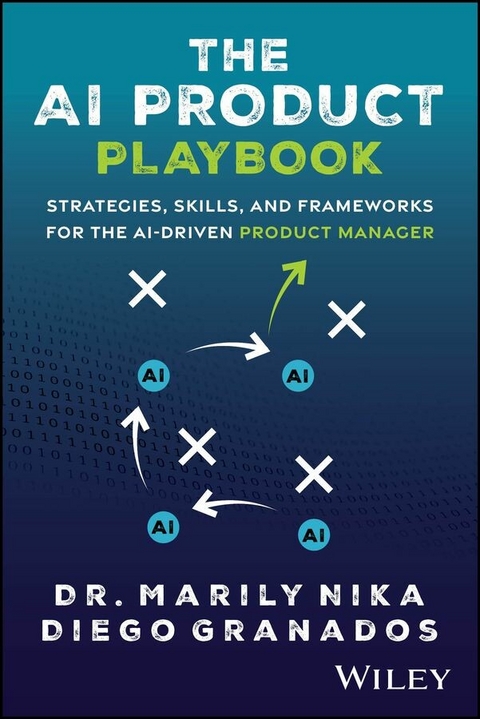
The AI Product Playbook (eBook)
456 Seiten
Wiley (Verlag)
978-1-394-33566-4 (ISBN)
A comprehensive guide for aspiring and current AI product managers
The AI Product Playbook: Strategies, Skills, and Frameworks for the AI-Driven Product Manager, by Dr. Marily Nika and Diego Granados, is a practical resource designed to empower product managers to effectively build, launch, and manage successful AI-powered products. This playbook bridges the gap between artificial intelligence theory and real-world product management, offering actionable learnings tailored to non-technical professionals.
Drawing from extensive industry experience, Dr. Nika and Granados introduce the three essential AI product manager roles: AI Experiences PM, AI Builder PM, and AI-Enhanced PM. They offer guidance on developing skills crucial for each role and navigating common challenges in the workplace. Readers will also find valuable strategies for career growth, lifelong learning, and crafting a distinctive AI portfolio.
Inside the book:
- Practical frameworks for discovering AI opportunities and aligning AI capabilities with business goals
- A deep technical dive with clear explanations of foundational AI and machine learning concepts, including supervised learning, unsupervised learning, reinforcement learning, and generative AI
- Guidelines for ethical AI implementation, addressing bias, fairness, and compliance with AI regulations
- Strategies for effective collaboration with cross-functional teams and enhancing productivity through AI
- Interactive exercises, action plans, checklists, templates, and quizzes designed to reinforce learning and build real-world skills
Essential reading for aspiring and experienced product managers alike, The AI Product Playbook provides a roadmap to mastering AI-driven product management and advancing your career in the dynamic field of artificial intelligence.
Dr. Marily Nika is an award-winning GenAI Product Leader at Google and one of the world's foremost AI educators, with over 13 years of experience building AI products at Google and Meta. She holds a PhD in machine learning and is an author, TED AI speaker, Harvard Business School fellow and co-founder of the AI Product Hub (www.aiproduct.com) which offers AI product management certifications.
Diego Granados is a Product Leader with more than 6 years of experience bringing AI products to life in top tech companies in Silicon Valley. He holds an MBA from Duke University and an M.S. in C.S. focused on AI & ML from Georgia Tech and is co-founder of the AI Product Hub (www.aiproduct.com) which offers AI product management certifications.
A comprehensive guide for aspiring and current AI product managers The AI Product Playbook: Strategies, Skills, and Frameworks for the AI-Driven Product Manager, by Dr. Marily Nika and Diego Granados, is a practical resource designed to empower product managers to effectively build, launch, and manage successful AI-powered products. This playbook bridges the gap between artificial intelligence theory and real-world product management, offering actionable learnings tailored to non-technical professionals. Drawing from extensive industry experience, Dr. Nika and Granados introduce the three essential AI product manager roles: AI Experiences PM, AI Builder PM, and AI-Enhanced PM. They offer guidance on developing skills crucial for each role and navigating common challenges in the workplace. Readers will also find valuable strategies for career growth, lifelong learning, and crafting a distinctive AI portfolio. Inside the book: Practical frameworks for discovering AI opportunities and aligning AI capabilities with business goals A deep technical dive with clear explanations of foundational AI and machine learning concepts, including supervised learning, unsupervised learning, reinforcement learning, and generative AI Guidelines for ethical AI implementation, addressing bias, fairness, and compliance with AI regulations Strategies for effective collaboration with cross-functional teams and enhancing productivity through AI Interactive exercises, action plans, checklists, templates, and quizzes designed to reinforce learning and build real-world skills Essential reading for aspiring and experienced product managers alike, The AI Product Playbook provides a roadmap to mastering AI-driven product management and advancing your career in the dynamic field of artificial intelligence.
CHAPTER 1
Artificial Intelligence and Machine Learning: What Every Product Manager Needs to Know
Stepping into the world of AI product management can feel like learning a new language. You may find yourself in meetings where the conversation suddenly shifts to “training the model,” “feature vectors,” and “precision versus recall.” This technical jargon can be intimidating and can create a barrier between you and your technical counterparts, making it difficult to contribute meaningfully or ask the right strategic questions.
This chapter is designed to break down that barrier. Our goal is to provide you with a solid, PM-focused foundation in the core concepts of Artificial Intelligence and Machine Learning. We will demystify the terminology and explain the fundamental principles in a clear, accessible way, using real-world analogies and product examples.
This isn't about learning to code algorithms; it's about learning to “speak the language” of AI so you can lead your products and teams with confidence. In this chapter, we will clarify the very important difference between AI and ML, explore the major types of Machine Learning, see how models actually learn from data, and walk through the data science lifecycle from a PM's perspective.
AI vs. ML
The terms “Artificial Intelligence” (AI) and “Machine Learning” (ML) are often used interchangeably, but for a Product Manager, understanding their distinction is very important. Think of AI as the broad goal of creating intelligent systems, while ML is a specific and powerful method used to achieve that intelligence.
AI aims to simulate human intelligence in machines to perform tasks like problem-solving, understanding language, and making decisions. Historically, this often involved programming explicit rules. For example, an early chess-playing computer was a form of AI, but it didn't learn; it simply followed a massive set of pre-programmed instructions for every possible move.
Machine Learning (ML), in contrast, is a subset of AI where systems learn directly from data. Instead of being explicitly programmed for every scenario, ML algorithms identify patterns to make predictions and improve their performance over time. This is the key difference. Within ML, Deep Learning (DL) is a specialized branch that employs multi-layered neural networks to automatically learn highly complex patterns from vast amounts of data. Figure 1-1 illustrates the relationship between these concepts.
NOTE Think of teaching a dog a trick. You don't program the dog's muscles; you show examples, give rewards, and the dog learns . ML is similar.
Why This Matters to a PM
Understanding this distinction is not just academic; it directly impacts your day-to-day role as an AI Product Manager in several critical ways:
- Feasibility: Knowing whether a problem is best solved with rule-based AI or data-driven ML helps you assess technical feasibility.
- Resource Allocation: ML requires data—often lots of it. Understanding this helps you plan resources (data collection, labeling, engineering time).
- Iteration Cycles: ML models learn and improve over time. This impacts your product roadmap and release planning.
- User Expectations: ML-powered features can be less predictable than rule-based systems. This requires careful management of user expectations.
Figure 1-1: The relationship between Artificial Intelligence (AI), Machine Learning (ML), and Deep Learning (DL). ML is a subfield of AI, and DL is a specialized subfield within ML.
Key Differences Between AI and ML
To summarize these core distinctions, the following table provides a clear, side-by-side comparison.
| FEATURE | ARTIFICIAL INTELLIGENCE (AI) | MACHINE LEARNING (ML) |
|---|
| Scope | Broad: Machines simulating human intelligence. | Specific: A way to achieve AI by learning from data. |
| Method | Can be rule-based, logic-based, or learning-based. | Relies on algorithms that learn patterns and make predictions from data. |
| Learning | Not always required. | Essential; systems improve with experience (data). |
| Example (Product) | Smart thermostat with a pre-set schedule. | Recommendation engine that learns your viewing preferences and recommends new shows to watch. |
| PM Implication | Simpler to implement, less adaptable. | More powerful, requires data and iteration. |
This distinction is key: a PM guiding a simple, rule-based AI feature will have very different planning and resource conversations than one guiding a feature powered by ML. The following examples further illustrate this difference:
- AI (Not ML): A customer service chatbot that uses predefined scripts to answer FAQs. It's “intelligent” in a limited way, but it doesn't learn.
- ML: A spam filter that learns to identify spam emails based on patterns in the text and sender information. It gets better over time as it sees more data.
- AI Powered by ML: Self-driving cars. They use ML extensively (to process sensor data, understand the environment) to achieve the broader AI goal of autonomous navigation.
- AI Powered by ML (Generative AI): Models like DALL-E 2 (image generation) or ChatGPT (text generation). They've learned from vast datasets to create new content.
Common Misconceptions for PMs: Myths vs. Reality
As you begin your AI PM journey, it's important to dispel some common myths. Navigating these misconceptions early will save you time, help you set realistic expectations, and allow you to collaborate more effectively with your technical teams.
| MYTH | REALITY |
|---|
| “AI is a magic black box that just works.” | AI is applied mathematics and statistics running on data. Its success depends entirely on the quality of the data, the chosen algorithm, and the clarity of the problem definition—all areas where a Product Manager has significant influence. |
| “We need a massive, perfect dataset before we can start.” | While more high-quality data is better, many impactful AI projects start with smaller, well-curated datasets to build a baseline model (an “AI MVP”). The process is iterative; the model and data can be improved over time. |
| “AI will replace the need for user research.” | AI amplifies the need for user research. AI can tell you what users are doing, but it can't tell you why. Qualitative user research is essential for understanding the context behind the data and ensuring you're solving the right problem. |
| “Launching an AI feature is a one-and-done project.” | An AI model is a living system. Its performance can degrade over time as real-world data changes (a concept called “model drift”). AI features require ongoing monitoring, maintenance, and retraining, which must be planned for in your roadmap. |
Internalizing these realities is a key step in shifting from a traditional software mindset to an AI-first product mindset.
Your Glossary as a PM
To help you speak the language of AI confidently, the following table breaks down the core AI/ML terms you'll need in your toolkit. We'll go beyond simple definitions and provide context to help you truly grasp the concepts:
| TERM | DEFINITION | IN SIMPLE TERMS | EXAMPLE |
|---|
| Artificial Intelligence (AI) | The broad field of computer science focused on creating machines capable of intelligent behavior. | Making computers “smart” enough to do things that normally require human intelligence, like problem-solving, learning, and decision-making. | A chatbot that understands customer questions and provides helpful answers, or an image recognition system that can identify objects in a photo. |
| Machine Learning (ML) | A subset of AI that focuses on enabling machines to learn from data without being explicitly programmed. | Teaching computers to learn from examples, so they can make predictions or decisions on their own, without us having to tell them exactly what to do every time. | Predicting which customers are likely to churn, or recommending products based on a user's past purchases. |
| Deep Learning (DL) | A subfield of ML that uses artificial neural networks with multiple layers (hence “deep”) to analyze complex data. | A more advanced type of Machine Learning that's particularly good at handling very complex patterns, like those found in images or language. | Facial recognition in photos, real-time language translation tools. |
| Algorithm | A set of rules or instructions that a computer follows to solve a problem. | A recipe that tells the computer what to do step-by-step to achieve a... |
| Erscheint lt. Verlag | 30.9.2025 |
|---|---|
| Sprache | englisch |
| Themenwelt | Mathematik / Informatik ► Informatik ► Theorie / Studium |
| Schlagworte | AI product management • ai product management book • ai product management checklists • ai product management guide • ai product management handbook • ai product management skills • ai product management tools • ai product management workbook |
| ISBN-10 | 1-394-33566-0 / 1394335660 |
| ISBN-13 | 978-1-394-33566-4 / 9781394335664 |
| Informationen gemäß Produktsicherheitsverordnung (GPSR) | |
| Haben Sie eine Frage zum Produkt? |
 EPUB (Adobe DRM)
Kopierschutz: Adobe-DRM
Adobe-DRM ist ein Kopierschutz, der das eBook vor Mißbrauch schützen soll. Dabei wird das eBook bereits beim Download auf Ihre persönliche Adobe-ID autorisiert. Lesen können Sie das eBook dann nur auf den Geräten, welche ebenfalls auf Ihre Adobe-ID registriert sind.
Details zum Adobe-DRM
Dateiformat: EPUB (Electronic Publication)
EPUB ist ein offener Standard für eBooks und eignet sich besonders zur Darstellung von Belletristik und Sachbüchern. Der Fließtext wird dynamisch an die Display- und Schriftgröße angepasst. Auch für mobile Lesegeräte ist EPUB daher gut geeignet.
Systemvoraussetzungen:
PC/Mac: Mit einem PC oder Mac können Sie dieses eBook lesen. Sie benötigen eine
eReader: Dieses eBook kann mit (fast) allen eBook-Readern gelesen werden. Mit dem amazon-Kindle ist es aber nicht kompatibel.
Smartphone/Tablet: Egal ob Apple oder Android, dieses eBook können Sie lesen. Sie benötigen eine
Geräteliste und zusätzliche Hinweise
Buying eBooks from abroad
For tax law reasons we can sell eBooks just within Germany and Switzerland. Regrettably we cannot fulfill eBook-orders from other countries.
aus dem Bereich