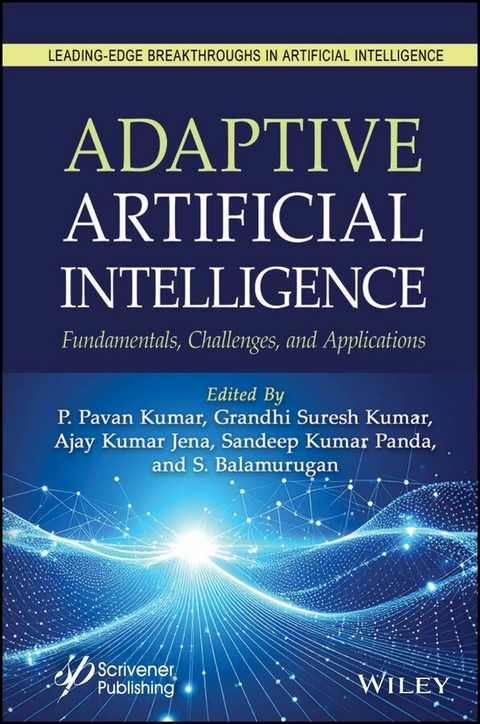
Adaptive Artificial Intelligence (eBook)
632 Seiten
Wiley-Scrivener (Verlag)
978-1-394-38905-6 (ISBN)
Master the next frontier of technology with this book, which provides an in-depth guide to adaptive artificial intelligence and its ability to create flexible, self-governed systems in dynamic industries.
Adaptive artificial intelligence represents a significant advancement in the development of AI systems, particularly within various industries that require robust, flexible, and responsive technologies. Unlike traditional AI, which operates based on pre-defined models and static data, adaptive AI is designed to learn and evolve in real time, making it particularly valuable in dynamic and unpredictable environments. This capability is increasingly important in disciplines such as autonomous systems, healthcare, finance, and industrial automation, where the ability to adapt to new information and changing conditions is crucial.
In industry development, adaptive AI drives innovation by enabling systems that can continuously improve their performance and decision-making processes without the need for constant human intervention. This leads to more efficient operations, reduced downtime, and enhanced outcomes across sectors. As industries increasingly rely on AI for critical functions, the adaptive capability of these systems becomes a cornerstone for achieving higher levels of automation, reliability, and intelligence in technological solutions.
Readers will find the book:
- Introduces the emerging concept of adaptive artificial intelligence;
- Explores the many applications of adaptive artificial intelligence across various industries;
- Provides comprehensive coverage of reinforcement learning for different domains.
Audience
Research scholars, IT professionals, engineering students, network administrators, artificial intelligence and deep learning experts, and government research agencies looking to innovate with the power of artificial intelligence.
P. Pavan Kumar, PhD is an associate professor in the Department of Artificial Intelligence and Data Science at the ICFAI Foundation for Higher Education, Hyderabad, Telangana, India. He has published more than 20 scholarly peer-reviewed research articles in international journals and two Indian patents. His research interests include real-time systems, multi-core systems, high-performance systems, and computer vision.
Grandhi Suresh Kumar, PhD is an associate professor and Associate Dean of Academics in the School of Science and Technology at the ICFAI Foundation for Higher Education, Hyderabad, Telangana, India with more than ten years of experience. He has published one authored book, one edited book, one book chapter, and more than 15 articles. His research interests include intelligent manufacturing, robotics, sustainable energy solutions, CO2 capture, and applications of AI in mechanical engineering.
Ajay Kumar Jena, PhD is an assistant professor and Associate Dean in the School of Computer Engineering at the Kalinga Institute of Industrial Technology, Bhubaneswar, Odisha, India. He has published three books, seven book chapters, and 61 research papers in various international journals and conferences. His research interests include blockchain, object-oriented software testing, software engineering, data science, soft computing, and machine learning.
Sandeep Kumar Panda, PhD is a professor and an Associate Dean in the School of Science and Technology at the ICFAI Foundation for Higher Education, Hyderabad, Telangana, India. He has published six books, several book chapters, and 80 articles in international journals and conferences. His research interests include blockchain technology, W3, metaverse, the Internet of Things, AI, and cloud computing.
S. Balamurugan, PhD is the Director of Research, iRCS, an Indian technological research and consulting firm. He has published more than 100 books, 300 papers in international journals and conferences, and 300 patents. With 20 years of research experience using various cutting-edge technologies, he provides expert guidance in technology forecasting and decision-making for leading companies and startups.
Master the next frontier of technology with this book, which provides an in-depth guide to adaptive artificial intelligence and its ability to create flexible, self-governed systems in dynamic industries. Adaptive artificial intelligence represents a significant advancement in the development of AI systems, particularly within various industries that require robust, flexible, and responsive technologies. Unlike traditional AI, which operates based on pre-defined models and static data, adaptive AI is designed to learn and evolve in real time, making it particularly valuable in dynamic and unpredictable environments. This capability is increasingly important in disciplines such as autonomous systems, healthcare, finance, and industrial automation, where the ability to adapt to new information and changing conditions is crucial. In industry development, adaptive AI drives innovation by enabling systems that can continuously improve their performance and decision-making processes without the need for constant human intervention. This leads to more efficient operations, reduced downtime, and enhanced outcomes across sectors. As industries increasingly rely on AI for critical functions, the adaptive capability of these systems becomes a cornerstone for achieving higher levels of automation, reliability, and intelligence in technological solutions. Readers will find the book: Introduces the emerging concept of adaptive artificial intelligence;Explores the many applications of adaptive artificial intelligence across various industries;Provides comprehensive coverage of reinforcement learning for different domains. Audience Research scholars, IT professionals, engineering students, network administrators, artificial intelligence and deep learning experts, and government research agencies looking to innovate with the power of artificial intelligence.
1
From Data to Diagnosis—Integrating Adaptive AI in Reshaping Healthcare
Kumar Saurabh* and Raghuraj Singh Suryavanshi
Department of Computer Science & Engineering, Pranveer Singh Institute of Technology, Kanpur, UP, India
Abstract
Real-time data and continuous feedback are prerequisites for adaptive artificial intelligence in healthcare disease identification. By adding AI in healthcare system, medical experts can improve efficiency and reduce diagnostic faults; artificial intelligence improves its capacity to detect ailments and provide individualized treatment advice. While they are constantly developing, healthcare systems might utilize artificial intelligence to boost efficiency, enhance diagnosis accuracy, and customize treatment to the needs of patients. Using artificial intelligence to examine enormous amounts of medical data quickly improves patient outcomes and consequently supports the development of predictive drugs and disease diagnostics. Moreover, healthcare automation helps medical professionals relax, so they may devote more time and attention to difficult circumstances that require human participation. By allowing evidence-based medical decision-making, adaptive artificial intelligence raises diagnostic precision and the benchmark for creative, patient-centered treatment.
Keywords: Health diagnostic, image recognition, wearable devices, patient-care
1.1 Introduction
In healthcare diagnostic, adaptive artificial intelligence entails real-time adjustment of its algorithms and decision-making; therefore, this AI produces more accurate and customized patient diagnoses by continuously learning and enhancing its diagnosis potential based on new information and feedback. Health diagnostic systems with adaptive artificial intelligence enhance patient outcomes by enhancing the productivity and effectiveness of healthcare staff in diagnostic tasks. By offering clinicians more guidance and direction, adaptive artificial intelligence could reduce the risk of human error in diagnosing complicated medical conditions. This technology can painstakingly navigate data and medical literature to identify likely diagnosis and treatment possibilities, guiding clinicians in making decisions. Further, adaptive artificial intelligence could enable earlier disease diagnosis and more effective therapies by assisting human physicians in viewing patterns in patient data that are not necessarily visible to them. Adaptive artificial intelligence-based health diagnostics could transform patient quality of life worldwide and alter healthcare delivery. With more accurate and effective diagnostic potential, it is highly significant in transforming healthcare. This tool ensures rapid and accurate diagnosis by understandably and rapidly processing enormous volumes of data. With the addition of new data and user feedback, adaptive artificial intelligence increasingly assists in enhancing the accuracy of diagnosis. This eases patients since it simplifies the diagnosis process and offers doctors more accurate data to base decisions on when choosing a treatment approach. Adaptive artificial intelligence would be beneficial to patient care and healthcare diagnostic systems, it will allow doctors to reevaluate their patient treatment strategy. Artificial intelligence is revolutionizing healthcare with its incredibly rapid data processing and continually improved diagnosis accuracy. With better, timely decisions, adaptive artificial intelligence helps medical professionals enhance patient outcomes. AI-based diagnostic technologies enhance overall industrial efficiency, lower healthcare costs significantly, and enhance therapeutic quality with a massive industrial productivity boost. If artificial intelligence makes routine tasks smoother and repetitive tasks automated, medical professionals can perhaps spend more time and energy on the more complex and critical aspects of patient care. AI can help doctors detect patient trends that are not necessarily black and white, thereby enabling early treatment and diagnosis of any ill health condition. Preventive care in the healthcare system could enhance patient outcomes in general and even save lives. AI can help reduce staff shortages and the workload of medical professionals, thereby enabling more efficient and personalized treatment of more patients. Adaptive artificial intelligence is transforming the healthcare industry, including diagnosis and treatment. With the ability to analyze large amount of data and learn from past errors, this can now provide more accurate diagnoses earlier. Early disease detection is good for patients and results in better overall conditions. It also saves doctor’s and hospital’s time and money. Moreover, adaptive AI-based diagnosis systems can enhance patient care and outcomes by generating treatment plans appropriate to every patient’s need. Flexible artificial intelligence is transforming healthcare by opening new avenues for better, more effective treatments. AI has the capability to refurbish healthcare by virtue of it being able to look for the patterns people cannot fish out among the heaps of data. Artificial intelligence is supporting the medical professionals in making wise decisions; therefore, patient outcomes are being improved and money is being saved. Mainly in the aftermath of the rapid rate of technological advancement, the various applications of artificial intelligence in healthcare have vast potential for future disease detection, prediction, and treatment.
1.2 Literature Review
For Smart Health Monitoring (SHM) using deep learning and AI, the author of the paper [1], presents a comprehensive review that focuses on the literature for innovative health monitoring systems (SHM) powered by artificial intelligence. Basically, the approach includes an analysis of different studies to have a comprehensive learning of how AI technology is applied in SHM. The main results include that SHM has been very essential in disease detection and patient monitoring, which in turn significantly improves healthcare outcomes. The diversity of sensor data is a main obstacle to standardizing and effective application. This study emphasizes how artificial intelligence might drastically change healthcare monitoring and help address important data problems. The author in the paper [2], presents a new framework, including an energy-efficient routing protocol and an adaptive transmission data rate (ATDR) algorithm to generate novel healthcare applications. The findings show that this design effectively manages energy efficiency and boosts healthcare system reliability. One limitation the study did observe is the routing process’s general energy use. Nevertheless, the proposed approach significantly enhances AI-driven novel healthcare systems utilizing better data flow and network dependability. The author of paper [3], methodically explored several databases to look into the use of AI in the healthcare and pharmaceutical sectors. The study indicates that artificial intelligence may enhance drug development, diagnostics, and treatment personalizing by mining medical and pharmaceutical data for practical insights. One major limitation is the need for sufficiently large datasets to train AI models. The paper underlines the data challenges that must be solved before the technology can be widely used, even as it emphasizes the transformational powers of artificial intelligence in healthcare. Though he refrains from endorsing a particular approach, the author of the paper [4], provides a comprehensive study of healthcare improvements brought about by artificial intelligence. The findings indicate that artificial intelligence may enhance diagnosis, treatment planning, and healthcare efficiency, which would help patients immensely. Still, the study highlights algorithm bias, poor data quality, and the necessity of standardizing to ensure correct and fair AI-driven healthcare solutions. The research [5], emphasizes both the possibilities and the limitations of artificial intelligence in the medical field released in 2023, highlights the importance of working together in reducing diagnosis mistakes in AI-based medical diagnosis. Although it provides no therapy, the study emphasizes the need for more consistent artificial intelligence diagnosis tools. The major outcomes suggest that the lack of diagnostic error studies in artificial intelligence medicine makes AI-driven treatments less reliable. Notwithstanding these limitations, the study highlights the need for medical professionals and artificial intelligence designers to work together to improve AI accuracy and reduce diagnostic errors using cooperation. Examining in great-depth the medical imaging artificial intelligence diagnostics, the author in his study [6], have shown especially in radiology and pathology, that artificial intelligence has quicker and more precisely improved image-based diagnosis. Guidelines specify applicability, algorithm bias, and dataset variation. While artificial intelligence may increase diagnostic accuracy, ethical and data issues must be handled before we enjoy equality and efficiency. Examining artificial intelligence-driven medical wearables in [7], using artificial intelligence algorithms, wearable sensors can monitor vital signs, find abnormalities, and project health dangers in real-time. This creative thinking might improve long-term medical therapy. The study reveals issues such as data privacy, wearable battery limitations, and the possibility of AI-based prediction errors. Despite these limitations, the study highlights the significance of artificial intelligence-powered wearables...
| Erscheint lt. Verlag | 30.9.2025 |
|---|---|
| Sprache | englisch |
| Themenwelt | Mathematik / Informatik ► Informatik ► Theorie / Studium |
| ISBN-10 | 1-394-38905-1 / 1394389051 |
| ISBN-13 | 978-1-394-38905-6 / 9781394389056 |
| Informationen gemäß Produktsicherheitsverordnung (GPSR) | |
| Haben Sie eine Frage zum Produkt? |
 EPUB (Adobe DRM)
Kopierschutz: Adobe-DRM
Adobe-DRM ist ein Kopierschutz, der das eBook vor Mißbrauch schützen soll. Dabei wird das eBook bereits beim Download auf Ihre persönliche Adobe-ID autorisiert. Lesen können Sie das eBook dann nur auf den Geräten, welche ebenfalls auf Ihre Adobe-ID registriert sind.
Details zum Adobe-DRM
Dateiformat: EPUB (Electronic Publication)
EPUB ist ein offener Standard für eBooks und eignet sich besonders zur Darstellung von Belletristik und Sachbüchern. Der Fließtext wird dynamisch an die Display- und Schriftgröße angepasst. Auch für mobile Lesegeräte ist EPUB daher gut geeignet.
Systemvoraussetzungen:
PC/Mac: Mit einem PC oder Mac können Sie dieses eBook lesen. Sie benötigen eine
eReader: Dieses eBook kann mit (fast) allen eBook-Readern gelesen werden. Mit dem amazon-Kindle ist es aber nicht kompatibel.
Smartphone/Tablet: Egal ob Apple oder Android, dieses eBook können Sie lesen. Sie benötigen eine
Geräteliste und zusätzliche Hinweise
Buying eBooks from abroad
For tax law reasons we can sell eBooks just within Germany and Switzerland. Regrettably we cannot fulfill eBook-orders from other countries.
aus dem Bereich