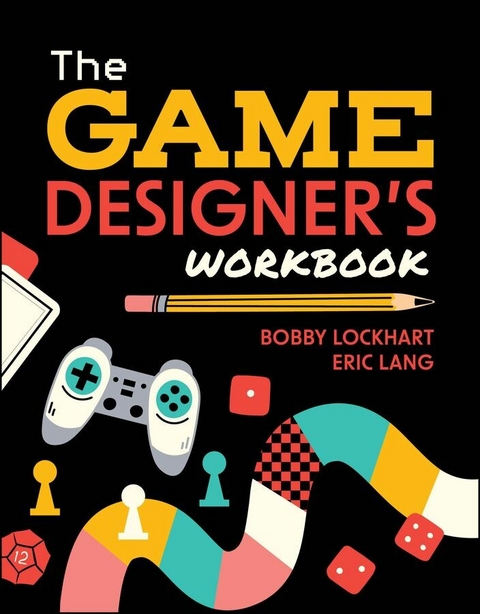
The Game Designer's Workbook (eBook)
341 Seiten
Wiley (Verlag)
978-1-394-27394-2 (ISBN)

Hands-on tools, exercises, walkthroughs, and resources for new game designers. All you need is a pencil!
In The Game Designer's Workbook, two experienced game designers, Bobby Lockhart and Eric Lang, walk you through design tips and exercises you can apply immediately to take your next game to the next level. The authors draw on decades of combined experience in game design, helping you ideate, storyboard, create fun and challenging levels, and more.
The book is structured as a set of practical exercises and examples to give budding game designers hands-on experience with the nuts and bolts of designing games. Equipped only with a pencil, you can level-up your skills in critical areas of game design. While you're free to use a computer, a pair of dice, or to team up with a group of friends, The Game Designer's Workbook lets you develop your skills whenever you've got something to write with and 10 minutes of spare time.
The book includes reflection sections that allow you to think deeply about your future game design practice, challenges that prompt you to modify and improve an existing game, break down games into their component parts to better understand their inner workings, and discussions of concepts common to all sorts of games.
You'll also find:
- A link to a companion website that includes additional resources, like printable resources, extra dot grid pages, papercraft exercises, random number generators, and scaffolded work pages
- Explanations of cross-disciplinary skills useful for any aspiring game designers
- Stand-alone chapters you can tackle beginning-to-end or one at a time
The Game Designer's Workbook is an essential toolkit for aspiring and beginning game designers, as well as anyone interested in games and game design.
BOBBY LOCKHART is a game designer specializing in learning games with more than 10 years' experience designing games for all audiences, including children and adult professionals undertaking career training.
ERIC LANG is a human-centered designer who makes whimsical, award-winning, educational video games played by millions of kids around the world. He is the Art Director at the Field Day Lab based out of the University of Wisconsin-Madison.
Chapter One
Setting the Stage
The only way to learn is by playing. The only way to win is by learning. And the only way to begin is by beginning.
—Sam Reich Game Changer
Reflection: Who Is the Game Designer You?
If you read through the introduction of this book, we wouldn’t blame you one bit if you were daydreaming through some if it. Maybe you were imagining yourself in the future, accepting an award for your innovative game, or watching people line up outside an electronics store at midnight, each waiting for the chance to buy something you helped create. Well, that’s what this reflection is all about. What do you dream of?
Specifically:
- What are your goals as a game designer?
- What kinds of games do you want to have a hand in creating?
- When your colleagues describe you, what kind of game designer do you want them to say you are?
- Is there something wrong about a particular genre of games, or about games in general, that you feel you need to correct?
TAKE THIS SPACE TO WRITE YOUR RESPONSES!
Throughout this workbook, we’ll be asking you to revise your designs to make them better. Here is where you define what “better” means to you. Is it all about visceral pleasure? What about evoking emotion in the player? Self-expression? There are many valid answers, but it’s important to define what the answer is to you.
USE THIS SPACE TO DEFINE WHAT “BETTER” MEANS TO YOU:
It’s possible that over time what you value in a game may shift. It certainly has for us, more than once. The following space is reserved so that you can revisit this question and reflect on what may have influenced your change of heart.
What Is…a GDD?
GDD stands for “game design document.” In short, a GDD is to a game what a screenplay is to a movie. Though this book talks a lot about rules, rules are only part of what’s specified in a GDD. A GDD can also describe the story and aesthetics of the game, how you want the player to feel, and more. Ideally, it should also have lots of pictures.
Rather than a single monolithic document, a GDD is often built of many smaller GDDs, each describing a piece of the game. One GDD might cover a game mechanic (aka gameplay feature), a level, or an non-player character (NPC) behavior. It’s also a “living document,” which is constantly altered over the course of a game’s production.
The purpose of a GDD can vary depending on its audience and the stage of a project. Before a single playing card is scribbled into being or a single line of code is written, a GDD acts as a pitch, helping to sell the ideas of the game to external stakeholders, to members of your team, and to yourself. Once you start building, the GDD is the blueprint of the game.
TIME TO GIVE IT A SHOT!
Your task is to think of a game you know very well and fill out the GDD on the following page as if it were a game you were about to build yourself. Keep it general, describing the whole game concept at a low level of detail, knowing that more specifics will be fleshed out in future GDDs.
Since games are so incredibly diverse, there is no single structure that GDDs take, but we’ve created a form with some elements we recommend you include. It’s not one-size-fits-all, so if a section doesn’t apply, you can safely ignore it. If there is something vital about your chosen game that isn’t covered, please add it.
Game Title
Executive Summary
Write one or two sentences explaining the basic idea of the game.
Audience
Who is the game for, primarily? There are a lot of ways to slice this. Demographics. Personality. You can also give examples of specific people who you think would enjoy the game, and why (we call these “personas”).
Concept Drawings
Draw a couple of images representative of what the player will see in the most interesting parts of gameplay. In later chapters we will practice the kinds of visualizations that make a GDD come alive: storyboards, wireframes, and schematics.
Experience Pillars
What do you want the player(s) to experience, even if everything else about the design changes? What are the most important things you want a player to do, to see, or to feel?
| _________________________________ _________________________________ _________________________________ _________________________________ | _________________________________ _________________________________ _________________________________ _________________________________
|
| _________________________________ _________________________________ _________________________________ _________________________________ | _________________________________ _________________________________ _________________________________ _________________________________ |
Platform(s)
What kind of game pieces or computing hardware will the players be using?
Goals of the Player
Sometimes called the object of the game. How do players win? Can they win at all, or just do better than before? Is it the same for all players, or do different players have different goals?
Obstacles Blocking Those Goals
Other players? NPCs? The nature of the world?
Interface
Zoom out a bit. When a player uses their abilities, what are they actually doing with their bodies? Are they placing a card? Pressing a button? Swiping a touchscreen?
Story
Setting and Genre
When and where does it take place? What genre is it? It can be useful to refer to literature and film.
Main Characters
Include their name, whether they are playable or an NPC, a brief description, what they want, and what stands in their way.
| _________________________ _________________________ _________________________ _________________________ _________________________ _________________________ | _________________________ _________________________ _________________________ _________________________ _________________________ _________________________ | _________________________ _________________________ _________________________ _________________________ _________________________ _________________________ |
Elements
What kinds of elements—objects, units, etc.—are players likely to encounter in this game? Just give two or three examples of what they are and how they operate to help or hinder the player. How do they relate to the other elements?
Remix: Tic-Tac-Toe (Naughts & Crosses)
Game designers often refer to the universe of possible rules, or rulespace, that they are exploring as they create a new game. This type of exploration usually begins using a known game as a sort of base camp. Eventually you may find the confidence to delve deep into the unknown wilderness of games to find the treasures that lurk there. In these Remix exercises you’ll be asked to start simply, by charting the rulespace next door to one that is well-known.
The Rules of Tic-Tac-Toe:
- Two players alternate turns.
- Each player has a symbol associated with themself, traditionally, “X” and “O.”
- Play occurs on a discrete playfield of nine empty squares arranged 3x3.
- On each player’s turn they choose an unoccupied square and write their symbol in it.
- The first player to arrange three of their own symbols in a line (vertically, horizontally, or diagonally) wins the game.
Your task: Try to improve the game of tic-tac-toe by revising one rule other than rule 3. Write your revised rule on the following lines, as well as which numbered rule it will replace. Be as specific as you can. Assume that the reader of the rule won’t have you around to explain it.
TRY IT OUT!
Create your revised rule:
Try it out with your new and improved rule.
After...
| Erscheint lt. Verlag | 30.9.2025 |
|---|---|
| Sprache | englisch |
| Themenwelt | Mathematik / Informatik ► Informatik |
| Schlagworte | game design exercises • Game design guide • game design handbook • game design resources • game design storyboarding • game design techniques • game design tips • game design tools • Level Design • level design techniques • level design tips |
| ISBN-10 | 1-394-27394-0 / 1394273940 |
| ISBN-13 | 978-1-394-27394-2 / 9781394273942 |
| Informationen gemäß Produktsicherheitsverordnung (GPSR) | |
| Haben Sie eine Frage zum Produkt? |
 EPUB (Adobe DRM)
Kopierschutz: Adobe-DRM
Adobe-DRM ist ein Kopierschutz, der das eBook vor Mißbrauch schützen soll. Dabei wird das eBook bereits beim Download auf Ihre persönliche Adobe-ID autorisiert. Lesen können Sie das eBook dann nur auf den Geräten, welche ebenfalls auf Ihre Adobe-ID registriert sind.
Details zum Adobe-DRM
Dateiformat: EPUB (Electronic Publication)
EPUB ist ein offener Standard für eBooks und eignet sich besonders zur Darstellung von Belletristik und Sachbüchern. Der Fließtext wird dynamisch an die Display- und Schriftgröße angepasst. Auch für mobile Lesegeräte ist EPUB daher gut geeignet.
Systemvoraussetzungen:
PC/Mac: Mit einem PC oder Mac können Sie dieses eBook lesen. Sie benötigen eine
eReader: Dieses eBook kann mit (fast) allen eBook-Readern gelesen werden. Mit dem amazon-Kindle ist es aber nicht kompatibel.
Smartphone/Tablet: Egal ob Apple oder Android, dieses eBook können Sie lesen. Sie benötigen eine
Geräteliste und zusätzliche Hinweise
Buying eBooks from abroad
For tax law reasons we can sell eBooks just within Germany and Switzerland. Regrettably we cannot fulfill eBook-orders from other countries.
aus dem Bereich