


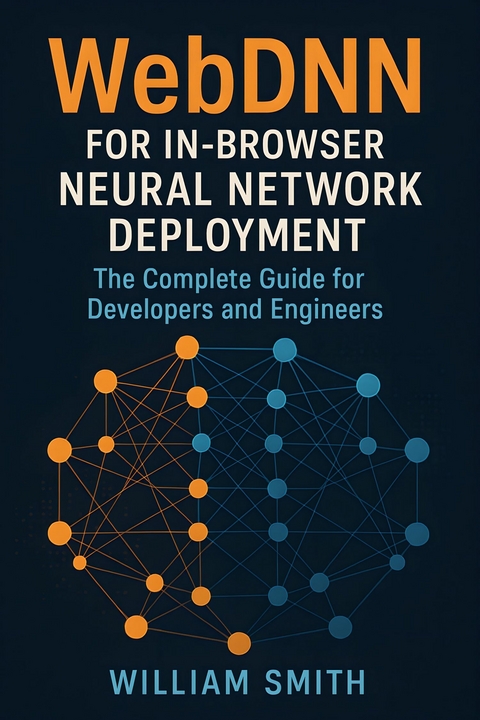
WebDNN for In-Browser Neural Network Deployment (eBook)
250 Seiten
HiTeX Press (Verlag)
978-0-00-106222-1 (ISBN)
'WebDNN for In-Browser Neural Network Deployment'
'WebDNN for In-Browser Neural Network Deployment' offers a comprehensive exploration of the evolving landscape of neural computing within the browser environment. This authoritative guide begins by establishing the foundational concepts behind client-side machine learning, detailing how advances in browser architectures, hardware accelerators, and web standards have broken new ground for privacy-preserving and latency-sensitive applications. Through a thorough analysis of the strengths and limitations of current frameworks-including WebDNN, TensorFlow.js, and ONNX.js-the book contextualizes the growing momentum and distinctive opportunities for deploying neural networks directly in web applications.
Delving into the architecture and technical underpinnings of WebDNN, the book provides clarity on its core design principles: speed, universality, and streamlined deployment. Readers are guided through intricacies of model preparation and conversion, runtime optimizations, and hardware-specific accelerations using WebGPU, WebGL, and WebAssembly. Richly detailed sections on performance tuning, memory optimization, and seamless integration strategies equip developers and machine learning practitioners to deliver high-performing inference across heterogeneous client devices and platforms. The book also covers advanced topics such as chaining multiple models, progressive enhancement techniques, and interfacing with various user and media inputs in complex real-world web applications.
Furthermore, 'WebDNN for In-Browser Neural Network Deployment' addresses modern challenges in security, privacy, compliance, and user trust-equipping readers with best practices for safeguarding models and user data within the browser's sandboxed environment. Expansive chapters examine cutting-edge and emerging use cases, from real-time computer vision and offline ML workflows to federated, collaborative, and hybrid cloud-client inference. Concluding with forward-looking perspectives, the guide highlights ongoing research, the trajectory of emerging standards like WebGPU and WebNN, and the broad societal potential of transformative browser-centric machine learning-making it an indispensable resource for developers, architects, and researchers at the forefront of web-based AI innovation.
| Erscheint lt. Verlag | 20.8.2025 |
|---|---|
| Sprache | englisch |
| Themenwelt | Mathematik / Informatik ► Informatik ► Programmiersprachen / -werkzeuge |
| ISBN-10 | 0-00-106222-0 / 0001062220 |
| ISBN-13 | 978-0-00-106222-1 / 9780001062221 |
| Informationen gemäß Produktsicherheitsverordnung (GPSR) | |
| Haben Sie eine Frage zum Produkt? |
 EPUB (Adobe DRM)
Größe: 807 KB
Kopierschutz: Adobe-DRM
Adobe-DRM ist ein Kopierschutz, der das eBook vor Mißbrauch schützen soll. Dabei wird das eBook bereits beim Download auf Ihre persönliche Adobe-ID autorisiert. Lesen können Sie das eBook dann nur auf den Geräten, welche ebenfalls auf Ihre Adobe-ID registriert sind.
Details zum Adobe-DRM
Dateiformat: EPUB (Electronic Publication)
EPUB ist ein offener Standard für eBooks und eignet sich besonders zur Darstellung von Belletristik und Sachbüchern. Der Fließtext wird dynamisch an die Display- und Schriftgröße angepasst. Auch für mobile Lesegeräte ist EPUB daher gut geeignet.
Systemvoraussetzungen:
PC/Mac: Mit einem PC oder Mac können Sie dieses eBook lesen. Sie benötigen eine
eReader: Dieses eBook kann mit (fast) allen eBook-Readern gelesen werden. Mit dem amazon-Kindle ist es aber nicht kompatibel.
Smartphone/Tablet: Egal ob Apple oder Android, dieses eBook können Sie lesen. Sie benötigen eine
Geräteliste und zusätzliche Hinweise
Buying eBooks from abroad
For tax law reasons we can sell eBooks just within Germany and Switzerland. Regrettably we cannot fulfill eBook-orders from other countries.
aus dem Bereich


