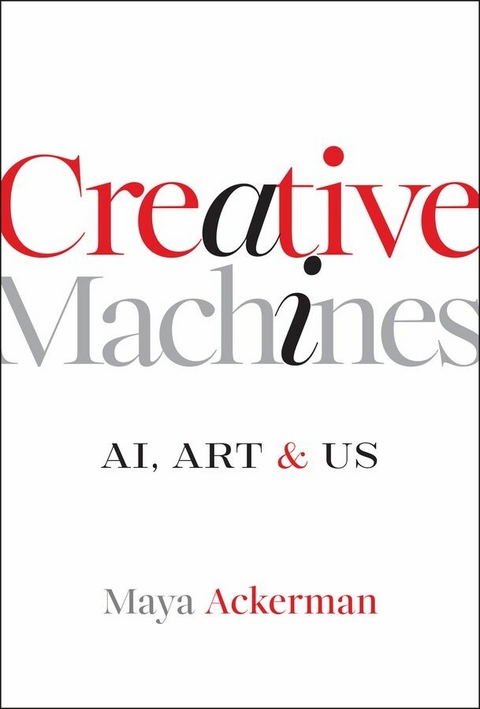
Creative Machines (eBook)
244 Seiten
Wiley (Verlag)
978-1-394-31627-4 (ISBN)
A bold and thought-provoking journey into AI's power to transform human creativity
In Creative Machines: AI, Art & Us, world-renowned AI researcher and generative AI pioneer, Maya Ackerman, takes you on a thrilling journey into the rise of creative AI, from its earliest pioneers to the cutting-edge tools shaping music, art, and human imagination today.
Ackerman cuts through the hype, revealing the true capabilities and limitations of generative AI while championing its potential to amplify human creativity rather than replace it. Drawing on psychology, philosophy, and her own cutting-edge research, she reveals how generative AI exposes both the brilliance and the blind spots of human society-our ingenuity, our biases, our assumptions about intelligence and identity.
The book contains:
- The hidden history and explosive growth of AI-generated creativity
- Explorations of the true capabilities and limitations of creative AI
- A visionary framework for using AI as a tool to enhance, rather than hinder, human creativity
- A bold new perspective on AI ethics and why fixing AI is not enough
Perfect for entrepreneurs, tech leaders, developers, ethicists, and creative professionals, Creative Machines offers deep insights, compelling stories, and a visionary perspective on AI's impact on human society. An essential read for anyone doing their best to navigate the rapidly evolving landscape of generative AI.
MAYA ACKERMAN, PHD, is an internationally renowned leader in generative AI, pioneering the next chapter of creativity. As CEO and Co-Founder of WaveAI, one of the earliest generative AI startups, she has enabled millions to explore new frontiers in creative expression through AI. An Associate Professor at Santa Clara University, Dr. Ackerman is widely known for her research on AI and creativity. Dr. Ackerman's insights have been featured in NBC News, NPR, Forbes, and more. Her work champions the role of AI in amplifying-rather than replacing-human creativity.
A bold and thought-provoking journey into AI's power to transform human creativity In Creative Machines: AI, Art & Us, world-renowned AI researcher and generative AI pioneer, Maya Ackerman, takes you on a thrilling journey into the rise of creative AI, from its earliest pioneers to the cutting-edge tools shaping music, art, and human imagination today. Ackerman cuts through the hype, revealing the true capabilities and limitations of generative AI while championing its potential to amplify human creativity rather than replace it. Drawing on psychology, philosophy, and her own cutting-edge research, she reveals how generative AI exposes both the brilliance and the blind spots of human society our ingenuity, our biases, our assumptions about intelligence and identity. The book contains: The hidden history and explosive growth of AI-generated creativity Explorations of the true capabilities and limitations of creative AI A visionary framework for using AI as a tool to enhance, rather than hinder, human creativity A bold new perspective on AI ethics and why fixing AI is not enough Perfect for entrepreneurs, tech leaders, developers, ethicists, and creative professionals, Creative Machines offers deep insights, compelling stories, and a visionary perspective on AI's impact on human society. An essential read for anyone doing their best to navigate the rapidly evolving landscape of generative AI.
CHAPTER 1
AARON the Machine Painter
The Only Voice of Reason
The only voice of reason,
Unheard, unseen.
I am the creative breath,
Brushing through the wind.
It wasn’t OpenAI or Google Brain that first discovered the marvelous terrain of creative machines. Even the most triumphant industry players joined the parade only long after the pioneers had already blazed the trail. By the time that Microsoft, Google, and IBM arrived on the scene, the quiet explorers had long since proved that the land of machine creativity was fertile.
The true pioneers of machine creativity worked humbly, far from the spotlight. Driven by nothing but passion and the pursuit of knowledge, these curious minds ventured into uncharted territories. Like all true explorers, they pressed forward without knowing if their efforts would ever bear fruit.
These early adventurers weren’t overconfident warriors, guns blazing, arrogantly trampling over creative traditions. Instead, many were artists – respected figures in their fields – risking their reputations to carve out this new domain.
I first encountered one of these passionate pioneers back in 2015. My story begins on a warm San Diego beach. The sun glistened across the ocean, framed by palm trees and the purple flowers that define the paradise of this splendid coast. I’d been reluctantly attending the workshop on Information Theory and Applications all week, and it was the same routine of machine learning techniques and mathematical proofs.
After over a decade of education and preparation, I had just landed a job as a professor of computer science. Such a big title! Shouldn’t I have been excited? I’d worked so hard to achieve this. Like a marriage that had withered too soon, my passion for machine learning, which had once consumed me through my Master’s and PhD, had all but faded.
Where I expected certainty and confidence in my new position, I felt more lost and confused than ever. Even against the landscape of the San Diego paradise, a wave of melancholy washed over me.
In my hotel room, I felt paralyzed by doubt. What have I done all this for? Why did I devote a decade to studying something that now feels so meaningless? Conversations failed to engage me. The talks bored me. I drifted through the conference in a fog, disconnected, lost, and burdened by my own indifference.
I was yearning for something I couldn’t name. My lifelong passion for music ached in my bones, but I was at a loss for what to do with it. It was becoming painfully clear that while I loved music, I had no desire to seek a musician’s career. Music needed to remain my lover, a passionate side fling full of life and fire.
But the search for fulfillment felt aimless. What am I looking for? Does it even exist? I was starting to believe that I might never find what I was seeking.
Then, while glancing over the workshop schedule, something jumped out at me. A small session, tucked away on the last day of the workshop, titled “Computational Creativity.”
Something about art and music. I made a mental note to attend.
Walking into the dusty, dimly lit lecture hall, I took a seat near the back. Close to the door. I didn’t want to be trapped if the presentations were as boring as usual.
I settled into my chair. An older man I had never heard of named Harold Cohen was leading the presentation. One by one, beautiful paintings flashed on the screen: abstract flowers in vivid purples, blues, and yellows, and more abstract shapes in bright pigments collaged against one another.
Then, something extraordinary happened.
Cohen suddenly raised his voice, shouting: “And I was the only voice of reason. Saying, I’m the creative one!”
I straightened in my chair and started paying attention. His passion was palpable, his emotion raw and infectious. What had upset him so deeply?
I quickly pieced it together.
Cohen had created an automated painter, AARON, which had produced these impressive works of art that I had just seen. And some people had started to refer to the program, AARON, as a creative entity. Many, in fact, argued that AARON – Cohen’s own creation – was proof that machines, lifeless computer programs, could be creative.
And this made Harold very, very angry.
Tingles traveled through me, head to toe. Creative machines! Where had they been all my life?
The Birth of a Machine Artist
Harold Cohen didn’t fit the mold of an AI pioneer. He wasn’t a computer scientist. He wasn’t a programmer. He was an artist – brilliant, world-renowned, and celebrated for his explosive use of color and bold compositions. In 1966, he represented Britain at the Venice Biennale, one of the most prestigious art events in the world. Cohen had arrived. He was at the top of his field.
But within two years, something shifted. In 1968, Cohen found himself on the other side of the world, at the University of California, San Diego – the very campus where, decades later, I sat in the audience, enthralled by his passion. It was there, almost by accident, that he stumbled into computer programming.
By 1971, at Stanford University’s Artificial Intelligence Laboratory, Cohen began building AARON, a machine that could make art. But not just any art – art that could stand on its own, that could hang in galleries. This project wasn’t just about machines; it was about Cohen himself. In an audacious act of self-exploration, he set out to crack open his own mind and decode the mystery of his creative process.
Capturing the depth of Harold Cohen’s creativity in lines of code was no simple task. It became a decades-long obsession. AARON’s earliest works in the 1970s were humble – simple, monochrome line drawings that felt like a child’s first tentative sketches. But by the 1980s, AARON had matured. It began drawing intricate forms – human figures, plants, everyday objects – capturing the natural world with surprising sensitivity.
For years, AARON acted as Cohen’s silent collaborator. The machine laid down the structure; Cohen brought it to life with his vibrant colors. Color was the soul of his work, and he doubted AARON would ever master it. “It’s taken me 20 years to teach AARON to draw. How can I possibly teach it to color before I die?” he mused (Garcia 2016).
But by the mid-1990s, Cohen had done the seemingly impossible. Using a robotic arm and a sophisticated color-mixing system, the machine could now create vibrant, full-color images without any human touch.1
This breakthrough took center stage in 1995 at the Computer Museum in Boston. The exhibit, The Robotic Artist: AARON in Living Color, showcased AARON’s newfound abilities. Viewers watched as the machine, brush in hand, brought vivid canvases to life. It wasn’t just a technical milestone – it was proof that a creative machine could step out from under its creator’s shadow and reach much greater creative independence (Garcia 2016).
Here Come the Critics
Despite Cohen’s groundbreaking achievements, many remained skeptical, questioning whether AARON’s creations could truly be called art. Computer scientist Larry Cuba famously dismissed AARON as merely a “Harold Cohen simulator” (Lambert 2003).
But Cohen didn’t shy away from the critique. Instead, he acknowledged its validity. AARON was, after all, an extension of himself – a system designed to echo his creative process.
While some sought to minimize Cohen’s accomplishments, others were awestruck. In a presidential address at the American Association for Artificial Intelligence, Buchanan claimed AARON “is a much more talented and creative artist than most of us would claim to be.” But Cohen wasn’t swayed by the praise. He knew exactly where AARON’s boundaries lay:
“AARON will never make a choice to break the rules, nor will it reflect on those constraints as something that it might want to change… AARON has no sense of continuity or sense of experience from one drawing to the next”
– Sundararajan 2014
Cohen refused to exaggerate AARON’s abilities. In a world driven by self-promotion and hype, his honesty still stands out. He built AARON during the age of “expert systems” – machines that followed explicit, hand-coded instructions. There was no independent thought, no learning. AARON could only do what Cohen told it to.
But things have changed. Today’s AI systems don’t rely on hand-coded rules. They learn from vast datasets, consuming more information than any human ever could. Modern creative machines routinely produce work that surpasses the capabilities of their makers, forcing us to grapple with deeper challenges around the creative capabilities of machines.
And yet, even as generative AI tools far outpace the pioneering efforts of expert systems, there’s still much to learn from Cohen. His unwavering commitment to integrity over acclaim offers a lesson today’s AI developers would do well to remember.
The Bond Between AI and Its Maker
Despite passionately emphasizing AARON’s limitations, Harold Cohen shared a deeply personal bond with his creation. AARON was an extension of himself. He even gave it his own Hebrew name, a gesture meant to capture...
| Erscheint lt. Verlag | 26.9.2025 |
|---|---|
| Sprache | englisch |
| Themenwelt | Mathematik / Informatik ► Informatik ► Theorie / Studium |
| Schlagworte | ai art • AI Creativity • AI ethics • AI music • Artificial Intelligence Ethics • Computational Creativity • creative artificial intelligence • generative AI • generative ai ethics • generative artificial intelligence • generative artificial intelligence ethics |
| ISBN-10 | 1-394-31627-5 / 1394316275 |
| ISBN-13 | 978-1-394-31627-4 / 9781394316274 |
| Informationen gemäß Produktsicherheitsverordnung (GPSR) | |
| Haben Sie eine Frage zum Produkt? |
 EPUB (Adobe DRM)
Kopierschutz: Adobe-DRM
Adobe-DRM ist ein Kopierschutz, der das eBook vor Mißbrauch schützen soll. Dabei wird das eBook bereits beim Download auf Ihre persönliche Adobe-ID autorisiert. Lesen können Sie das eBook dann nur auf den Geräten, welche ebenfalls auf Ihre Adobe-ID registriert sind.
Details zum Adobe-DRM
Dateiformat: EPUB (Electronic Publication)
EPUB ist ein offener Standard für eBooks und eignet sich besonders zur Darstellung von Belletristik und Sachbüchern. Der Fließtext wird dynamisch an die Display- und Schriftgröße angepasst. Auch für mobile Lesegeräte ist EPUB daher gut geeignet.
Systemvoraussetzungen:
PC/Mac: Mit einem PC oder Mac können Sie dieses eBook lesen. Sie benötigen eine
eReader: Dieses eBook kann mit (fast) allen eBook-Readern gelesen werden. Mit dem amazon-Kindle ist es aber nicht kompatibel.
Smartphone/Tablet: Egal ob Apple oder Android, dieses eBook können Sie lesen. Sie benötigen eine
Geräteliste und zusätzliche Hinweise
Buying eBooks from abroad
For tax law reasons we can sell eBooks just within Germany and Switzerland. Regrettably we cannot fulfill eBook-orders from other countries.
aus dem Bereich