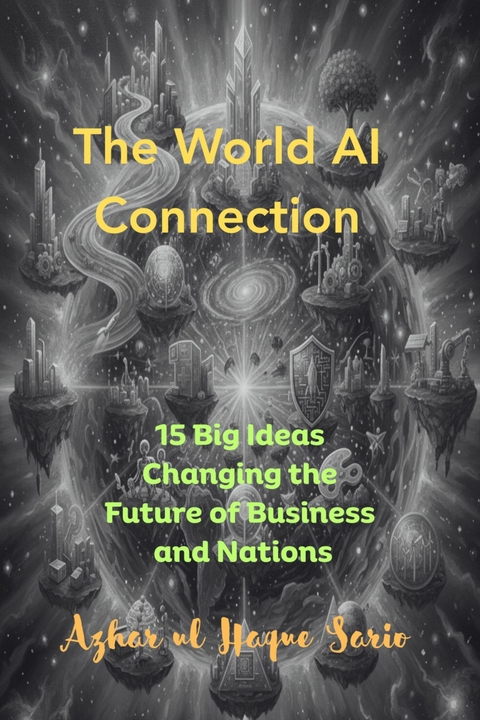
The World AI Connection (eBook)
196 Seiten
Azhar Sario Hungary (Verlag)
978-3-384-71667-5 (ISBN)
Ever wonder how AI is really changing the world, right now?
This book takes you on a global tour. It explores the future of artificial intelligence. We look beyond the usual headlines. You will discover 15 big ideas. These ideas are reshaping business. They are also changing nations. We travel to the United States to see how AI acts as an 'Algorithmic Doctor' in healthcare. In Germany, AI realizes the vision of Industrie 4.0 in smart manufacturing. Japan reimagines its society with AI and robotics in elderly care. The United Kingdom uses AI as a guardian of capital against financial fraud. China builds an 'Urban Nervous System' for its smart cities. We explore Canada's 'Digital Harvest' in precision agriculture and South Korea's 'Algorithmic Idol' in media. See how India provides education for a billion with personalized learning. Discover Singapore's 'Intelligent Hub' for logistics, Brazil's AI 'Watchtower' for the Amazon, and the UAE's 'Hyper-Personalized Oasis' in tourism. From Australia's autonomous mining frontier to the Netherlands' AI-powered water management, each chapter is a deep dive. It shows a real-world revolution in progress.
Many books on AI are too technical. They are often filled with jargon. Others talk about a distant, sci-fi future. This book is different. It's grounded in what's happening today across the globe. It connects the dots between technology, national priorities, and real human impact. Instead of just abstract theory, you get concrete case studies from leading nations, each pioneering a unique AI application. You'll learn how a country's specific challenges and economic strengths shape its AI strategy. This book provides a unique roadmap, revealing the most important AI applications that are transforming entire industries and societies. It's not just about the code; it's about the world being built and the competitive advantages available to those who truly understand these powerful connections.
The author has no affiliation with the board and this work is independently produced under nominative fair use.
South Korea - The Algorithmic Idol: Generative AI in Entertainment and Media
7.1 AI as a Cultural Export Strategy: Amplifying the Korean Wave (Hallyu) through Technology
South Korea’s approach to artificial intelligence in the entertainment world is fascinating. It’s not about fixing a problem. The Korean Wave, or Hallyu, is already a massive global success. It’s a cultural powerhouse built on the magnetic appeal of K-pop, the addictive storytelling of K-dramas, and the global obsession with Korean beauty and food. So, if the system isn’t broken, why bring in something as disruptive as generative AI?
The answer is simple yet brilliant: South Korea isn't playing defense. It’s playing offense. This is an "opportunity-seizing" strategy, a calculated move to amplify what is already working and catapult its cultural influence into a new, uncharted digital frontier. The leaders of this cultural movement looked at their success and didn't see a peak to rest on; they saw a launchpad.
The limitations of human-centric entertainment are well-known. Idols get tired. They age. They require immense resources for global tours. They can get caught in scandals that can tarnish a group’s reputation overnight. Language barriers, while often overcome with hard work, still present a challenge in creating deep, personal connections with a global fanbase. These aren't failures of the system, but natural constraints of being human. Generative AI is being strategically deployed to shatter these constraints.
Imagine a K-pop group that can perform a live concert in Seoul, New York, and a virtual metaverse arena all at the same time. Imagine an idol who can speak flawless Japanese to their fans in Tokyo, then switch to perfect Brazilian Portuguese for a live chat with their followers in São Paulo, using local slang and cultural nuances. This is the new frontier AI opens up. It allows for hyper-localization and omnipresence on a scale previously unimaginable. The cultural product—the music, the performance, the interaction—is no longer bound by physical space or human limitations.
This strategy is about future-proofing Hallyu. By creating virtual idols and AI-driven personalities, entertainment companies are building durable, controllable, and infinitely scalable intellectual properties. A virtual idol doesn’t need to sleep. It never has a bad day. Its personality, crafted by generative AI trained on mountains of data, can be perfectly aligned with brand values. This drastically reduces the investment risk that is so common in the entertainment industry. It’s a move from the unpredictable art of star-making to the predictable science of creating a perfect cultural ambassador.
Furthermore, this isn't just about replacing humans. It's about expanding the entire ecosystem. AI can generate endless streams of content: personalized messages for fans, social media updates, even song lyrics and musical concepts. This creates a deeper, more continuous level of engagement that keeps fans connected 24/7. It transforms fans from passive consumers into active participants in an ever-evolving digital world centered around their favorite groups.
In essence, South Korea is leveraging generative AI not as a tool, but as a strategic partner. It is a deliberate choice to amplify its cultural voice, to make it more accessible, more interactive, and more enduring. They are building a new layer on top of the Korean Wave—a digital layer that is more resilient, more scalable, and capable of cementing South Korea’s position as a dominant global cultural exporter for decades to come.
7.2 The Generative AI Production Pipeline: Creating and Managing Virtual Idols with Motion Capture
So, how does a virtual idol go from a simple idea to a global sensation? It's not magic. It’s a sophisticated production pipeline, a fascinating blend of human artistry and cutting-edge technology. This process is about building a digital being from the ground up, piece by piece, with generative AI and motion capture as the foundational tools.
The very first step is creating the soul of the idol: its personality. This is where generative AI does its most impressive work. Think of it like a writer creating a character, but supercharged with technology. A team feeds a Large Language Model (LLM) an enormous and carefully curated dataset. This data might include everything from transcripts of interviews with beloved real-life K-pop stars, fan letters, popular web fiction, song lyrics that define the genre, and even philosophical texts to give the character depth. The AI learns the nuances of conversation, the specific way an idol might express excitement, sadness, or gratitude. The goal is to create a personality that is consistent, engaging, and, most importantly, feels real. This AI can then generate dialogue for live streams, write captions for social media posts, and interact with fans in a way that is always "in character."
Once the personality is defined, it needs a body. This usually starts with talented human artists who design the idol's visual appearance—their face, their style, their entire aesthetic. This 3D model is the digital puppet. But a puppet is lifeless without movement. This is where motion capture, or "mocap," comes in.
In a mocap studio, a real human performer—often a highly skilled professional dancer—wears a special suit covered in sensors. As they perform the intricate, high-energy choreography that K-pop is famous for, a system of cameras tracks the exact position of every sensor. This data captures the performance with stunning realism. It’s not just the big movements; it’s the subtle swagger in a walk, the flick of a wrist, the human-like shift in weight. This motion data is then mapped directly onto the virtual idol's 3D model. The result is a digital character who moves with the fluidity, grace, and power of a top-tier human performer. It's the technology that breathes physical life into the digital avatar.
The final piece of this puzzle is the voice. Often, AI voice synthesis is used. A company might hire a real singer to provide voice samples. Then, AI models are trained on these samples to create a unique, synthetic singing voice. This AI voice can be manipulated to hit any note perfectly, sing in any language, and deliver a performance without the limitations of a human vocalist. It becomes another tool in the producer's toolkit, a completely controllable vocal instrument.
Managing this virtual idol is an ongoing process. The AI personality engine continues to interact with fans, and that fan feedback can even be used to further refine the AI's responses over time. The mocap team constantly works with dancers to create new choreography for music videos and virtual concerts. It's a continuous, dynamic loop of creation. What we see as a single, cohesive virtual performer is actually the brilliant synthesis of a generative AI "brain," a mocap-animated "body," and an AI-synthesized "voice," all managed by a team of human creatives. It is the new factory floor for 21st-century entertainment.
7.3 Monetizing Synthetic Media: The Business Model and Market Performance of Virtual Entertainers
The idea of a virtual K-pop idol selling a million albums once sounded like science fiction. Now, as we look at the landscape in 2025, it’s not a matter of if, but when. The one-million-unit milestone is more than just a number; it’s a powerful symbol that synthetic media has arrived as a commercially dominant force. It proves that a carefully constructed digital persona can command the same, if not greater, market power as a human artist. This achievement is not an accident. It is the result of a revolutionary business model that redefines what an "entertainer" can be and how audiences connect with them.
At its core, the business model for a virtual idol group is built on the principle of minimizing human limitations while maximizing intellectual property (IP). A traditional K-pop group is a massive investment with inherent risks. Idols get tired, they age, they make personal mistakes, and their careers have a natural lifespan. A virtual idol, on the other hand, is an eternally perfect asset. It never has a scandal, can appear in multiple places at once, and can be active 24/7. The initial investment in technology—hyper-realistic CGI, advanced vocal synthesis, and AI-driven personality engines—is immense. But once that asset is created, the operational costs plummet. There are no housing costs, no lavish travel expenses, and a much smaller support staff is needed for day-to-day activities.
So, how does this lean operational model translate into a million-selling album? The key is diversifying revenue streams that all funnel back to reinforce the core IP. The album itself is just the beginning.
First, there is the music. The music produced for virtual idols is created by the same world-class producers who work with human groups. The quality is identical. The album, however, is packaged as a gateway to a deeper experience. A physical copy in 2025 isn’t just a CD and a photobook. For a virtual group, it includes augmented reality (AR) photo cards that come to life through a smartphone app, allowing the digital idol to perform a song right on your desk. It contains QR codes that unlock exclusive digital content, like a behind-the-scenes look at the "making of" their music video (which is essentially a showcase of the incredible animation and tech involved). This turns the album from a simple music product into a...
| Erscheint lt. Verlag | 26.9.2025 |
|---|---|
| Sprache | englisch |
| Themenwelt | Informatik ► Theorie / Studium ► Künstliche Intelligenz / Robotik |
| Schlagworte | ai strategy • Artificial Intelligence • future of business • Global Technology Policy • Industry 4.0 • smart cities • Technological Innovation |
| ISBN-10 | 3-384-71667-1 / 3384716671 |
| ISBN-13 | 978-3-384-71667-5 / 9783384716675 |
| Informationen gemäß Produktsicherheitsverordnung (GPSR) | |
| Haben Sie eine Frage zum Produkt? |
 EPUB (Ohne DRM)
Digital Rights Management: ohne DRM
Dieses eBook enthält kein DRM oder Kopierschutz. Eine Weitergabe an Dritte ist jedoch rechtlich nicht zulässig, weil Sie beim Kauf nur die Rechte an der persönlichen Nutzung erwerben.
Dateiformat: EPUB (Electronic Publication)
EPUB ist ein offener Standard für eBooks und eignet sich besonders zur Darstellung von Belletristik und Sachbüchern. Der Fließtext wird dynamisch an die Display- und Schriftgröße angepasst. Auch für mobile Lesegeräte ist EPUB daher gut geeignet.
Systemvoraussetzungen:
PC/Mac: Mit einem PC oder Mac können Sie dieses eBook lesen. Sie benötigen dafür die kostenlose Software Adobe Digital Editions.
eReader: Dieses eBook kann mit (fast) allen eBook-Readern gelesen werden. Mit dem amazon-Kindle ist es aber nicht kompatibel.
Smartphone/Tablet: Egal ob Apple oder Android, dieses eBook können Sie lesen. Sie benötigen dafür eine kostenlose App.
Geräteliste und zusätzliche Hinweise
Buying eBooks from abroad
For tax law reasons we can sell eBooks just within Germany and Switzerland. Regrettably we cannot fulfill eBook-orders from other countries.
aus dem Bereich