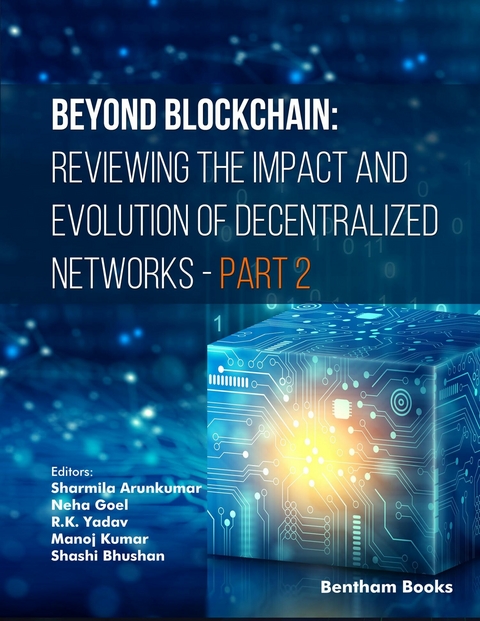
Beyond Blockchain (eBook)
211 Seiten
Bentham Science Publishers (Verlag)
979-8-89881-009-2 (ISBN)
Beyond Blockchain: Reviewing the Impact and Evolution of Decentralized Networks (Part 2) continues the journey into the rapidly evolving world of blockchain and decentralized technologies. Building on the foundations laid in Part 1, this volume delves deeper into advanced applications such as decentralized finance (DeFi), decentralized identity systems, blockchain governance, and cross-chain interoperability. It also explores the future role of Web3, token economies, and data ownership in reshaping digital ecosystems. Designed for clarity and accessibility, the book simplifies complex ideas, enabling non-technical readers to grasp the broader implications of decentralization and its growing impact on business, governance, and daily life. Key Features: Explains DeFi, DAOs, and decentralized identity with clarity Explores cross-chain interoperability and next-gen blockchain tools Highlights blockchain's role in shaping Web3 and digital governance Examines ethical implications and future regulatory landscapes Continuation of real-world case studies and thematic insights
A Paradigm Shift: Blockchain-Driven Federated Learning
R. Uma Mageswari1, *, K. Nallarasu2, L. Remegius Praveen Sahayaraj3, A. A. Abd El-Aziz4, 5
Abstract
Blockchain-driven Federated Learning (BFL) represents an intriguing intersection of two cutting-edge technologies: blockchain and federated learning. A form of distributed machine learning technique known as Federated Learning (FL) aims to preserve the privacy of user data. FL supports privacy preservation, decentralization, and collaborative learning by the means of retaining user data on local devices, training the models without sharing raw data, minimizing the danger of leakage of user data, and avoiding the need for centralized data storage. Beyond these attractive features held by FL, arduous challenges like ensuring secure model aggregation and communication, failure of single points, vulnerability faced by centralized parameter servers, minimal client participation due to lack of motivation, and incentives lacking are encountered. To provide a solution for these obstructions, an innovative idea is to integrate FL with blockchain, which is another decentralized cutting-edge technology. This collaboration leads to a much more robust BFL. FL can be enhanced through blockchain via data provenance where blockchain records data origins as well as model updates by using consensus mechanisms. The consensus mechanisms here ensure the decentralized model integrity, and then the Smart Contracts ensure the automated reward distribution to incentivize participation. FL and blockchain technology use cases are mostly involved in sectors like healthcare, finance, transportation, smart cities, etc. independently. These two core technologies, FL and blockchain, are constructively combined to achieve inviolable higher-end applications, which promise minimized data leakage risk in collaborative data sharing.
* Corresponding author R. Uma Mageswari: Vel Tech Rangarajan Dr. Sagunthala R&D Institute of Science and Technology, Chennai, India; E-mail: uma18.research@gmail.com
INTRODUCTION
Traditional methods of data collection and analysis often involve centralizing data, raising issues regarding privacy breaches and data security. Federated Learning (FL) emerges as a promising solution, offering a paradigm shift in how we approach machine learning models. As a subset of the machine learning field, FL works on training a local model to ensure that the data remains decentralized in the local node or server from where the data originates. Alternatively, federated learning is called collaborative learning. Moreover, it differs from traditional machine learning in terms of decentralization [1]. A local model is trained by each client in the respective local node by using one’s own generated data samples. In order to cope up with the global model, these local nodes exchange the weight and bias parameters of Deep Neural Networks periodically. From the perspectives of data privacy, data minimization, and data access rights, FL faces tremendous challenges such as single point of failure, malicious data injections, and vulnerable nodes due to unreliable communications in the network. Nevertheless, FL is made to provide data privacy by incorporating blockchain and federated learning, thus resulting in Blockchain-driven Federated Learning (BFL). Blockchain smart contracts automate the processes based on predefined rules that prevent the contract-violating malicious nodes from taking participation [1]. Meanwhile, blockchain records each transaction and Proof of Work (PoW) consensus for ensuring data integrity and preventing malicious behaviour [2].
Integrating blockchain technology with FL introduces several benefits and addresses certain challenges inherent in decentralized learning environments.
Data Integrity and Immutability
Blockchain's decentralized and tamper-resistant ledger ensures the integrity and immutability of transactions. In FL, where model updates are transmitted and aggregated across multiple nodes, blockchain can confirm the integrity and authenticity of these updates, thus avoiding unauthorized modifications or tampering.
Transparent and Auditable Transactions
Blockchain provides transparency and auditability by recording all transactions in a distributed ledger. This transparency can enhance trust among participants in FL ecosystems, as they can verify the history of model updates and consensus mechanisms used for aggregation.
Decentralized Governance
Blockchain facilitates decentralized governance mechanisms, enabling stakeholders in FL ecosystems to participate in decision-making processes. Smart contracts, deployed on blockchain networks, can automate governance rules, such as determining eligibility criteria for participating nodes or allocating rewards based on contributions to model training.
Secure Data Sharing and Monetization
Blockchain enables data sharing in a secure and transparent manner among participants in FL networks. For providing privacy, smart contracts enforce data access control mechanisms by allowing the data owners to maintain control over their data while still monetizing its value through FL collaborations.
Incentive Mechanisms
Blockchain-based incentive mechanisms, such as tokenization and Decentralized Finance (DeFi) protocols, can incentivize participation and contribution to FL networks. Participants can earn rewards or tokens for sharing data, training models, or providing computational resources, thereby fostering a more collaborative and incentive-aligned ecosystem.
Scalability and Interoperability
Blockchain offers scalability and interoperability features that can facilitate FL being integrated with other decentralized networks and technologies. By leveraging blockchain's interoperability protocols, FL systems can interact with diverse blockchain platforms and ecosystems, expanding their reach and potential applications.
Privacy-Preserving Infrastructure
Some blockchain platforms, like privacy-focused blockchains or Zero-Knowledge Proof (ZKP) protocols, offer advanced privacy-preserving features. These features can improve the user privacy and confidentiality of FL transactions and data exchanges by ensuring the protection of crucial data throughout the training duration.
FEDERATED LEARNING (FL)
FL approach involves various heterogeneous clients such as mobile devices, IoT users, and smartphones. Hence, organizations train a machine learning model cooperatively under the control of a centralized server while having decentralized individual training data. FL incorporates the objectives of minimized data and focused collection. Being able to mitigate various privacy and security risks resulting from conventional machine learning is a significant strength of FL. The term FL was coined by McMahan et al. [2] in 2016.
Current Direction
Generally, there are multiple crucial milestones in the FL process. A global model is first initialized in a central manner. Next, local models are trained using methods such as gradient descent using data that is kept on servers or individual devices. Model changes, which are often expressed as gradients, are transmitted to the centralized server following the training carried out locally. These updates are aggregated by the central server that modifies the global model accordingly. Until convergence is attained, this iterative procedure is continued, producing a reliable global model. Without sharing raw data, a large number of computers or other devices, referred to as nodes, can take part in training the global model in this architecture. Only weights and gradients shared with the central server or aggregator during model updates are used by each node to train the model...
| Erscheint lt. Verlag | 15.9.2025 |
|---|---|
| Sprache | englisch |
| Themenwelt | Mathematik / Informatik ► Informatik |
| ISBN-13 | 979-8-89881-009-2 / 9798898810092 |
| Informationen gemäß Produktsicherheitsverordnung (GPSR) | |
| Haben Sie eine Frage zum Produkt? |
 EPUB (Ohne DRM)
Digital Rights Management: ohne DRM
Dieses eBook enthält kein DRM oder Kopierschutz. Eine Weitergabe an Dritte ist jedoch rechtlich nicht zulässig, weil Sie beim Kauf nur die Rechte an der persönlichen Nutzung erwerben.
Dateiformat: EPUB (Electronic Publication)
EPUB ist ein offener Standard für eBooks und eignet sich besonders zur Darstellung von Belletristik und Sachbüchern. Der Fließtext wird dynamisch an die Display- und Schriftgröße angepasst. Auch für mobile Lesegeräte ist EPUB daher gut geeignet.
Systemvoraussetzungen:
PC/Mac: Mit einem PC oder Mac können Sie dieses eBook lesen. Sie benötigen dafür die kostenlose Software Adobe Digital Editions.
eReader: Dieses eBook kann mit (fast) allen eBook-Readern gelesen werden. Mit dem amazon-Kindle ist es aber nicht kompatibel.
Smartphone/Tablet: Egal ob Apple oder Android, dieses eBook können Sie lesen. Sie benötigen dafür eine kostenlose App.
Geräteliste und zusätzliche Hinweise
Buying eBooks from abroad
For tax law reasons we can sell eBooks just within Germany and Switzerland. Regrettably we cannot fulfill eBook-orders from other countries.
aus dem Bereich