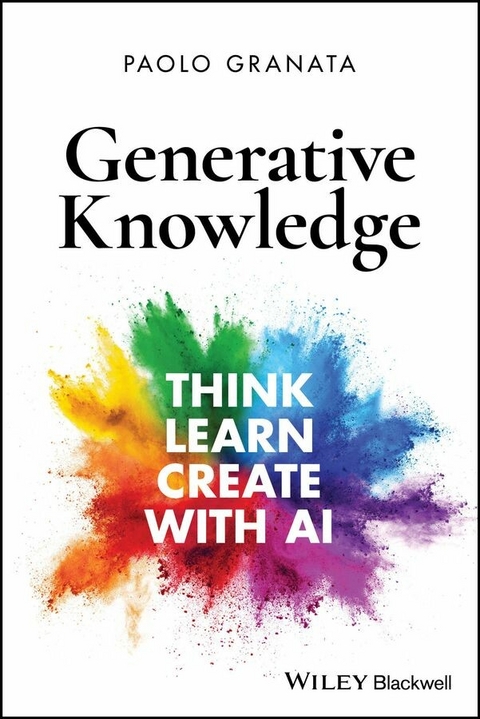
Generative Knowledge (eBook)
364 Seiten
Wiley-Blackwell (Verlag)
978-1-394-36301-8 (ISBN)
Provides a bold conceptual framework for reimagining knowledge creation in the age of artificial intelligence
What does it mean to know in a knowledge economy shaped by artificial intelligence? Generative Knowledge: Think, Learn, Create with AI explores how AI is redefining how we know and especially how knowledge itself is created, shared, and applied. Paolo Granata presents a compelling conceptual framework of Generative Knowledge-a dynamic and socially embedded form of knowing that expands through iterative, collaborative, and tool-mediated processes-showing how human-AI collaboration unlocks creative potential previously unimaginable.
Drawing from a rich intellectual tradition that spans media theory, epistemology, and cognitive science, Generative Knowledge invites readers to rethink what it means to know, not in spite of AI, but in partnership with it. The book is structured around six foundational principles-iteration, instrumentality, sociality, inquiry, learnability, and creativity-developing new forms of critical thinking for the AI age. These principles and the closing portrait of today's 'generative thinkers' mirror Granata's conceptual argument and serve as a model for epistemic engagement, with AI as a cognitive partner to generate new knowledge.
Repositioning AI from a mere tool of automation or productivity enhancer to a co-creative partner in intellectual inquiry, Generative Knowledge:
- Emphasizes the generative mindset-flexible, collaborative, and forward-thinking-for thriving in an AI-enhanced knowledge economy
- Reframes AI as an epistemic technology that mediates and reshapes the human pursuit of understanding
- Provides a transdisciplinary synthesis of media ecology, pragmatist philosophy, cognitive science, and constructionist epistemology for cultivating AI Literacy
- Introduces a new lexicon and a conceptual framework to help readers navigate emerging epistemic and technological paradigms
Generative Knowledge: Think, Learn, Create with AI is ideal for upper-level undergraduate and graduate students in courses such as AI Literacy, Media Theory, Epistemology, Philosophy of Technology, Educational Technology, and Knowledge Management. It is also a valuable resource for educators, researchers, and professionals working in the knowledge economy and knowledge-driven fields within arts, humanities, and interdisciplinary programs.
PAOLO GRANATA is a Professor of Book and Media Studies at the University of Toronto's St. Michael's College and a Fellow at the Schwartz Reisman Institute for Technology and Society. An award-winning educator and internationally recognized media scholar, his work spans media ecology, semiotics, and philosophy of technology. He is the founder and director of the Media Ethics Lab and has held academic positions in Canada, Italy, Brazil, and China.
Provides a bold conceptual framework for reimagining knowledge creation in the age of artificial intelligence What does it mean to know in a knowledge economy shaped by artificial intelligence? Generative Knowledge: Think, Learn, Create with AI explores how AI is redefining how we know and especially how knowledge itself is created, shared, and applied. Paolo Granata presents a compelling conceptual framework of Generative Knowledge a dynamic and socially embedded form of knowing that expands through iterative, collaborative, and tool-mediated processes showing how human-AI collaboration unlocks creative potential previously unimaginable. Drawing from a rich intellectual tradition that spans media theory, epistemology, and cognitive science, Generative Knowledge invites readers to rethink what it means to know, not in spite of AI, but in partnership with it. The book is structured around six foundational principles iteration, instrumentality, sociality, inquiry, learnability, and creativity developing new forms of critical thinking for the AI age. These principles and the closing portrait of today's generative thinkers mirror Granata's conceptual argument and serve as a model for epistemic engagement, with AI as a cognitive partner to generate new knowledge. Repositioning AI from a mere tool of automation or productivity enhancer to a co-creative partner in intellectual inquiry, Generative Knowledge: Emphasizes the generative mindset flexible, collaborative, and forward-thinking for thriving in an AI-enhanced knowledge economy Reframes AI as an epistemic technology that mediates and reshapes the human pursuit of understanding Provides a transdisciplinary synthesis of media ecology, pragmatist philosophy, cognitive science, and constructionist epistemology for cultivating AI Literacy Introduces a new lexicon and a conceptual framework to help readers navigate emerging epistemic and technological paradigms Generative Knowledge: Think, Learn, Create with AI is ideal for upper-level undergraduate and graduate students in courses such as AI Literacy, Media Theory, Epistemology, Philosophy of Technology, Educational Technology, and Knowledge Management. It is also a valuable resource for educators, researchers, and professionals working in the knowledge economy and knowledge-driven fields within arts, humanities, and interdisciplinary programs.
CHAPTER 1
Ars Artificialiter Cognoscendi
Gutenberg's Fingerprint
Scribes and innovators inhabited the same streets of mid‐fifteenth‐century Mainz, though they occupied entirely different worlds. Hunched over his desk, fingers stained with ink, a scribe dips his quill again and again, copying every character with relentless care—a task so demanding that months slip by before anyone turns the finished pages. Across town, another craftsman—inventor, visionary, generative thinker—focuses just as intently on a daring synthesis of skills: goldsmithing, alloying, ink‐making, mechanics, and design, all driven by sheer ingenuity. That fusion will materialize as perhaps humanity's most consequential invention: movable‐type printing.
Gutenberg's invention exemplifies the essence of generative knowledge—which I defined in the Preamble as knowledge that accumulates and then propagates, producing further knowledge in an ongoing and recursive process—and some of its principles: the culmination of existing insights combined into trailblazing innovation (the iterative principle); a pivotal moment in social and cultural history in which technology deepens and reconfigures our modes of inquiry (the instrumental principle); and a decisive mechanism that by leveraging the collective mind of society transformed how new knowledge was generated, preserved, and disseminated (the social principle). Likewise, the other principles of generative knowledge—epistemic curiosity, learnability, and creativity—might have oiled the gears of the Mainz press.
The coming of printing in the mid‐fifteenth century and its swift dispersal across Europe abruptly multiplied the availability of books, enriching the libraries of learned elites while simultaneously reconfiguring entire structures of knowledge dissemination, enabling different groups—printers, church authorities, merchants, monarchs—to leverage print for their own disparate ends. The printed‐word ecosystem thrived wherever a wealthy and literate public, publishing innovators, and supportive infrastructures of patronage and commerce existed, suggesting that technology alone, absent social receptivity, would have been insufficient to satisfy the quest for order with the age of print (Burke 2000).
As literacy rates began a long, if uneven, ascent, the printed page acquired unprecedented authority in disseminating scholarship and shaping belief. It was the character of the medium itself, particularly the “typographical fixity” that printing conferred on texts (Eisenstein 1979, p. 113)—reducing the drift and variation once inevitable in scribal copies while also fostering a new permanence, a textual immortality of sorts—that sparked an entirely new curatorial approach to knowledge. Think, for example, of the immense labor behind the press in preparing an editio princeps—the very first printed edition of a classical text or cherished manuscript—involving collations of various manuscript sources, meticulous correction of scribal inaccuracies, and scholarly hands in determining the text's most authentic form, and so on. Pressed into new habits, readers also acquired new ways of structuring thought in terms of evidence gathering and comparison, fostered by the analytic processes that mirrored the mechanical precision of the printed page itself. These features encouraged a systematic approach to knowledge, a cognitive orientation toward organic evidence, hierarchy, and the logic of linear argumentation—precursors to modern scientific method.
With the clarity of a well‐inked plate, the printing press greatly enriched the early modern knowledge ecosystem, offering an epistemic framework in which uniform editions invited readerships to engage in critical, introspective, unbound analysis. Scholars like Febvre and Martin (1976), Steinberg (2017), and Elizabeth Eisenstein (1979) have substantiated that the printing press played a key role in facilitating a realignment of how knowledge was gathered, generated, verified, circulated, and ultimately integrated into the fabric of the emerging modern society. While not supplanting older forms of textual transmission outright, the printing press as an epistemic technology—whose intrinsic nature is to enhance human knowledge processes, enlarging the bandwidth of perception, memory, inference, and communication—nonetheless enabled modes of standardization, reproducibility, and accessibility that scribal culture could scarcely match, fostering a more autonomous and emancipated relationship to knowledge. This autonomy dovetailed neatly with the revival of empiricism in the Renaissance and the rise of rationalism in the Enlightenment, as self‐directed study of standardized texts engendered a mindset and an intellectual climate where direct observation, experiment, and forms of critical reasoning flourished.
Printers like Aldus Manutius in Venice, Charlotte Guillard in Paris, William Caxton in London saw themselves as scholarly trailblazers and cultural gatekeepers. Their decisions over what to print—and how—were shaped by commercial considerations and, equally, by intellectual aspirations to preserve the classical corpus, articulate new vernacular literatures, and provide an apparatus for what would later become the so‐called Republic of Letters (Fumaroli 2018), marking the transition from a predominantly hermeneutic Middle Ages to a culture increasingly defined by logic, systematization, and empirical discovery, but also characterized by an overwhelming abundance of books (Blair 2003). Such networks of print‐enabled discourse reshaped the knowledge ecosystem of early modern Europe, in which intellectual labor found forms of systematic codification and scrutiny that would have been unimaginable under the slower propagation methods of scribal culture. Perhaps most significantly, printing's normalization of texts, as mentioned above, established the epistemic underpinnings necessary for science as it developed from the seventeenth century onward. Such adaptivity recalls what Paul Humphreys (2004) terms epistemic enhancements, in which technology deepens and reconfigures our modes of inquiry. In essence, the movable type enabled the refinement, replication, and circulation of ideas in ways hitherto unimaginable, giving tangible form to what might be properly called movable knowledge.
Interfaces for Knowledge
As Gutenberg's enduring imprint on early modern Europe, the printing press fundamentally recast the book, consecrating it as the quintessential interface for knowledge and underwriting the sweeping transformations in culture and modes of thought that Marshall McLuhan (1962) recognized as defining features of what he pithily called the Gutenberg Galaxy. This epistemic order was understood less as a phase of technologically determined substitution or innovation—McLuhan was a media ecologist, not a technological determinist (Gordon 2010; Granata 2021)—and more as an expansive, epoch‐defining reconfiguration in the very mental, social, and cultural patterns by which knowledge was encountered, structured, conferred legitimacy, and ultimately generated. As a knowledge interface, the book functioned like a generative medium through which institutions fostered, maintained, transmitted, and often imposed their intellectual life, mediating the very ways communities come to conceive, challenge, and renew knowledge—a dynamic that has shaped institutional practices for centuries and continues to reverberate in the structures we still depend on for research, education, and innovation, orchestrating the conditions under which we access, produce, and circulate knowledge.
Bound to these transformations, printing not only enabled already existing knowledge to be reconstituted, retrieved, and reimagined—mirroring the iterative principle of generative knowledge, according to which generative knowledge grows from existing knowledge—but also, by allowing strong critique and cross‐pollination of ideas among scholars scattered across Europe, actively facilitated new ways of thinking—the social principle—so illustrating how a strong epistemic technology does magnify intellectual capacities throughout whole networks of users—the instrumental principle—and rebalance a whole cultural and social environment, integrating scattered communities of inquiry into a collective knowledge‐making enterprise.
Hot off the press, each print run fostered ongoing experimentation, networked collaborations, and the rigorous exchange of ideas that, reorganizing the world of learning (Burke 2000), ultimately shaped the foundational structures of early modern intellectual life. Imprinted by this revolution, we witness the essence of epistemic technologies: their role is not additive; it is ecological. The epistemic ecosystem of any given era depends as much on the content of knowledge flowing through it as on the material and technological substrates through which that knowledge is mediated, substrates that in turn become part of the ecosystem within which knowledge grows, spreads, and evolves.
One can now see more clearly why I chose to emphasize the role of the printing press as an interface for knowledge. Today, in this unfolding AI age, we evidently find ourselves grappling with a similar pattern of large‐scale shifts in how knowledge is generated, validated, and disseminated. In pursuit of...
| Erscheint lt. Verlag | 23.9.2025 |
|---|---|
| Sprache | englisch |
| Themenwelt | Mathematik / Informatik ► Informatik ► Theorie / Studium |
| Schlagworte | AI epistemology • AI generativity • AI intellectual creativity • AI knowledge creation • AI literacy • artificial intelligence generative knowledge • critical thinking • Epistemic Virtues • generative knowledge • generative knowledge framework • generative knowledge textbook • generative knowledge theory • generative thinking • Human-AI Collaboration • Knowledge Society |
| ISBN-10 | 1-394-36301-X / 139436301X |
| ISBN-13 | 978-1-394-36301-8 / 9781394363018 |
| Informationen gemäß Produktsicherheitsverordnung (GPSR) | |
| Haben Sie eine Frage zum Produkt? |
 EPUB (Adobe DRM)
Kopierschutz: Adobe-DRM
Adobe-DRM ist ein Kopierschutz, der das eBook vor Mißbrauch schützen soll. Dabei wird das eBook bereits beim Download auf Ihre persönliche Adobe-ID autorisiert. Lesen können Sie das eBook dann nur auf den Geräten, welche ebenfalls auf Ihre Adobe-ID registriert sind.
Details zum Adobe-DRM
Dateiformat: EPUB (Electronic Publication)
EPUB ist ein offener Standard für eBooks und eignet sich besonders zur Darstellung von Belletristik und Sachbüchern. Der Fließtext wird dynamisch an die Display- und Schriftgröße angepasst. Auch für mobile Lesegeräte ist EPUB daher gut geeignet.
Systemvoraussetzungen:
PC/Mac: Mit einem PC oder Mac können Sie dieses eBook lesen. Sie benötigen eine
eReader: Dieses eBook kann mit (fast) allen eBook-Readern gelesen werden. Mit dem amazon-Kindle ist es aber nicht kompatibel.
Smartphone/Tablet: Egal ob Apple oder Android, dieses eBook können Sie lesen. Sie benötigen eine
Geräteliste und zusätzliche Hinweise
Buying eBooks from abroad
For tax law reasons we can sell eBooks just within Germany and Switzerland. Regrettably we cannot fulfill eBook-orders from other countries.
aus dem Bereich