


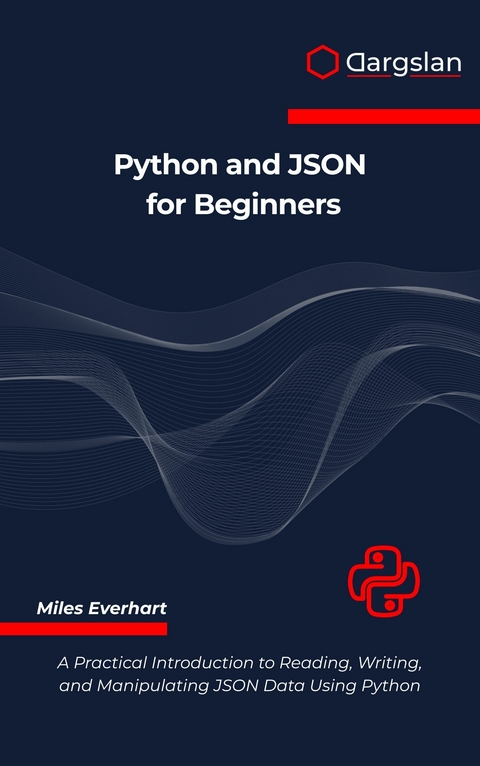
Python and JSON for Beginners (eBook)
360 Seiten
Dargslan s.r.o. (Verlag)
978-0-00-105879-8 (ISBN)
Master JSON Data Handling in Python with This Complete Beginner's Guide
Transform your Python programming skills with the essential guide to JSON data manipulation. 'Python and JSON for Beginners' is your comprehensive roadmap to mastering one of today's most critical programming skills - seamlessly working with JSON data using Python's powerful built-in capabilities.
Why This Book Is Essential for Every Python Developer
In our data-driven world, JSON has become the universal language of web APIs, configuration files, and data exchange. This practical guide bridges the gap between basic Python knowledge and real-world JSON implementation, giving you the confidence to handle any data challenge.
What You'll Master:
Python's built-in json module and all its powerful features
Reading JSON from files, APIs, and external sources effortlessly
Writing clean, well-formatted JSON output for any application
Manipulating complex nested data structures with Python's intuitive syntax
Advanced error handling strategies specific to JSON operations
API integration patterns and best practices
Custom serialization techniques for complex data types
Performance optimization for large JSON datasets
Data validation and formatting for production applications
Learn Through Hands-On Practice
Every concept is reinforced with practical examples and real-world scenarios. You'll work with actual APIs, process configuration files, and build data manipulation scripts that you can immediately apply to your projects. The progressive structure ensures you build solid foundations before tackling advanced topics.
From Beginner to Expert in 12 Comprehensive Chapters
Starting with Python basics and JSON syntax, you'll progress through reading and writing data, advanced manipulation techniques, and professional-grade error handling. The journey culminates with API integration, validation strategies, and performance optimization - everything you need for production applications.
Bonus Resources Included:
Complete Python json module reference
Curated list of practice APIs
Ready-to-use JSON templates
Perfect For:
Python beginners expanding their skillset
Web developers working with APIs
Data analysts processing JSON datasets
Anyone building modern applications
Why Python and JSON?
Python's elegant syntax perfectly complements JSON's lightweight structure, creating an unbeatable combination for modern development. This book teaches you to leverage Python's strengths - readability, powerful data structures, and extensive libraries - to become proficient in JSON handling.
Real-World Applications You'll Master:
Web scraping and API consumption
Configuration management
Data processing and analysis
Start Building Professional Applications Today
Whether you're automating data tasks, building web applications, or integrating with external services, this book provides the practical knowledge you need. Learn not just the 'how' but the 'why' behind best practices, enabling you to write maintainable, scalable code.
Your Complete Learning Package
With clear explanations, practical examples, and comprehensive appendices, this book serves as both learning guide and reference manual. The skills you'll develop extend far beyond JSON - you'll gain deeper Python expertise and data handling confidence that applies across all programming domains.
Transform your Python capabilities today. Master JSON handling and unlock new possibilities for your programming projects.
Chapter 1: Introduction to JSON and Python
Understanding the Digital Language of Modern Applications
In the vast landscape of modern software development, data flows like rivers between applications, services, and systems. At the heart of this digital ecosystem lies a fundamental challenge: how do we enable different programs, written in different languages, running on different platforms, to communicate effectively? The answer to this challenge has largely been solved through the adoption of standardized data interchange formats, with JSON (JavaScript Object Notation) emerging as one of the most prevalent and powerful solutions.
JSON represents more than just a data format; it embodies the principles of simplicity, readability, and universal compatibility that have made it the backbone of modern web applications, APIs, and data storage systems. When combined with Python's elegant syntax and powerful data manipulation capabilities, JSON becomes an incredibly versatile tool for handling structured information in ways that are both intuitive and efficient.
This chapter serves as your comprehensive introduction to the world of JSON and Python, establishing the foundational knowledge necessary to understand, manipulate, and leverage these technologies effectively. We will explore the historical context that led to JSON's creation, examine its structural principles, and demonstrate how Python's built-in capabilities make it an ideal language for working with JSON data.
What is JSON?
The Genesis of a Universal Data Format
JSON, which stands for JavaScript Object Notation, emerged from the need for a lightweight, text-based data interchange format that could be easily read by both humans and machines. Despite its name suggesting a connection to JavaScript, JSON has transcended its origins to become a language-independent standard that serves as the lingua franca of modern data exchange.
The format was originally specified by Douglas Crockford in the early 2000s, drawing inspiration from JavaScript's object literal notation syntax. However, JSON's design philosophy prioritized simplicity and universality over language-specific features, resulting in a format that could be easily parsed and generated by virtually any programming language.
Core Characteristics and Design Philosophy
JSON's success stems from several key characteristics that make it exceptionally well-suited for data interchange:
Human Readability: Unlike binary formats or complex markup languages, JSON maintains a clear, intuitive structure that developers can easily read and understand without specialized tools. This readability significantly reduces debugging time and makes data inspection straightforward.
Lightweight Structure: JSON's minimalist approach to syntax means that data can be represented with minimal overhead. The format uses only a small set of structural elements, making it efficient for network transmission and storage.
Language Independence: While derived from JavaScript syntax, JSON is completely language-agnostic. This universality means that a JSON document created by a Python application can be seamlessly consumed by a Java service, a JavaScript frontend, or any other system with JSON parsing capabilities.
Hierarchical Organization: JSON naturally supports nested data structures, allowing for the representation of complex relationships and hierarchies within a single document. This capability makes it ideal for representing real-world data that often exhibits multi-level relationships.
JSON Syntax and Structure
Understanding JSON's syntax is crucial for effective data manipulation. The format is built upon a small set of structural elements that combine to create powerful data representations:
Basic Data Types
JSON supports six fundamental data types, each serving specific purposes in data representation:
Strings: Text data enclosed in double quotes, supporting Unicode characters and escape sequences. Strings in JSON must always use double quotes, never single quotes.
{
"name": "John Doe",
"description": "A software developer with expertise in Python and JSON"
}
Numbers: Numeric values represented in decimal notation, supporting both integers and floating-point numbers. JSON does not distinguish between different numeric types at the format level.
{
"age": 30,
"salary": 75000.50,
"temperature": -15.7
}
Booleans: Logical values represented as true or false (lowercase only).
{
"isActive": true,
"hasPermissions": false
}
Null: Represents the absence of a value, denoted as null.
{
"middleName": null,
"optionalField": null
}
Complex Data Structures
JSON's power becomes apparent when working with complex data structures:
Objects: Collections of key-value pairs enclosed in curly braces, where keys are always strings and values can be any valid JSON data type.
{
"person": {
"firstName": "Jane",
"lastName": "Smith",
"contact": {
"email": "jane.smith@example.com",
"phone": "+1-555-0123"
}
}
}
Arrays: Ordered lists of values enclosed in square brackets, where values can be of mixed types.
{
"skills": ["Python", "JavaScript", "SQL"],
"scores": [95, 87, 92, 88],
"mixed": [1, "text", true, null, {"nested": "object"}]
}
JSON Validation and Best Practices
Valid JSON must adhere to strict syntactic rules:
Rule
Description
Example
String Delimiters
All strings must use double quotes
"valid" not 'invalid'
Key Requirements
Object keys must be strings
{"key": "value"}
Trailing Commas
No trailing commas allowed
[1, 2, 3] not [1, 2, 3,]
Root Element
Must be object or array
{} or []
Escape Sequences
Special characters must be escaped
"He said /"Hello/""
Why Python for JSON?
Python's Natural Affinity for JSON
Python's relationship with JSON is remarkably harmonious, stemming from fundamental similarities in their design philosophies and data representation approaches. Both technologies prioritize readability, simplicity, and intuitive structure, making Python an ideal language for JSON manipulation.
The correspondence between Python's native data types and JSON's structure creates a nearly seamless translation layer. Python dictionaries map directly to JSON objects, Python lists correspond to JSON arrays, and Python's basic data types (strings, numbers, booleans, and None) have direct JSON equivalents. This natural alignment means that working with JSON in Python feels intuitive rather than forced.
Built-in JSON Support
Python's standard library includes the json module, providing comprehensive functionality for JSON parsing, generation, and manipulation without requiring external dependencies. This built-in support ensures that JSON capabilities are available in any Python environment, from local development setups to production servers.
The json module offers both high-level functions for common operations and lower-level classes for advanced use cases. This flexibility allows developers to choose the appropriate level of abstraction for their specific needs, whether they're performing simple data conversions or implementing custom serialization logic.
Performance and Efficiency Considerations
Python's JSON implementation is optimized for both performance and memory efficiency. The underlying C implementation of the JSON parser provides excellent performance characteristics, while Python's garbage collection and memory management ensure efficient resource utilization even when processing large JSON documents.
For applications requiring extreme performance,...
| Erscheint lt. Verlag | 22.9.2025 |
|---|---|
| Sprache | englisch |
| Themenwelt | Mathematik / Informatik ► Informatik ► Programmiersprachen / -werkzeuge |
| ISBN-10 | 0-00-105879-7 / 0001058797 |
| ISBN-13 | 978-0-00-105879-8 / 9780001058798 |
| Informationen gemäß Produktsicherheitsverordnung (GPSR) | |
| Haben Sie eine Frage zum Produkt? |
 EPUB (Adobe DRM)
Größe: 1,1 MB
Kopierschutz: Adobe-DRM
Adobe-DRM ist ein Kopierschutz, der das eBook vor Mißbrauch schützen soll. Dabei wird das eBook bereits beim Download auf Ihre persönliche Adobe-ID autorisiert. Lesen können Sie das eBook dann nur auf den Geräten, welche ebenfalls auf Ihre Adobe-ID registriert sind.
Details zum Adobe-DRM
Dateiformat: EPUB (Electronic Publication)
EPUB ist ein offener Standard für eBooks und eignet sich besonders zur Darstellung von Belletristik und Sachbüchern. Der Fließtext wird dynamisch an die Display- und Schriftgröße angepasst. Auch für mobile Lesegeräte ist EPUB daher gut geeignet.
Systemvoraussetzungen:
PC/Mac: Mit einem PC oder Mac können Sie dieses eBook lesen. Sie benötigen eine
eReader: Dieses eBook kann mit (fast) allen eBook-Readern gelesen werden. Mit dem amazon-Kindle ist es aber nicht kompatibel.
Smartphone/Tablet: Egal ob Apple oder Android, dieses eBook können Sie lesen. Sie benötigen eine
Geräteliste und zusätzliche Hinweise
Buying eBooks from abroad
For tax law reasons we can sell eBooks just within Germany and Switzerland. Regrettably we cannot fulfill eBook-orders from other countries.
aus dem Bereich


