


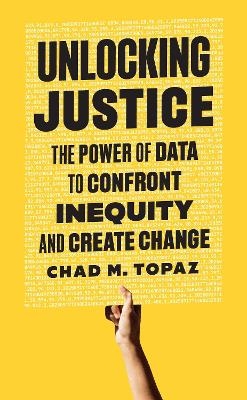
Unlocking Justice
The Power of Data to Confront Inequity and Create Change
Seiten
2026
Princeton University Press (Verlag)
978-0-691-27615-1 (ISBN)
Princeton University Press (Verlag)
978-0-691-27615-1 (ISBN)
- Noch nicht erschienen (ca. Mai 2026)
- Portofrei ab CHF 40
- Auch auf Rechnung
- Artikel merken
How we can challenge social injustice—with data and humanity
The American legal system does not offer equal justice to all; we can see obvious racial disparities in sentencing, policing, and incarceration. In Unlocking Justice, Chad Topaz offers a concrete way forward, demonstrating how a candid dialogue between social justice and data science can empower communities, spark informed debate, and inspire advocacy. In addition to big ideas, Topaz brings the receipts—the data. Drawing on unedited police call logs, chaotic city websites, fragmented judicial records, and other overlooked sources, Topaz explains how social forces shape the data we collect, influencing whose voices are heard and whose remain unheard. From a rural New England town plagued by police misconduct to New York’s notorious Rikers Island jail, the stories Topaz tells demonstrate how numbers can expose injustice—and how data can underpin activism.
Topaz shows readers how to interpret data in context and question underlying assumptions, providing even those who might be math-averse with practical tools to challenge inequities. He takes readers through his own data science activism, including an examination of public judicial data that revealed the identities of judges who imposed excessive bail; a data-driven investigation of racial disparities in policing, prompted by a police station’s openly displayed portrait of Hitler; and an analysis of Florida’s controversial risk algorithm, COMPAS, for racial bias. The book’s “Show Your Work” companion website connects readers to data sources and the studies behind the stories. When we are armed with the facts and the numbers, Topaz assures us, we can all be effective advocates for transparency, accountability, and justice.
The American legal system does not offer equal justice to all; we can see obvious racial disparities in sentencing, policing, and incarceration. In Unlocking Justice, Chad Topaz offers a concrete way forward, demonstrating how a candid dialogue between social justice and data science can empower communities, spark informed debate, and inspire advocacy. In addition to big ideas, Topaz brings the receipts—the data. Drawing on unedited police call logs, chaotic city websites, fragmented judicial records, and other overlooked sources, Topaz explains how social forces shape the data we collect, influencing whose voices are heard and whose remain unheard. From a rural New England town plagued by police misconduct to New York’s notorious Rikers Island jail, the stories Topaz tells demonstrate how numbers can expose injustice—and how data can underpin activism.
Topaz shows readers how to interpret data in context and question underlying assumptions, providing even those who might be math-averse with practical tools to challenge inequities. He takes readers through his own data science activism, including an examination of public judicial data that revealed the identities of judges who imposed excessive bail; a data-driven investigation of racial disparities in policing, prompted by a police station’s openly displayed portrait of Hitler; and an analysis of Florida’s controversial risk algorithm, COMPAS, for racial bias. The book’s “Show Your Work” companion website connects readers to data sources and the studies behind the stories. When we are armed with the facts and the numbers, Topaz assures us, we can all be effective advocates for transparency, accountability, and justice.
Chad M. Topaz is professor of complex systems at Williams College and cofounder of the QSIDE Institute, which uses data science to promote equity and justice. An award-winning educator and researcher recognized by the National Academy of Sciences, the Association for Women in Mathematics, and the Society for Industrial and Applied Mathematics, he has written numerous studies at the intersection of data science, social justice, and public policy. His opinion pieces have appeared in The Chicago Tribune, The New York Daily News, The Philadelphia Inquirer, Inside Higher Ed, and other publications.
| Erscheint lt. Verlag | 19.5.2026 |
|---|---|
| Zusatzinfo | 10 b/w illus. |
| Verlagsort | New Jersey |
| Sprache | englisch |
| Maße | 140 x 216 mm |
| Themenwelt | Mathematik / Informatik ► Mathematik ► Angewandte Mathematik |
| Sozialwissenschaften ► Politik / Verwaltung ► Politische Systeme | |
| Sozialwissenschaften ► Politik / Verwaltung ► Staat / Verwaltung | |
| Sozialwissenschaften ► Soziologie | |
| ISBN-10 | 0-691-27615-3 / 0691276153 |
| ISBN-13 | 978-0-691-27615-1 / 9780691276151 |
| Zustand | Neuware |
| Informationen gemäß Produktsicherheitsverordnung (GPSR) | |
| Haben Sie eine Frage zum Produkt? |
Mehr entdecken
aus dem Bereich



aus dem Bereich
Buch | Softcover (2025)
Springer Vieweg (Verlag)
CHF 62,95
Buch | Softcover (2025)
Springer Fachmedien Wiesbaden (Verlag)
CHF 69,95
Buch | Softcover (2024)
Springer Vieweg (Verlag)
CHF 53,15


