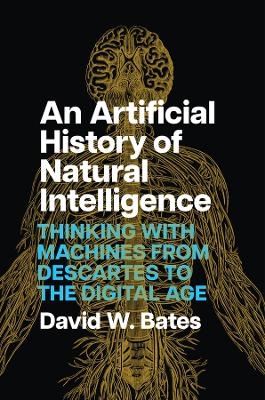
An Artificial History of Natural Intelligence
University of Chicago Press (Verlag)
978-0-226-84914-0 (ISBN)
- Noch nicht erschienen (ca. März 2026)
- Versandkostenfrei
- Auch auf Rechnung
- Artikel merken
We imagine that we are both in control of and controlled by our bodies—autonomous and yet automatic. This entanglement, according to David W. Bates, emerged in the seventeenth century when humans first built and compared themselves with machines. Reading varied thinkers from Descartes to Kant to Turing, Bates reveals how time and time again technological developments offered new ways to imagine how the body’s automaticity worked alongside the mind’s autonomy. Tracing these evolving lines of thought, An Artificial History of Natural Intelligence offers a new theorization of the human as a being that is dependent on technology and produces itself as an artificial automaton without a natural, outside origin.
David W. Bates is professor of rhetoric at the University of California, Berkeley. He is the author of three books, including Enlightenment Aberrations: Error and Revolution in France.
Frame
1. Autonomy and Automaticity: On the Contemporary Question of Intelligence
Part One: The Automatic Life of Reason in Early Modern Thought
2. Integration and Interruption: The Cartesian Thinking Machine
3. Spiritual Automata: From Hobbes to Spinoza
4. Spiritual Automata Revisited: Leibniz and Automatic Harmony
5. Hume’s Enlightened Nervous System
Threshold: Kant’s Critique of Automatic Reason
6. The Machinery of Cognition in the First Critique
7. The Pathology of Spontaneity: The Critique of Judgment and Beyond
Part Two: Embodied Logics of the Industrial Age
8. Babbage, Lovelace, and the Unexpected
9. Psychophysics: On the Physio-Technology of Automatic Reason
10. Singularities of the Thermodynamic Mind
11. The Dynamic Brain
12. Prehistoric Humans and the Technical Evolution of Reason
13. Creative Life and the Emergence of Technical Intelligence
Prophecy: The Future of Extended Minds
14. Technology Is Not the Liberation of the Human but Its Transformation . . .
Part Three: Crises of Order: Thinking Biology and Technology between the Wars
15. Techniques of Insight
16. Brains in Crisis, Psychic Emergencies
17. Bio-Technicity in Von Uexküll
18. Lotka on the Evolution of Technical Humanity
19. Thinking Machines
20. A Typology of Machines
21. Philosophical Anthropology: The Human as Technical Exteriorization
Hinge: Prosthetics of Thought
22. Wittgenstein on the Immateriality of Thinking
Part Four: Thinking Outside the Body
23. Cybernetic Machines and Organisms
24. Automatic Plasticity and Pathological Machines
25. Turing and the Spirit of Error
26. Epistemologies of the Exosomatic
27. Leroi-Gourhan on the Technical Origin of the Exteriorized Mind
The Beginning of an End
28. Technogenesis in the Networked Age
29. Failures of Anticipation: The Future of Intelligence in the Era of Machine Learning
Acknowledgments
Notes
Index
| Erscheint lt. Verlag | 11.3.2026 |
|---|---|
| Zusatzinfo | 15 halftones |
| Sprache | englisch |
| Maße | 152 x 229 mm |
| Gewicht | 454 g |
| Themenwelt | Geisteswissenschaften ► Philosophie |
| Mathematik / Informatik ► Informatik | |
| ISBN-10 | 0-226-84914-7 / 0226849147 |
| ISBN-13 | 978-0-226-84914-0 / 9780226849140 |
| Zustand | Neuware |
| Informationen gemäß Produktsicherheitsverordnung (GPSR) | |
| Haben Sie eine Frage zum Produkt? |
aus dem Bereich