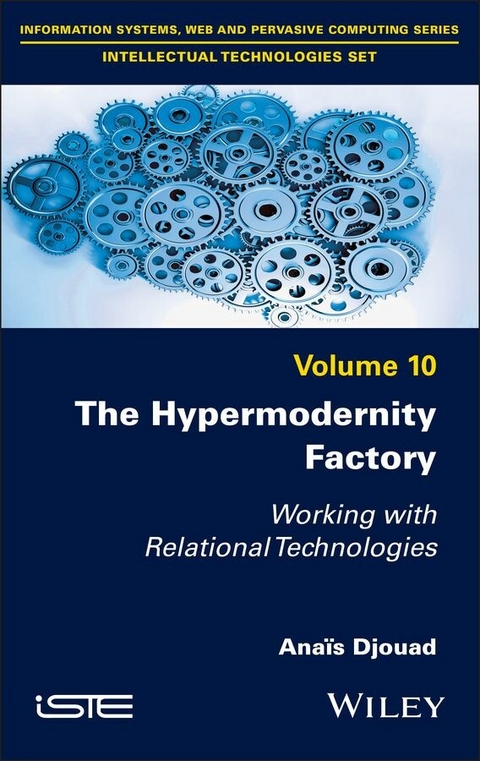
The Hypermodernity Factory (eBook)
378 Seiten
Wiley-Iste (Verlag)
978-1-394-41123-8 (ISBN)
The digital regime and its bio-anthropotechnology, characteristic of hypermodernity, are giving rise to unprecedented living and working conditions. Relational, inter-individual and exchange systems are being transformed. Technologies bring new ways of communicating, speaking, writing, organizing and controlling tasks. They are explicit, but their reticularities also operate invisibly, underground. However, they define powerful norms for work.
Beyond the digital object, at the heart of the computerization process of the last fifty years in France, a progressive transformation of the work regime has taken place. As our social ecologies adapt, adopt, conform and metamorphose, conflict, polemics and sometimes creative resistance emerge.
The Hypermodernity Factory is based on an investigation carried out within an administrative department of Inria (the French public institute for research into information technology and techniques) - then in the midst of a social crisis - to discern psychic and collective individuation processes, in a context of instability and specific communication difficulties. Immersed in these almost disruptive anthropotechnical conditions, and subject to unavoidable processes of subjectivation, the subject of office life, from manager to employee, finds themselves in a confused situation; they are constantly living a complex experience of their own in the hybrid, dynamic evolution of the digital regime.
Anaïs Djouad, after various assignments in the public and private sectors, became a game designer during the serious games boom. In 2022, she defended her sociology thesis at the EHESS; she is now a sociologist and teacher.
The digital regime and its bio-anthropotechnology, characteristic of hypermodernity, are giving rise to unprecedented living and working conditions. Relational, inter-individual and exchange systems are being transformed. Technologies bring new ways of communicating, speaking, writing, organizing and controlling tasks. They are explicit, but their reticularities also operate invisibly, underground. However, they define powerful norms for work. Beyond the digital object, at the heart of the computerization process of the last fifty years in France, a progressive transformation of the work regime has taken place. As our social ecologies adapt, adopt, conform and metamorphose, conflict, polemics and sometimes creative resistance emerge. The Hypermodernity Factory is based on an investigation carried out within an administrative department of Inria (the French public institute for research into information technology and techniques) then in the midst of a social crisis to discern psychic and collective individuation processes, in a context of instability and specific communication difficulties. Immersed in these almost disruptive anthropotechnical conditions, and subject to unavoidable processes of subjectivation, the subject of office life, from manager to employee, finds themselves in a confused situation; they are constantly living a complex experience of their own in the hybrid, dynamic evolution of the digital regime.
1
Company, Employees, Society and Technology
1.1. Introduction
In France, whether employed or self-employed, we spend over 1,600 hours a year at work. It seems that, on average, we spend 80% of our time using digital devices1.
Space, whether related to the question of time or not, opens the door to an anthropic relationship with our work: a lifetime devoted to work, time fragmented by the fragmentation of space dedicated to working time. Working time absorbs personal time, which is the result of overlaps between social spheres. In the digital age, work fragments time and space in unprecedented ways.
The new frameworks, spaces and assemblages of working life, the new communication dimensions and the new symbolism of time that have arisen from the digitization of work are part of what we call the new semantics of management. This is a new semantics, since an assemblage seems to be the most innovative feature of managerial ideology. This is an assemblage of the new ideas of the hypermodern company, its spirit, its ethics and its sociality and an assemblage of space that contributes to the text (as understood by Roland Barthes), to the aestheticization of the corporate world. We could ask whether a new semantics is a genuine revolution or a result of social norms and frameworks that just tend towards an ideology of the working society, whose praxeology would be unattainable.
This is why we want to highlight the growing difficulties that the actors have to deal with at work to give concrete meaning to their day-to-day activities, with the opening hypothesis that this loss of meaning is an integral part of a management style that we consider here to be paradoxical (Gaulejac and Hanique 2015). The evolution of communication and information technologies has transformed our relationship with the world, often suggesting two human societies: the one before information and communication technologies and the one after.
In addition to the social functions of work, we know that it is an activity that predestines us to social typologies outside the company, just as much as our origins and social characteristics seem to destine us to certain sectors and types of employment (Quijoux 2015). Individual and collective identities, everyday languages, strategies and organizations of social life, encounters, geographical locations and opportunities for advancement in fields of knowledge are those that we develop outside of work. During the apprenticeship period (choice or otherwise of schools and universities, geographical location of studies, first job, etc.), and then in the course of the professional situations we encounter, our social existence is largely influenced by the choices we make; we build ourselves, as it were, around the idea we have of work, and then around its practice. Work culture is part of a wider culture. Both influence one another (Sainsaulieu and Alter 2014). ICT, the artifacts that enable the renewal of this work culture, have the particularity of being technological devices that are present in all our spheres of life, and whose functions and modes of operation have situational, aesthetic and functional similarities that are sometimes puzzling.
The individual, both subject and actor in daily work life, undergoes and builds communication systems that serve “purely” professional objectives and “purely” social objectives (Moscovici et al. 2008), inherent to their social condition as an actor-subject, with a view to inclusion and evolution within the work context. Individuals will build mediation strategies according to their expectations of rewards (beyond salary) and according to the levels of social inclusion they have set for themselves.
These modes of interaction are an integral part of telecommunicative action2 and have obvious social functions in everyday working life, which is a social space like any other. In an environment in crisis, deep-rooted changes are occurring, social representations are being shaken up and normative models are being disrupted.
In the industrial era, then the post-industrial era, every discourse carries the following two objects with it: the social and cultural aspects of work. Work remains what it is, but with other possible forms of existence. The discourse that supports them uses means of control that are visible today, but awareness of these alienating forms does not prevent them.
It is still rare to find French studies that take into account the interrelationship between the cultural mutations in society, generated by the use of ICT, and the new patterns of subjection to work activity in companies. In this context, we raise the question of management ethics, pointing out that ICT are dependent on modes of use in their control function. We do this without entering into a functionalist or interactionist analysis of ICT, which in fact removes the possibility of truly shifting the game of subjugation from (capitalist) power and its ideological drivers.
In the sciences, the information era highlights the difficulty of linking research in information and communication sciences with sociology. Let us just say that ICT are observed as mechanistic drivers, dependent on a single corporate requirement or decision to use (implement). Their interactive nature is set aside or relegated to psychological, medical or pathological analyses of the ICT user or, often, to positivist conceptual analyses of their implementation through management, information and communication sciences. This is perhaps the case because the scientific tradition in telematics is to define tools as communicational objects that influence our communications, but do not hinder our communicational patterns.
Nevertheless, it is fair to say that corporate culture in the service sector is genetically enabled by new communication and information management systems: new technical systems and new ideas. The four social groups that have developed most rapidly over the last 30 years (since the 1970s) are the professions of health, education, communication and business services. This transformation is made possible by the abstraction of cerebral logic that only the computer has been able to realize3. It is indeed the interdependencies and interactions in our communication patterns that are being deviated from their standards, by tools that still seem, at this stage, to reproduce those standards.
In a paradigm that criticizes the work system as a system of subjection, the two mechanisms detailed by sociologists are the game of decision-making (strategic management) and adherence to the production process (operational management). Decision-making is now in the hands of agents and computers, and this is one of the major changes in work processes. The ability to produce data will gradually reshape these processes.
The renewal of sociological methods with social psychology and CIS4, and the close link between research activity and the social field of work, seem to be closely linked to the development of overlapping dialogue between the world of work and the French social sciences. These overlaps constitute a new sociology, whose productions are often seen as structuralist or pragmatic drifts, as Geneviève Vidal points out with the expression “sociological marketing” (Vidal 2012). The drift noted by the communications sociologist is that sociological research into the use of ICT in business does not integrate a contrasting relationship to the use of ICT, in that it is a potential regulator of organizational ideology, and therefore, beyond new communications situations, there is a reappropriation by the management of standard communications devices, a reappropriation that is enabled by the sociological analyses themselves. In a way, it echoes the critical view taken by Jérôme Denis (2009) and Serge Proulx’s (2015) observations of uses that exclude a dissociative analysis of the nature of the object and its role in the social organization of work. It is as if the field of functionalist analysis of ICT usage were reserved for the information and communication sciences, whereas the social structure that enables activity could only be analyzed structurally when technological devices are taken into account. Functions and structures are thus dissociated, and the social field is relegated to the status of a functional system. By excluding the interdisciplinarity required for the advent of ICT in the workplace, sociology seems to be slowing down its ability to evolve its review of the ideological system in place by depriving itself of research developments in the field of cognition, social behavior and the psychology of the actor in action.
However, the information era is one in which the new ideological mechanisms of the company are developing (Buisson 2008). For us, it is the illustration of an ideological rearrangement that is taking place in the context of a cultural, economic and social crisis that extends beyond the company. A new type of management is emerging from a managerial praxeology (Vidal 2012) that, while still affiliating itself with the sciences, seeks to develop new production strategies. In this praxeology, the role of ICT is seen as a means of disrupting and rescaling social relations in a productive, positive logic.
Managerial ideology and its revealed mechanisms have, paradoxically, only served to reinforce the principle of servitude or to use Thomas Heller’s term, subjugation (Heller 2009). Although “varied” forms of wage-earning and its organization exist today, a system...
| Erscheint lt. Verlag | 12.9.2025 |
|---|---|
| Reihe/Serie | ISTE Invoiced |
| Sprache | englisch |
| Themenwelt | Mathematik / Informatik ► Informatik ► Theorie / Studium |
| Schlagworte | bio-anthropotechnology • computerization • Hypermodernity • Individuation • inria • Subjectivation |
| ISBN-10 | 1-394-41123-5 / 1394411235 |
| ISBN-13 | 978-1-394-41123-8 / 9781394411238 |
| Informationen gemäß Produktsicherheitsverordnung (GPSR) | |
| Haben Sie eine Frage zum Produkt? |
 EPUB (Adobe DRM)
Kopierschutz: Adobe-DRM
Adobe-DRM ist ein Kopierschutz, der das eBook vor Mißbrauch schützen soll. Dabei wird das eBook bereits beim Download auf Ihre persönliche Adobe-ID autorisiert. Lesen können Sie das eBook dann nur auf den Geräten, welche ebenfalls auf Ihre Adobe-ID registriert sind.
Details zum Adobe-DRM
Dateiformat: EPUB (Electronic Publication)
EPUB ist ein offener Standard für eBooks und eignet sich besonders zur Darstellung von Belletristik und Sachbüchern. Der Fließtext wird dynamisch an die Display- und Schriftgröße angepasst. Auch für mobile Lesegeräte ist EPUB daher gut geeignet.
Systemvoraussetzungen:
PC/Mac: Mit einem PC oder Mac können Sie dieses eBook lesen. Sie benötigen eine
eReader: Dieses eBook kann mit (fast) allen eBook-Readern gelesen werden. Mit dem amazon-Kindle ist es aber nicht kompatibel.
Smartphone/Tablet: Egal ob Apple oder Android, dieses eBook können Sie lesen. Sie benötigen eine
Geräteliste und zusätzliche Hinweise
Buying eBooks from abroad
For tax law reasons we can sell eBooks just within Germany and Switzerland. Regrettably we cannot fulfill eBook-orders from other countries.
aus dem Bereich