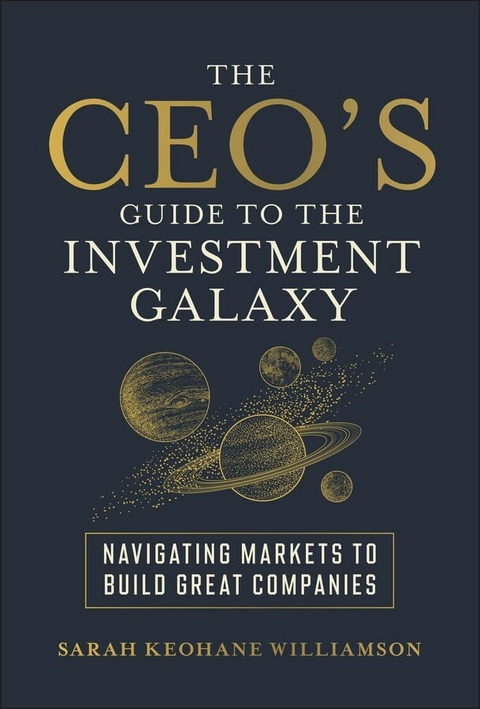
The CEO's Guide to the Investment Galaxy (eBook)
318 Seiten
Wiley (Verlag)
978-1-394-32674-7 (ISBN)
Navigate the investment community with confidence to build great companies
The CEO's Guide to the Investment Galaxy by Sarah Keohane Williamson provides indispensable insights for business leaders navigating the landscape of the global investment community. Not all shareholders are created equal. Knowing who your shareholders and the other members of the investment community are-and what drives them-is key to your success. Whether you're stepping into a CEO role at an established company or spearheading a promising start-up, this guide demystifies the diverse members of the investment community you will encounter, from pension funds to private equity firms to proxy advisors, and provides practical advice to help attract the shareholders who can support you in building a great company.
Williamson draws on her extensive research of and experience with the investment community to deliver actionable strategies for engaging with shareholders and insulating your company from short-term pressures. The book offers a roadmap to effective communication and capital raising, helping you succeed in today's complex business environment-and fortify you against future challenges.
Inside the book:
- Gain insights into the personalities, motivations, and strategies of various investor types
- Learn effective communication tactics to manage investor expectations
- Explore practical approaches to aligning your business with long-term investment goals
The CEO's Guide to the Investment Galaxy is written for CEOs, board members, business leaders, and entrepreneurs looking to deepen their understanding of the investor landscape to fuel long-term company performance. It's also invaluable for journalists, policymakers, investors, and students aiming to grasp the nuances of modern of corporate finance.
SARAH KEOHANE WILLIAMSON is the CEO of FCLTGlobal, a nonprofit organization that mobilizes companies and investors to focus capital on the long-term to build lasting financial security for savers, businesses, and communities. Under her leadership, FCLTGlobal develops innovative, practical research and builds a global community of CEOs focused on solving long-term challenges across global capital markets.
Williamson assumed this role in 2016, after spending over 21 years at Wellington Management, most recently as a Partner and Director of Alternative Investments. Previously, Williamson spent over five years with McKinsey & Company, was a special assistant at the U.S. Department of State, and was a mergers and acquisitions investment banker in New York and London for Goldman, Sachs & Co.
Williamson serves as a Director of Evercore (NYSE:EVR) and of EXL (NASDAQ:EXLS). She is chair of the board of the Whitehead Institute for Biomedical Research and is a member of the MITIMCo board, the Boston Children's Hospital investment committee, and the board of the Women's Foundation of Boston. She is a member of the Council on Foreign Relations.
Williamson earned her MBA, with distinction, from Harvard Business School and her BA in Economics, with honors, from Williams College. She holds the CFA and CAIA designations.
Navigate the investment community with confidence to build great companies The CEO's Guide to the Investment Galaxy by Sarah Keohane Williamson provides indispensable insights for business leaders navigating the landscape of the global investment community. Not all shareholders are created equal. Knowing who your shareholders and the other members of the investment community are and what drives them is key to your success. Whether you're stepping into a CEO role at an established company or spearheading a promising start-up, this guide demystifies the diverse members of the investment community you will encounter, from pension funds to private equity firms to proxy advisors, and provides practical advice to help attract the shareholders who can support you in building a great company. Williamson draws on her extensive research of and experience with the investment community to deliver actionable strategies for engaging with shareholders and insulating your company from short-term pressures. The book offers a roadmap to effective communication and capital raising, helping you succeed in today's complex business environment and fortify you against future challenges. Inside the book: Gain insights into the personalities, motivations, and strategies of various investor types Learn effective communication tactics to manage investor expectations Explore practical approaches to aligning your business with long-term investment goals The CEO's Guide to the Investment Galaxy is written for CEOs, board members, business leaders, and entrepreneurs looking to deepen their understanding of the investor landscape to fuel long-term company performance. It's also invaluable for journalists, policymakers, investors, and students aiming to grasp the nuances of modern of corporate finance.
CHAPTER TWO
BUILDING GREAT COMPANIES WITH SHORT-TERM INVESTORS IS A CHALLENGING MISSION
A mismatch of time horizons and incentives between the investment community and companies is a fact of life.
Here's a surprising fact for most public company CEOs: many of your shareholders may not care much about your company's success. It's natural to assume that your own objectives—to build a thriving business that delights customers, attracts talent, and creates long-term value—are shared by the investors in your company. Why wouldn't an investor think and act like an owner of a business?
In an ideal world, investors want the best results over the long term for the company. They understand and support the strategy of the CEO and the board. Besides their capital, these investors may also bring nonfinancial resources, from competitive intelligence to governance expertise to strategic insight.
But that isn't usually the case. Over time, successful CEOs of both public and private companies learn to let go of rosy assumptions about their shareholders' goals and incentives and understand the perspective of investors and their place in the investment galaxy.
The purpose of this book is to help ensure that any CEO who relies on public or private capital markets to fund their company—or is considering tapping into these markets as their business grows—has their eyes wide open to the personalities, time horizons, and incentives of the various members of the investment community. Armed with that knowledge, you can choose—or at least influence—who your investors are and how they engage with your company.
Companies attract the wrong shareholders when executives underestimate the complexity of today's markets. The global capital market “galaxy” is enormous, diverse, and constantly shape-shifting.
CEOs who know how to make these markets work for their companies can access tremendous resources and insight to drive growth, unlock innovation, and create value for their company. And, because capital markets are truly global today, a CEO who understands how to navigate them can actively seek out the right investors for their business—even from the other side of the world.
Even though each player in global capital markets has its own set of goals and incentives, a thoughtful CEO should be able to find plenty of overlap between their objectives and those of many investors.
WHY LONG-TERM CAPITAL MATTERS
“A management team distracted by a series of short-term targets is as pointless as a dieter stepping on a scale every half hour.” So said Larry Page and Sergey Brin, founders of Google, in their letter to shareholders at the time of the company's famously unorthodox initial public offering (IPO) in 2004. The founders vowed to emphasize long-term business building over short-term results: “As a private company, we have concentrated on the long term, and this has served us well. As a public company, we will do the same. In our opinion, outside pressures too often tempt companies to sacrifice long-term opportunities to meet quarterly market expectations.”1
Page and Brin acknowledged that “our long-term focus does have risks. Markets may have trouble evaluating long-term value, thus potentially reducing the value of our company.” In the event, the company's initial shareholders have seen the value of their investments grow a hundredfold since the IPO. By February 2025, Alphabet, Google's parent company, was worth $2.28 trillion—up from $23 billion in 2004.2,3
Google's story offers an example of the deliberate steps that CEOs can take to counter a short-term focus—and to signal to their investors that shareholding in their company is an endeavor of long-term value creation. A large number of investors worldwide support this approach and recognize that good things, like building a company for long-run value creation, take time. Warren Buffet is one of them: he has quipped that his ideal holding period is “forever.”4
A key goal for most CEOs is to seek out and attract long-term investors who will act like true owners of the company. These are the kinds of investors who stay with you as you grow, and bring expertise, helpful oversight, and partnerships along with their financial resources. Finding such investors can be hard—much harder than just accepting whoever shows up. But the effort is worth it, because long-term investors can help your company grow and achieve success far into the future.
As we'll explore in later chapters, investors come in many different shapes and sizes, and with many different expectations and behaviors. In your voyages around the investment galaxy, the private equity “planet” is going to feel quite different from the active manager “planet,” for example. But whichever planet they come from, the best long-term investors understand that big ideas, from building a brand to transforming a corporate culture, need time. Indeed, they realize that the patience to let big ideas come to fruition can reduce risks for investors over the long term and ensure a greater chance of success. If you have long-term investors on board, you will also, paradoxically, have greater scope to move fast and take risks, since you can be confident your owners will stick with you through the inevitable twists and turns on the journey.
The research on the benefits of long-term behavior is clear: a long-term focus on strategy, business fundamentals, and investment sets companies up for success. A McKinsey Global Institute study, for example, demonstrated that long-term companies exhibit stronger financial performance over time: from 2001 to 2014, on average, the market capitalization of such companies grew approximately 50% more than that of other firms, and their total return to shareholders was also superior. By contrast, companies whose shareholders had a short-term focus underperformed the market by 7% over the same period, and a disproportionate number of them have ceased to operate as independent entities.5
Research conducted by FCLTGlobal bears out those findings globally. All else being equal, a 10% increase in the proportion of long-term shareholders is associated with 8% higher long-term return on invested capital (ROIC) over a cumulative five-year period. In Canada, a 10% increase in long-term shareholders was associated with a 5% increase in ROIC over five years. In Europe, a 10% increase in long-term shareholder base was associated with a 4% increase in ROIC over five years.6
Strong long-term companies also create value for savers, employees, and communities. They are better able to take risks and innovate, which in turn provides the goods, services, and employment that society needs, along with returns to capital providers. The McKinsey study found that long-term firms, on average, added nearly 12,000 more jobs per company than other firms from 2001 to 2015.7 The FCLTGlobal research found that companies with a 10% increase in the proportion of long-term investors were associated with significantly greater investment for the long term: a 4% increase in allocation to capital expenditure and a 3% increase in R&D.8
Some of the world's largest and most successful companies, with the support of their investors, have taken the need for long-term value creation to heart. Amazon did not register a profit for its first seven years as it plowed every available dollar into the business, even though its investors saw little growth in their shares over that period. Nvidia, today one of the world's most valuable companies, almost went under in 1992, but kept investing for future growth.9
The best companies recognize that overly focusing on the quarterly cycle is a distraction from building a great business. Most companies don't issue quarterly earnings guidance (non-US companies don't tend to issue quarterly EPS guidance at all). In fact, issuing quarterly guidance is a minority practice, even in the United States. By 2024, only 21% of S&P 500 companies were still issuing quarterly EPS guidance, down from 36% in 2010.10 But of course, there is a difference between formally issuing quarterly EPS guidance and giving the market some “guidance” to point them in the right direction.
One of the reasons companies like to go or stay private is to avoid this quarterly cycle in the public eye—although PE firms certainly watch the numbers closely. But strong companies can avoid this quarterly trap, even in public markets.
We know that long-term capital—with the willingness of investors to ride out short-term fluctuations—is critical to the success of businesses. That's especially true for those companies commercializing new technologies.
Consider the expansion of the railroads across the United States in the 1800s. A small number of people put up capital to build railroads, and those who succeeded created enormous fortunes and names for themselves and their families. Vanderbilt, Stanford, Carnegie, Rockefeller, and Morgan are renowned to this day. High-risk capital should earn a high reward if it succeeds in building great value.
THE COST OF SHORT-TERM INVESTORS
As the examples in this chapter make clear, CEOs have plenty of opportunities to encourage investors to join them on a journey of long-term performance. But if you don't approach the investment...
| Erscheint lt. Verlag | 12.9.2025 |
|---|---|
| Sprache | englisch |
| Themenwelt | Mathematik / Informatik ► Mathematik |
| Schlagworte | Business growth strategies • Capital Raising • ceo guidebook • Corporate Finance • Financial Leadership • investment community • investor communication • long-term investment strategies • Private Equity • Sustainable Finance • Venture Capital |
| ISBN-10 | 1-394-32674-2 / 1394326742 |
| ISBN-13 | 978-1-394-32674-7 / 9781394326747 |
| Informationen gemäß Produktsicherheitsverordnung (GPSR) | |
| Haben Sie eine Frage zum Produkt? |
 EPUB (Adobe DRM)
Kopierschutz: Adobe-DRM
Adobe-DRM ist ein Kopierschutz, der das eBook vor Mißbrauch schützen soll. Dabei wird das eBook bereits beim Download auf Ihre persönliche Adobe-ID autorisiert. Lesen können Sie das eBook dann nur auf den Geräten, welche ebenfalls auf Ihre Adobe-ID registriert sind.
Details zum Adobe-DRM
Dateiformat: EPUB (Electronic Publication)
EPUB ist ein offener Standard für eBooks und eignet sich besonders zur Darstellung von Belletristik und Sachbüchern. Der Fließtext wird dynamisch an die Display- und Schriftgröße angepasst. Auch für mobile Lesegeräte ist EPUB daher gut geeignet.
Systemvoraussetzungen:
PC/Mac: Mit einem PC oder Mac können Sie dieses eBook lesen. Sie benötigen eine
eReader: Dieses eBook kann mit (fast) allen eBook-Readern gelesen werden. Mit dem amazon-Kindle ist es aber nicht kompatibel.
Smartphone/Tablet: Egal ob Apple oder Android, dieses eBook können Sie lesen. Sie benötigen eine
Geräteliste und zusätzliche Hinweise
Buying eBooks from abroad
For tax law reasons we can sell eBooks just within Germany and Switzerland. Regrettably we cannot fulfill eBook-orders from other countries.
aus dem Bereich