


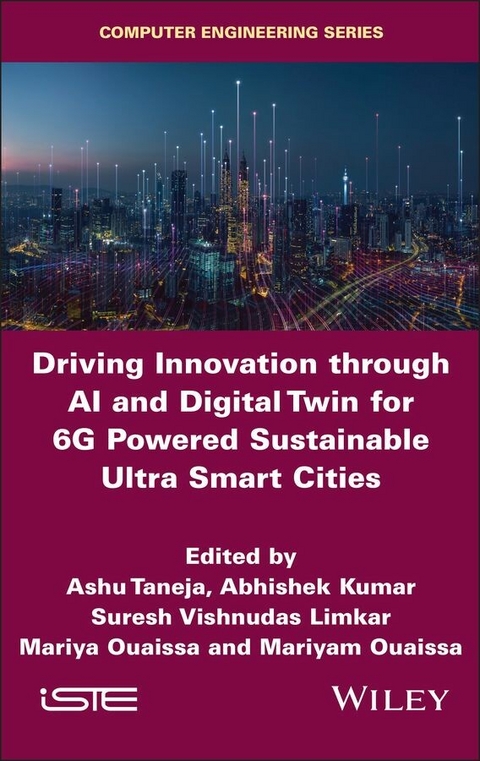
Driving Innovation through AI and Digital Twin for 6G Powered Sustainable Ultra Smart Cities (eBook)
468 Seiten
Wiley-Iste (Verlag)
978-1-394-41129-0 (ISBN)
This book presents the 6G powered integration of Artificial Intelligence (AI) and Digital Twin (DT) technology for sustainable smart cities. In the context of smart cities, 6G, AI and DT hold enormous potential for transformation by boosting city infrastructure and planning, streamlining healthcare facilities, and improving transportation. 6G offers high speed and low latency seamless transfer of vast amounts of data which, when analysed with sophisticated AI models, enhance the decision-making capabilities for smart city infrastructure and urban planning. DT technology, through continuous monitoring and virtual modeling of urban ecosystems, enables predictive maintenance for energy distribution, water management and waste management in a smart city landscape for environmental sustainability.
Driving Innovation through AI and Digital Twin for 6G Powered Sustainable Ultra Smart Cities covers the 6G technological innovations, trends and concerns, as well as practical challenges encountered in the implementation of AI and DT for transforming smart cities for a sustainable future.
Ashu Taneja is Associate Professor at the Centre for Research Impact and Outcome (CRIO), Chitkara University, India.
Abhishek Kumar is a Senior Member of IEEE and works as Assistant Director and Professor in the Computer Science & Engineering Department at Chandigarh University, India.
Suresh Vishnudas Limkar is Assistant Professor at the Department of Computer Science and Engineering at the Central University of Jammu, India.
Mariya Ouaissa is Professor of Cybersecurity and Networks at the Faculty of Sciences Semlalia, Cadi Ayyad University, Morocco.
Mariyam Ouaissa is Assistant Professor of Networks and Systems at ENSA, Chouaib Doukkali University, Morocco.
This book presents the 6G powered integration of Artificial Intelligence (AI) and Digital Twin (DT) technology for sustainable smart cities. In the context of smart cities, 6G, AI and DT hold enormous potential for transformation by boosting city infrastructure and planning, streamlining healthcare facilities, and improving transportation. 6G offers high speed and low latency seamless transfer of vast amounts of data which, when analysed with sophisticated AI models, enhance the decision-making capabilities for smart city infrastructure and urban planning. DT technology, through continuous monitoring and virtual modeling of urban ecosystems, enables predictive maintenance for energy distribution, water management and waste management in a smart city landscape for environmental sustainability. Driving Innovation through AI and Digital Twin for 6G Powered Sustainable Ultra Smart Cities covers the 6G technological innovations, trends and concerns, as well as practical challenges encountered in the implementation of AI and DT for transforming smart cities for a sustainable future.
1
Navigating Artificial Intelligence and Digital Twin for Smart Cities
Design and urban development have embraced a modern approach. The continued urbanization and population agglomeration of people facilitate the implementation of innovative solutions. Smart cities can be defined as urban areas where multiple sectors share information. By doing so, they manage assets and resources in a more efficient way. Furthermore, they develop new and better services for their citizens. A smart city is inhabited by citizens who are conscious of their city’s future and actively act on it. Characteristics of these cities include functionality, efficiency, sustainability, resilience, accessibility and desirable settings. Furthermore, the smart city relies on integrated systems of infrastructure, built environment and networks involving multiple stakeholders. These can be citizens, local and regional government officials, property developers, utility and public service providers, emergency services, and the commercial sector. In European countries, growing stress is placed on research and innovation. It has been argued that innovation should attend to the science and society relationship. Smart cities can be seen as a way of addressing the so-called grand challenges. Four major urban issues are frequently proposed under the grand challenge definition: climate change and energy, population growth and urbanization, globalization and competitiveness, and governance. Governance is understood as relating to the relationships between cities. Here, we can see the improvement of cooperation and the horizontal and vertical integration of policy-making and planning systems as detailed in this chapter. Currently, the most popular way of analyzing urban smartness is through the exploitation of big data. By acknowledging the complexity of cities and the reality that data is central to the process of understanding this complexity, the exploitation of big data has the potential to help governments make their cities more livable and, at the same time, better able to protect themselves. Thus, there is great potential that the urban-technological revolution in Europe will lead to a broader set of European societal values. It will promote a more decentralized, bottom-up and participative governance structure, and has the potential to make Europe more democratic.
1.1. Introduction
Cities are fundamental drivers of urban productivity, socioeconomic development and enhancement of urban living. A smart city is generally designed to optimize city management, improve quality of life for citizens and allow the city to achieve overall sustainable development. During the past decade, there has been an exponential increase in technological advances, especially artificial intelligence (AI) and the Internet of Things (Meng and Zhu 2024). Government policy-makers and political scientists regard AI as the key transformative technology driving the smart city. A new AI ecosystem within smart cities, such as the AI industry, AI hubs, AI clusters, data centers and AI-powered manufacturing industries, has ushered in a new wave of smart cities (Lynch et al. 2024). In this trend, interconnected AI-enabled digital twin technologies have shown potential. Constructing city-scale AI-powered digital twin in a smart city and developing service platforms for new entrants would stimulate new collaborations across business, industry, academia and governments, leading to a quantum leap in terms of systems and theory. In this chapter, the digital twin concept starts with the core concept in systems engineering (Hamada et al. 2024). Then, based on a typical digital twin-based intelligent urban simulation, the scope of this chapter ultimately narrows down to exploring systematic AI integration with the digital twin technique, and research objectives and policy implications will be briefly introduced. Digital twin, AI and their integration all point to promising futures for smart cities under the global trend of hastened urbanization (Wang et al. 2024). Nevertheless, some challenges must be overcome, and some policies may be made to address key aspects such as applicable industry, technology capacity, industry standards, professionals, and notably, stakeholder collaborations in availing smart cities, as shown in Figure 1.1.
Cities have attracted opportunities and challenges for society since time immemorial; for the last decade, the concept of a smart city has become popular, especially in western culture. A smart city is defined as an urban area that uses various forms of digital technologies and data-driven strategies to manage its assets, including, but not limited to, local departments’ information systems. Such cities harness technology as a means to widen citizens’ access to government services, notably by means of high-speed communication infrastructure (Karunanidhi et al. 2024). This access can include data collected by buses to provide an understanding during operation or sensors that monitor the environment, energy use, traffic, citizen engagement, crime and security. These cities deploy sensors and networks that generate huge volumes of data to improve infrastructure operations, government and citizen engagement. Smart cities are combinations of tech giants with humans and social systems (Andrade et al. 2024). A smart city is characterized by the large number of digital highways in its interior and the efficiency of the management and provision of services such as energy, water, health, education and transportation. Smart cities are also vulnerable because not only do they have large targets such as enterprises or critical infrastructure, but they also have ICT infrastructures that are like freeways where cybercriminals can easily spread severe malware and engage in a botnet attack. However, the main deterrent is that smart cities can recover from such attacks, unlike most cities, due to their resources. The digital highways are based on digital twin technology, so a digital city is also an emerging trend (Duque et al. 2024). In a smart city or a digital city, every physical element should have its twin.
Figure 1.1. Smart cities
Today’s cities are becoming increasingly complex, and urban areas are attracting more and more people from rural areas. Due to rapid industrial and commercial development in these metropolises, compensation for living expenses is also causing new challenges. Consequently, the issue of traffic congestion is becoming critical as the city population grows. Smart city concepts and digitalization-related technologies such as AI or Internet of Things sensor networks have considerable potential to address these challenges (Padmapriya and Srivenkatesh 2024). An intelligent city is one of the new forms of urban living that integrates information and communication technologies into the management of transport, buildings, waste, lighting, mining and energy services. Digital twins of intelligent cities focus on the interactions among citizens, infrastructure and the environment. They provide a comprehensive understanding and management of city systems that rely on sensing and advanced analytics to promote high performance and intermodality. Smart cities work on several key aspects: sustainability, financial success and quality of life (Somma et al. 2024). In terms of sustainability, technology can be used to minimize environmental damage and increase resource efficiency. Thus, trends in global climate change can be limited, and nations can adapt to the environmental effects of climate change. To create a better environment for the people and businesses in them, advanced technologies and solutions are also used to attract long-term investments in infrastructure and economic production. Smart cities are locations where technological opportunities help attract creative industries and contemporary facilities that promote growth. Over the last few years, many metropolitan regions worldwide have invested in building smart cities. Also, with more digital environments, residents have a growing opportunity to access real-time data and communicate for public services in intelligent cities (Batty 2024). Both the municipality and its individual elements – governance, technology, economy, community and physical infrastructure – constitute an urban system service, as shown in Figure 1.2.
Figure 1.2. Smart service solutions.
1.2. Artificial intelligence in smart cities
Expert systems such as AI are a core element of smart cities, enabling various applications, as shown in Figure 1.3. AI is widely seen within smart cities to be beneficial in areas such as environmental protection and traffic management, waste management, health and social care, urban public safety, city energy use, urban economies, and empowering city communities. It is attractive to incorporate AI because thousands of streams of data provide valuable, real-time information and insights at a fraction of the cost, with little to no human intervention (Yan and Kunhui 2024). Traffic management is challenging due to the complex and dynamic nature of required responses to transportation events, where real time is defined in millisecond intervals. The challenge is to use AI to allow the system to predict future states and make decisions over a fixed time horizon. AI is a tool for increasing capacity by fractionalizing, digital twinning and optimizing traffic within the system. The data may come from cameras, social media, GPS, sensors in...
| Erscheint lt. Verlag | 11.9.2025 |
|---|---|
| Reihe/Serie | ISTE Invoiced |
| Sprache | englisch |
| Themenwelt | Mathematik / Informatik ► Informatik ► Theorie / Studium |
| Schlagworte | 6G • Artificial Intelligence (AI) • continuous monitoring • Digital Twin (DT) • energy distribution • Environmental sustainability • Infrastructure • smart cities • urban planning • virtual modeling • waste management • Water Management |
| ISBN-10 | 1-394-41129-4 / 1394411294 |
| ISBN-13 | 978-1-394-41129-0 / 9781394411290 |
| Informationen gemäß Produktsicherheitsverordnung (GPSR) | |
| Haben Sie eine Frage zum Produkt? |
 EPUB (Adobe DRM)
Kopierschutz: Adobe-DRM
Adobe-DRM ist ein Kopierschutz, der das eBook vor Mißbrauch schützen soll. Dabei wird das eBook bereits beim Download auf Ihre persönliche Adobe-ID autorisiert. Lesen können Sie das eBook dann nur auf den Geräten, welche ebenfalls auf Ihre Adobe-ID registriert sind.
Details zum Adobe-DRM
Dateiformat: EPUB (Electronic Publication)
EPUB ist ein offener Standard für eBooks und eignet sich besonders zur Darstellung von Belletristik und Sachbüchern. Der Fließtext wird dynamisch an die Display- und Schriftgröße angepasst. Auch für mobile Lesegeräte ist EPUB daher gut geeignet.
Systemvoraussetzungen:
PC/Mac: Mit einem PC oder Mac können Sie dieses eBook lesen. Sie benötigen eine
eReader: Dieses eBook kann mit (fast) allen eBook-Readern gelesen werden. Mit dem amazon-Kindle ist es aber nicht kompatibel.
Smartphone/Tablet: Egal ob Apple oder Android, dieses eBook können Sie lesen. Sie benötigen eine
Geräteliste und zusätzliche Hinweise
Buying eBooks from abroad
For tax law reasons we can sell eBooks just within Germany and Switzerland. Regrettably we cannot fulfill eBook-orders from other countries.
aus dem Bereich


