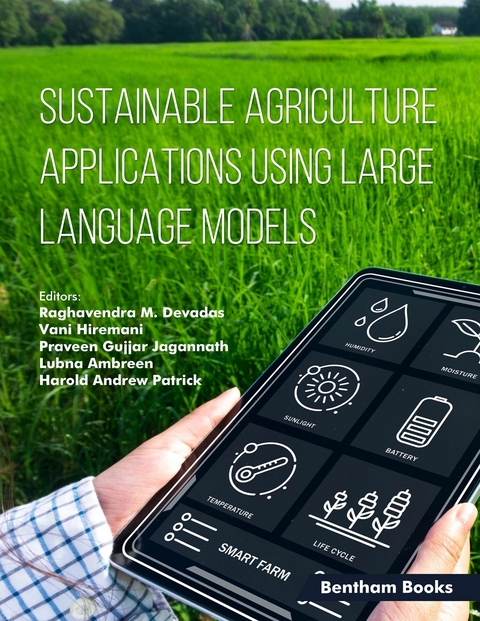
Sustainable Agriculture Applications Using Large Language Models (eBook)
130 Seiten
Bentham Science Publishers (Verlag)
979-8-89881-018-4 (ISBN)
Sustainable Agriculture Applications Using Large Language Models examines how AI-powered tools can enhance decision-making, resource optimization, and knowledge dissemination across diverse agricultural contexts. Spanning topics from crop management and pest control to water conservation and market analysis, the book features a multidisciplinary approach including real-world applications and case studies. It highlights how LLMs can support sustainable practices by analyzing agricultural data, improving communication with farmers, and enabling predictive insights. Special attention is given to ethical considerations and the responsible deployment of AI tools in rural and technologically evolving regions. Key Features: Demonstrates how LLMs support sustainable agriculture practices Showcases AI-driven approaches in crop, pest, and water management Presents real-world applications and case studies across regions Explores ethical considerations and responsible AI deployment in agriculture Analyzes LLM integration in agricultural education, communication, and polic
Leveraging Artificial Intelligence in India's Food Processing Industries: Advancing Sustainable Agriculture through Large Language Models
Uma Chandrakant Swadimath1, *, Shalini Acharya2
Abstract
Industrialisation and technological advancements are the key factors in a country’s economic development. With the Industry 4.0 revolution, technology has given rise to inventions like Artificial Intelligence (AI), the Internet of Things (IOT), Blockchain technology, and Machine Learning (ML). These technological tools have been adopted in the key economic sectors, namely agriculture, industry, and service. Agriculture is a predominant sector in India’s economic development. The share of the primary cultivation sector in India’s economy was 18% in 2022-23. Changes in demand, lifestyles, and food habits have led to the development of food processing industries. The food processing industry is considered a sunrise industry in India. Food processing refers to a set of methods that are used to convert agricultural products into value-added products by retaining their nutritional value for consumption. It is an act of producing raw vegetables and seafood products that are transformed into consumable products with the help of labour, technology, and research-based information.
Artificial intelligence (AI) or Robotic intelligence (RI) refers to the integration of intelligence into machines that can operate with vision system that can detect product defects, control quality, differentiate products, and perform rejection during the production process. AI can be defined as an injection of humanity's brain power into appliances/instruments that are programmed to imagine and act like human beings, which is an outcome of scientific research and technological knowledge. The application of AI in the Indian food processing industry has become indispensable due to the issues of chemicals found in processed spice products produced by companies like MDH and Everest. Production of food products is a crucial factor in confronting the expectations of consumers and also due to the popularity of ready-to-eat foods as consumers have adapted themselves to the fast-paced working lifestyles. AI or robots are used at every stage of food production. The food processing industry ranks fourth in terms of the adoption of AI technology to maintain hygiene and control the quality of
raw ingredients. The use of AI has become vital in the meat and dairy industries. Machine handling can help in identifying any damaged or contaminated processed food products and remove them from the production line. AI can help in reducing post-harvest losses and perishable wastages and increase the shelf life of processed food products. The Government of India has been encouraging the development of food processing industries. To support this development, it has also established food parks. The food parks have good warehousing facilities, rainwater harvesting, and cold storage facilities. With the availability of these infrastructural facilities and AI in these food parks, there is scope for food processing industries. The chapter examines the application of artificial intelligence in the food processing industries of India.
* Corresponding author Uma Chandrakant Swadimath: Faculty of Management Studies, CMS Business School, JAIN (Deemed-to-be University), Bengaluru, India; E-mail: dr.uma_swadimath@cms.ac.in
INTRODUCTION
Agro processing includes the process of conversion of agricultural products and fishery products into consumable and edible products. It is a subset of the agricultural sector. The Food and Agricultural Organisation (FAO) uses the concept of food processing as agro-processing. It covers products from agriculture, horticulture, plantation, and ocean products. The concepts of agro-processing and food processing are synonymous. Agro-processing activities aim at product research, application of technological tools for agri-business development, raising the income of farmers, and promoting sustainable agricultural development. All of these are covered under food processing, where hi-tech machines are used to process agricultural products from the farm level.
The Food Processing Industry (FPI) is an emerging industry in India. FPIs are equipped with necessary infrastructural facilities that help in the reduction of waste, crop diversification, post-harvesting technologies, employment, add to export earnings, and better income to the farmers. India’s agricultural sector is predominant, and it ranks second in the production of rice, wheat, fruits, and vegetables. It also ranks third in the production of milk, ghee, pulses ginger. With increased agricultural productivity and the supply of raw agricultural products, the FPI is growing at an average annual growth rate of 10%, which was previously just three percent. Food processing transforms agricultural produce into value-added products for consumption by consumers. It is an act of producing raw vegetables and seafood products that are transformed into consumable products with the help of labour, technology, and research-based information. The Food and Agricultural Organisation (FAO) uses the concept of FP as agro-processing. It covers products from agriculture, horticulture, plantation, and ocean products.
The Food and Drug Administration defines Food Processing (FP) as any food that includes any raw agricultural product that is subject to processing, canning, cooking, freezing, dehydration, and milling [1]. According to the Food and Agricultural Organisation (FAO), the FP includes all the activities to convert raw crops for consumption [2]. The Ministry of Food Processing Industries (MOFPIs), Government of India, has classified FP into manufactured processes and value-added processes. The manufactured process is concerned with the activity of transforming products of agriculture, animal husbandry, and fisheries into an edible form with the utilization of labour, capital, power, and machinery, whereas value-added process is concerned with creating significant value-addition in terms of tastes, nutrition, and flavor that are ready for consumption purpose [3]. According to the Food Standards Agency, the food industry includes farming, food production, packaging, distribution, retailing and catering [4]. The FPI includes agricultural, horticultural, plantation, and marine products. There are three stages of food processing namely primary processing, secondary and tertiary processing. In the primary processing stage, raw agricultural products go through different stages of cleaning, grading, sorting, and packaging, which are ready for consumption. The FPIs have attracted foreign direct investment amounts of 6.36 billion US dollars till June 2023 which has increased to 12.58 billion US dollars in March 2024. The exports of processed food products increased from 4.9 billion US dollars to 13.01 billion dollars in 2022-23, indicating a growth of 13 percent [5]. The agricultural or food products are transformed into processed food products and supplied to the retail sector for final consumption under the secondary and tertiary. Previously, it was confined only to the preservation of foods, packaging, and transportation, but today, its scope is enlarged to the production of new ready-to-eat food, beverages, processed and frozen fruits/vegetables, and marine and meat products due to the advancement in innovative technology and Artificial Intelligence (AI). The 21st century has witnessed enormous changes in the technology field, with rapid developments in the Internet of Things (IoT), machine learning, blockchain technology, and AI. Food processing industries (FPIs) are gradually using AI technologies to improve the efficiency and quality of processed food products. AI technology has revolutionised businesses across all economic sectors, and its application has been increasing over recent years. Some issues faced by Everest and MDH products, the use of AI has become necessary to monitor the quality of raw materials, to improve operational efficiency and to deliver the products on time to the consumers. The use of AI in FPIs will help in the reduction of food wastage by 127 billion dollars by 2030. AI has engulfed businesses by transforming them and function efficiently. AI in the FPI aligns the production process with the demand and preferences/tastes of consumers. AI helps maintain the accuracy of food labelling and packaging of processed food products.
REVIEW OF LITERATURE
John R. Baldwin and David Sabourin (2002) analysed how technology is used in the Canadian food processing industry. They emphasize the use of technology in controlling the quality of products, particularly in the dairy, fruits, and vegetable processing industries [6]. NITI AAYOG (2018) has formulated a national strategic framework for the development of AI....
| Erscheint lt. Verlag | 28.8.2025 |
|---|---|
| Sprache | englisch |
| Themenwelt | Informatik ► Theorie / Studium ► Künstliche Intelligenz / Robotik |
| ISBN-13 | 979-8-89881-018-4 / 9798898810184 |
| Informationen gemäß Produktsicherheitsverordnung (GPSR) | |
| Haben Sie eine Frage zum Produkt? |
 EPUB (Ohne DRM)
Digital Rights Management: ohne DRM
Dieses eBook enthält kein DRM oder Kopierschutz. Eine Weitergabe an Dritte ist jedoch rechtlich nicht zulässig, weil Sie beim Kauf nur die Rechte an der persönlichen Nutzung erwerben.
Dateiformat: EPUB (Electronic Publication)
EPUB ist ein offener Standard für eBooks und eignet sich besonders zur Darstellung von Belletristik und Sachbüchern. Der Fließtext wird dynamisch an die Display- und Schriftgröße angepasst. Auch für mobile Lesegeräte ist EPUB daher gut geeignet.
Systemvoraussetzungen:
PC/Mac: Mit einem PC oder Mac können Sie dieses eBook lesen. Sie benötigen dafür die kostenlose Software Adobe Digital Editions.
eReader: Dieses eBook kann mit (fast) allen eBook-Readern gelesen werden. Mit dem amazon-Kindle ist es aber nicht kompatibel.
Smartphone/Tablet: Egal ob Apple oder Android, dieses eBook können Sie lesen. Sie benötigen dafür eine kostenlose App.
Geräteliste und zusätzliche Hinweise
Buying eBooks from abroad
For tax law reasons we can sell eBooks just within Germany and Switzerland. Regrettably we cannot fulfill eBook-orders from other countries.
aus dem Bereich