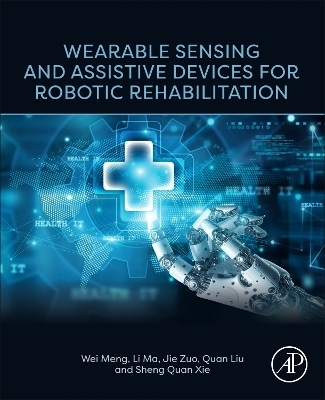
Wearable Sensing and Assistive Devices for Robotic Rehabilitation
Academic Press Inc (Verlag)
978-0-443-40463-4 (ISBN)
- Noch nicht erschienen (ca. April 2026)
- Versandkostenfrei
- Auch auf Rechnung
- Artikel merken
Wei Meng is currently a lecturer at the School of Information Engineering, Wuhan University of Technology. His research interests include robot-assisted rehabilitation, human–robot interaction, and iterative learning control. He has co-authored five books, published more than 80 academic journal and conference papers, and holds 22 patents. Li Ma is an associate professor at Wuhan University of Technology, China. From 2015 to 2016, he was a PhD exchange student in National Taiwan University, Taiwan and a joint training PhD student at UCLA, US, from 2016 to 2018. After that, he carried on one-year postdoctoral research fellow at University of Michigan, US. His research interest includes the biomedical signal processing, especially in brain monitoring during anaesthesia, brain modelling and brain-computer interfaces, and is now focusing on the brain inspired intelligence. Quan Liu is currently chair professor at the School of Information Engineering at Wuhan University of Technology. In the past five years, she authored more than 100 technical publications, proceedings, editorials, and books. She has directed more than 20 research projects. Her research interests include signal processing, embedded systems, and robots and electronics. Prof. Liu received two national awards and three provincial and ministerial awards. She was awarded as the “National Excellent Teacher in 2007. She is a Council Member of the Chinese Association of Electromagnetic Compatibility and the Hubei Institute of Electronics. Sheng Quan Xie is currently chair professor in robotics and autonomous systems at the Faculty of Engineering, University of Leeds. He has published seven books, 15 book chapters, and more than 300 international journal and conference papers. His current research interests include medical and rehabilitation robots and advanced robot control. Professor Xie was elected a Fellow of The Institution of Professional Engineers New Zealand in 2016. He has also served as a Technical Editor of the IEEE/ASME TRANSACTIONS ON MECHATRONICS. Jie Zuo received the Ph.D. degree in information engineering from Wuhan University of Technology, Wuhan, China, in 2022. She is currently working as a Lecturer at Wuhan University of Technology. From 2022 to 2024, she was a postdoctoral researcher in the School of Artificial Intelligence and Automation at Huazhong University of Science and Technology. Her research interests include robotic design, modelling and control strategies, rehabilitation bio-mechatronics.
1. Introduction
2. State of the Art
3. Wearable Optical Fibre Sensors and Signal Acquisition
4. Neuro-Muscular Interfaces for Motion Recognition
5. Brain-Computer Interface with Invasive Caps
6. Wearable Ankle-Foot Exoskeletons
7. Knee Exoskeletons for Walking Assistance
8. Human-Centred Interactive Control Systems
9. Applications and Validations of Wearable Devices
10. Conclusion
| Erscheint lt. Verlag | 1.4.2026 |
|---|---|
| Verlagsort | San Diego |
| Sprache | englisch |
| Maße | 191 x 235 mm |
| Gewicht | 450 g |
| Themenwelt | Informatik ► Theorie / Studium ► Künstliche Intelligenz / Robotik |
| Medizin / Pharmazie ► Physiotherapie / Ergotherapie ► Orthopädie | |
| Technik ► Medizintechnik | |
| ISBN-10 | 0-443-40463-1 / 0443404631 |
| ISBN-13 | 978-0-443-40463-4 / 9780443404634 |
| Zustand | Neuware |
| Informationen gemäß Produktsicherheitsverordnung (GPSR) | |
| Haben Sie eine Frage zum Produkt? |
aus dem Bereich