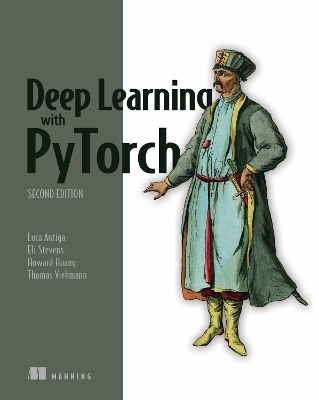
Deep Learning with PyTorch, Second Edition
Manning Publications (Verlag)
9781633438859 (ISBN)
- Noch nicht erschienen (ca. März 2026)
- Versandkostenfrei
- Auch auf Rechnung
- Artikel merken
Stop guessing at PyTorch syntax, start building production-ready models today. Bridge the gap between theory and working code with guided, hands-on projects. Confused by transformers and diffusion? Learn them through clear, incremental steps. Grow from basic tensors to complete neural networks without drowning in jargon. Feel confident diagnosing training issues using PyTorch’s powerful visualization tools. Stay market-relevant by mastering the latest generative AI techniques right now.
Project-based learning: Build an end-to-end medical image classifier that cements every concept.
Flexible PyTorch APIs: Customize layers, losses, and optimizers for research or production speed.
CNNs, RNNs, Transformers: Apply the right architecture to vision, language, and multimodal tasks.
Generative models: Create text and images with large language models and diffusion networks.
Optimization know-how: Improve accuracy, reduce inference cost, and streamline model deployment.
Deep Learning with PyTorch, Second Edition, by Luca Antiga, Eli Stevens, Howard Huang, and Thomas Viehmann, delivers a credible, code-first roadmap for serious AI practitioners. The book guides you through every stage, from data loading to scaled deployment.
Each chapter introduces a single concept, then immediately applies it to a working project. Updated coverage of transformers, diffusion, and distributed training keeps the content current. Friendly explanations, annotated code, and ample visuals make complex ideas clear and actionable.
Finish the book able to design, train, and ship state-of-the-art models using PyTorch’s flexible toolkit. You will upskill confidently and join the ranks of engineers pushing AI forward.
Ideal for Python developers, data scientists, and ML engineers seeking practical mastery of modern deep learning.
Luca Antiga is a deep learning researcher and entrepreneur known for translating theory into high-impact AI applications. With extensive industry and academic collaborations, Luca brings clarity and pragmatic rigor to every page. He distills years of neural-network innovation into guidance that accelerates reader competence. Eli Stevens is a seasoned machine-learning engineer recognized for simplifying complex architectures for production teams. With startup intensity and open-source spirit, Eli delivers frank, actionable insights throughout the book. He converts frontier research into approachable steps that help readers deploy real-world solutions. Howard Huang is a software engineer on the core PyTorch team, known for advancing distributed training at scale. With insider knowledge of the framework, Howard injects authoritative best practices into the narrative. He turns deep infrastructure expertise into clear tactics that boost reader productivity. Thomas Viehmann is a data-science consultant and educator praised for demystifying advanced AI concepts. With classroom experience and community mentorship, Thomas offers an encouraging, structured teaching style. He translates academic depth into tools and patterns readers can apply immediately.
PART 1: CORE PYTORCH
1 INTRODUCING DEEP LEARNING AND THE PYTORCH LIBRARY
2 PRETRAINED NETWORKS
3 IT STARTS WITH A TENSOR
4 REAL-WORLD DATA REPRESENTATION USING TENSORS
5 THE MECHANICS OF LEARNING
6 USING A NEURAL NETWORK TO FIT THE DATA
7 TELLING BIRDS FROM AIRPLANES: LEARNING FROM IMAGES
8 USING CONVOLUTIONS TO GENERALIZE
PART 2: PRACTICAL APPLICATIONS
9 HOW TRANSFORMERS WORK
10 DIFFUSION MODELS FOR IMAGES
11 USING PYTORCH TO FIGHT CANCER
12 COMBINING DATA SOURCES INTO A UNIFIED DATASET
13 TRAINING A CLASSIFICATION MODEL TO DETECT SUSPECTED TUMORS
14 IMPROVING TRAINING WITH METRICS AND AUGMENTATION
15 USING SEGMENTATION TO FIND SUSPECTED NODULES
16 TRAINING MODELS ON MULTIPLE GPUS
17 DEPLOYING TO PRODUCTION
| Erscheint lt. Verlag | 4.3.2026 |
|---|---|
| Verlagsort | New York |
| Sprache | englisch |
| Themenwelt | Informatik ► Programmiersprachen / -werkzeuge ► NET Programmierung |
| Informatik ► Software Entwicklung ► Objektorientierung | |
| Informatik ► Theorie / Studium ► Künstliche Intelligenz / Robotik | |
| ISBN-13 | 9781633438859 / 9781633438859 |
| Zustand | Neuware |
| Informationen gemäß Produktsicherheitsverordnung (GPSR) | |
| Haben Sie eine Frage zum Produkt? |
aus dem Bereich