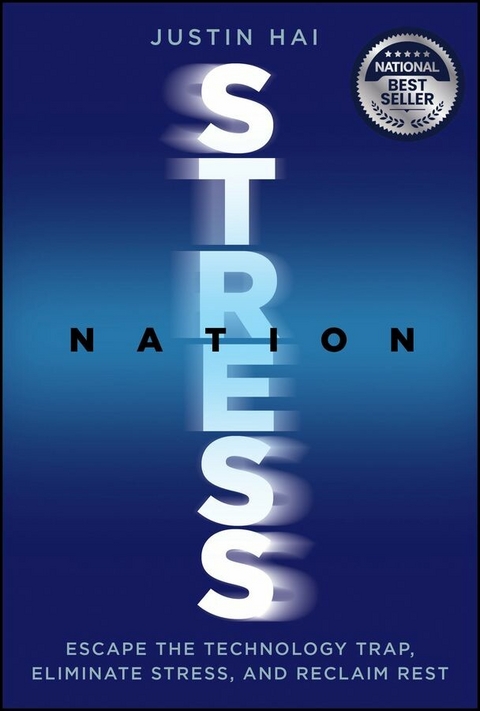
Stress Nation (eBook)
294 Seiten
Wiley (Verlag)
978-1-394-37500-4 (ISBN)
A provocative deep dive into how technology is wrecking our hormones and our health-and the powerful tools you need to reclaim your well-being and thrive.
Stress Nation provides answers to the lingering questions many people have about why they constantly feel tired, lonely, anxious, disconnected, and unwell, explaining in both humorous and poignant prose how the technology that was supposed to make our lives easier is actually one of the leading causes of chronic stress, dysregulated cortisol, and dangerously inadequate sleep. Equal parts commentary and practical guide, this book offers solutions that empower readers to manage their stress, improve their sleep, and implement scientifically supported methods to break the cycle of device addiction.
In this book, readers will discover:
- How cortisol-the Master Hormone and your body's overworked alarm system-can become dangerously imbalanced, ruin your health, and leave you feeling exhausted and overwhelmed.
- How Silicon Valley went for your attention instead of your well-being - and how that's warped the way we sleep, date, parent, and even think.
- Practical, empowering ways to unplug, reconnect, and start living like a human again - not a device-controlled zombie.
Stress Nation is both your wake-up call and game plan that delivers on its promise of a clearer mind, healthier body, and better life.
JUSTIN HAI is the Co-Founder and CEO of Rebalance Health, a company redefining hormone and stress management through clinically backed, award-winning innovation. A serial entrepreneur with a background in product design, biotech, and wellness, Hai has launched multiple ventures including Alastin Skincare (acquired by Galderma), GLO Pharmaceuticals, and Rebalance Health. He holds degrees from RISD and Pepperdine and has earned recognition from Fast Company, CNBC, Inc., and NASA. Under his leadership, Rebalance has been named Glossy Beauty's Wellness Brand of the Year, won Best in Small Business for Innovative Product, and was honored in TIME's 2024 Best Inventions list of menopausal solutions. Driven by personal experience and scientific rigor, Hai's work empowers people to take back control of their health-and Stress Nation is the manifesto for doing just that.
USA Today BestsellerPublishers Weekly BestsellerA provocative deep dive into how technology is wrecking our hormones and our health and the powerful tools you need to reclaim your well-being and thrive. Stress Nation provides answers to the lingering questions many people have about why they constantly feel tired, lonely, anxious, disconnected, and unwell, explaining in both humorous and poignant prose how the technology that was supposed to make our lives easier is actually one of the leading causes of chronic stress, dysregulated cortisol, and dangerously inadequate sleep. Equal parts commentary and practical guide, this book offers solutions that empower readers to manage their stress, improve their sleep, and implement scientifically supported methods to break the cycle of device addiction. In this book, readers will discover: How cortisol the Master Hormone and your body's overworked alarm system can become dangerously imbalanced, ruin your health, and leave you feeling exhausted and overwhelmed. How Silicon Valley went for your attention instead of your well-being and how that's warped the way we sleep, date, parent, and even think. Practical, empowering ways to unplug, reconnect, and start living like a human again not a device-controlled zombie. Stress Nation is both your wake-up call and game plan that delivers on its promise of a clearer mind, healthier body, and better life.
Introduction
How My Fascination with Cortisol Turned into a Solution for a Burned-Out, Tech-Addicted World
Imagine one day you are sitting on a park bench, minding your own business, when an eccentric billionaire approaches you with an offer: They'll give you 10 million dollars, right now, tax-free, for you to do whatever you wish with. The catch? You need to put your cell phone in a safety deposit box at the bank, it can't be opened until a year from now, and you can't get a new one. You'll be without a cell phone for the next 365 days, but you'll be 10 million dollars richer. You don't even have to think twice about the offer – how is this even a challenge? What's the catch?
You try to contain your smile as you nod solemnly at the mysterious figure and agree to the proposition. You walk with them to the nearest bank, power down your phone, drop it into the deposit box, sign a mountain of paperwork, and stare in awe as your account balance suddenly gains a whole lot more zeroes at the end of it.
In a daze, you shake the billionaire's hand and walk slowly out of the bank. Did that just happen? Are you a millionaire now? Not how you were expecting your day to go. Wait until your friends hear about this! You reach into your pocket to text them. Oh … wait. Ok, that's fine, you can just call them when you get home. Do you know anyone's numbers? You know your home phone number from childhood by heart and that Tommy Tutone bop, but you can't for the life of you think of your best friend's phone number. Or your parents. Or anyone in your favorites. Email it is! People email their friends all the time, right? It's just like a slower, longer, less efficient text message. That's a totally normal way to communicate with your friends and family in the twenty-first century. Not weird at all.
This definitely needs to be on your social media, though. There's no way people are going to believe this happened to you unless you take a photo of your account balance. You head over to the ATM to grab some money, but when the account balance pops up with all those beautiful zeroes on the end and you put your face next to it, point at the screen, and … you have nothing in your hand. Can't really take a selfie without a camera. Probably for the best – you don't want everyone asking you for money anyways, right? Better keep this on a need-to-know basis.
You were on your way to work, but clearly you don't need to do that anymore – multi-millionaires don't need to work. Just a quick “I quit” to your boss on the company messaging system … nope, no access to that right now without your phone, so it looks like you'll have to quit in person. Well, that will be more satisfying and probably the professional thing to do. So, your office is downtown and you know you need to go down that street, but was it a left on Elm or a right on Birch? Your GPS app would be really helpful right now, and if everyone could just please stop honking …
Ok, fine, communication is going to be an adjustment and you're going to start to have to pay a lot better attention to navigating when you're out and about, but you're set on money for the foreseeable future. Heck, you can hire somebody to drive you from point A to point B now. You can buy one of those self-driving cars. You can buy whatever you want. What do you want? Your mind has suddenly gone blank and you can't think of anything or anywhere to shop. It'd be really nice if you could go online right now and scroll for some inspiration. You've never missed influencers and targeted ads so badly in your life before. Why is it the only thing you can think about at the moment is a new phone?
The Dark Side of Smartphones We Didn't Foresee
Giving up your smartphone is a tempting proposition that sounds much easier than it actually is. Many people, from Gen Z to Baby Boomers, don't realize just how dependent they have become on their phones for their everyday activities. Entertainment, information, communication, connection, distraction, productivity – our phones are often the first thing we look at in the morning and the last thing we see before we go to bed. Standing in line at the grocery store? Grab your phone, check those emails, and optimize your time. Waiting for friends to show up at the restaurant? Pull out your phone and scroll through social media while you're idle.
We've adapted so well to technology in our daily lives that we've forgotten how to simply exist in a place without having to occupy our time with what's on the phone in front of us. We're addicted to the glow of the screen and what each swipe might reveal. A 2022 poll (Vision Direct, n.d.) found that Americans spend an incredible 382,652 hours and 48 minutes over the average adult lifetime of 60.7 years. That equals out to almost 44 years or over half the lifetime of the average person. Screens have actually taken over our lives.
But, it wasn't always this way. The first smartphone was introduced at the turn of the millennium and quickly evolved into the miniature computers we now carry in our pockets. Since that time we've become accustomed to having the world at our fingertips – quite literally. At first, the novelty of it all was intoxicating. We went from no phones to having a phone we could talk to our loved ones on from most places in the world to having an extremely advanced piece of technology that did everything we could possibly want (and some things we probably didn't need it to).
Now, there's a growing population that longs for the days when we weren't always connected. It's as if someone hit the fast-forward button, but many of us want to rewind or even eject the tape altogether. Nostalgia for “old” media is at an all-time high from all generations, with analog tech like typewriters, film cameras, print magazines, vinyl records, and even wired headphones making a return to the mainstream.
For those that remember the days before technology was infused into every part of our lives, there's a fondness and a longing for so-called simpler times.
Instead of sitting inside and staring at a screen, kids engaged with each other and played together. There was an interactiveness to our communication because there were no screens to hide behind or escape from the world when you were out in it. When you talked to someone, you looked them in the eyes and connected on a deeper level. We had fewer choices but we never felt like we were deprived because of it.
Walking into a Blockbuster to find a video for family movie night was always an exciting proposition because you weren't sure what was going to be available and there were only so many copies of a video cassette or DVD to choose from. Nowadays you can toggle from streaming app to streaming app with hundreds of options and spend an hour without finding anything to watch. We're overloaded by choice.
Dating today feels like an impersonal game of numbers as you mindlessly swipe through an app. Before it was thrown into a high-tech algorithm, dating meant taking the time to actually get to know someone and learning about them to form a deeper relationship through emotional intimacy.
We gave our full attention to a conversation instead of multitasking our way through each meeting, glancing at our phones or outright looking at our screens mid-conversation. The irony is that while we are technically more connected today than we've ever been, we've never been more disconnected from each other.
An unexpected side effect of all these screens? We are rapidly becoming a nation of extremely stressed out, sleep-deprived individuals:
- In recent years, the American Psychiatry Association has seen increases in self-reported stress levels for their annual Healthy Minds Poll (American Psychiatric Association, 2024).
- In 2024, 43 percent of adults said that they feel more anxious than they did the previous year, which was up from 37 percent in 2023, which in turn was up from 32 percent in 2022.
- The most recent data from the Centers for Disease Control shows that inadequate sleep is on the rise, with 35.5 percent of Americans reporting they get less than seven hours of sleep per night, up from 32.3 percent in 2020 (Vision Direct, n.d.).
Much has been written about the toll that technology takes on our mental health, but many people don't know that there is a direct link between all that screen time and your physical health.
That's a lesson that I had to discover in a very personal way and is the very foundation of both this book and my life's work into studying how stress impacts the body and technology's role in that equation.
The Company That Started It All
In 2020, l co-founded Rebalance Health out of a deep curiosity about how hormones impact every aspect of our lives – from sleep and energy to focus, mood, and long-term well-being. At the time, I was exploring the world of peptides and hormone replacement therapy (HRT), but one hormone kept standing out in our research: cortisol.
Cortisol, often called the “fight or flight” hormone, has an outsized influence on how our bodies handle stress – and it became clear that this one hormone might be at the root of much of what's going wrong in modern health. Working closely with endocrinologists, holistic doctors, and integrative practitioners, we began developing ways to support...
| Erscheint lt. Verlag | 8.9.2025 |
|---|---|
| Sprache | englisch |
| Themenwelt | Sachbuch/Ratgeber ► Gesundheit / Leben / Psychologie ► Lebenshilfe / Lebensführung |
| Sachbuch/Ratgeber ► Gesundheit / Leben / Psychologie ► Psychologie | |
| Geisteswissenschaften ► Psychologie ► Biopsychologie / Neurowissenschaften | |
| Mathematik / Informatik ► Informatik | |
| Medizin / Pharmazie | |
| Schlagworte | better sleep • cortisol effects • cortisol levels • cushings syndrome • device addiction • Mindfulness • reduce stress • sleep health • Sleep quality • stress management • technology addiction • technology brain fog • technology burnout |
| ISBN-10 | 1-394-37500-X / 139437500X |
| ISBN-13 | 978-1-394-37500-4 / 9781394375004 |
| Informationen gemäß Produktsicherheitsverordnung (GPSR) | |
| Haben Sie eine Frage zum Produkt? |
 EPUB (Adobe DRM)
Kopierschutz: Adobe-DRM
Adobe-DRM ist ein Kopierschutz, der das eBook vor Mißbrauch schützen soll. Dabei wird das eBook bereits beim Download auf Ihre persönliche Adobe-ID autorisiert. Lesen können Sie das eBook dann nur auf den Geräten, welche ebenfalls auf Ihre Adobe-ID registriert sind.
Details zum Adobe-DRM
Dateiformat: EPUB (Electronic Publication)
EPUB ist ein offener Standard für eBooks und eignet sich besonders zur Darstellung von Belletristik und Sachbüchern. Der Fließtext wird dynamisch an die Display- und Schriftgröße angepasst. Auch für mobile Lesegeräte ist EPUB daher gut geeignet.
Systemvoraussetzungen:
PC/Mac: Mit einem PC oder Mac können Sie dieses eBook lesen. Sie benötigen eine
eReader: Dieses eBook kann mit (fast) allen eBook-Readern gelesen werden. Mit dem amazon-Kindle ist es aber nicht kompatibel.
Smartphone/Tablet: Egal ob Apple oder Android, dieses eBook können Sie lesen. Sie benötigen eine
Geräteliste und zusätzliche Hinweise
Buying eBooks from abroad
For tax law reasons we can sell eBooks just within Germany and Switzerland. Regrettably we cannot fulfill eBook-orders from other countries.
aus dem Bereich