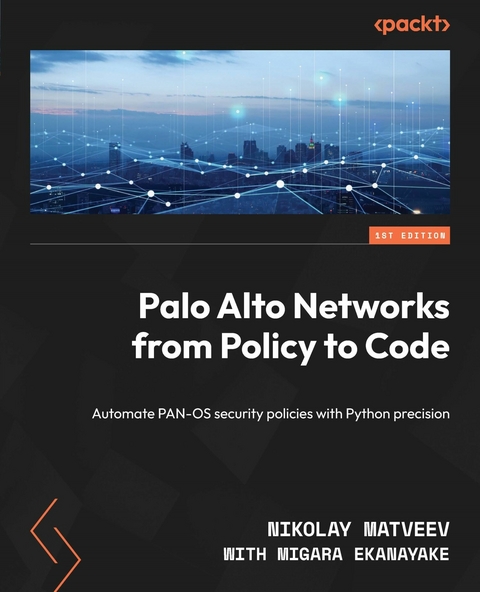
Palo Alto Networks from Policy to Code (eBook)
438 Seiten
Packt Publishing (Verlag)
978-1-83588-129-3 (ISBN)
Palo Alto Networks firewalls are the gold standard in enterprise security, but managing them manually often leads to endless configurations, error-prone changes, and difficulty maintaining consistency across deployments.
Written by cybersecurity experts with deep Palo Alto Networks experience, this book shows you how to transform firewall management with automation, using a code-driven approach that bridges the gap between powerful technology and practical implementation.
You'll start with next-gen firewall fundamentals before advancing to designing enterprise-grade security policies, applying threat prevention profiles, URL filtering, TLS decryption, and application controls to build a complete policy framework. Unlike other resources that focus on theory or vendor documentation, this hands-on guide covers best practices and real-world strategies. You'll learn how to automate policy deployment using Python and PAN-OS APIs, structure firewall configurations as code, and integrate firewalls with IT workflows and infrastructure-as-code tools.
By the end of the book, you'll be able to design, automate, test, and migrate firewall policies with confidence, gaining practical experience in quality assurance techniques, pilot testing, debugging, and phased cutovers-all while maintaining security and minimizing business impact.
Create automated security policies for Palo Alto Networks firewalls that transform manual processes into scalable, code-based solutionsKey FeaturesStreamline security policy deployment using Python and automation toolsLearn how PAN-OS processes and secures enterprise network trafficImplement automated security actions for real-time threat mitigationGet With Your Book: PDF Copy, AI Assistant, and Next-Gen Reader FreeBook DescriptionPalo Alto Networks firewalls are the gold standard in enterprise security, but managing them manually often leads to endless configurations, error-prone changes, and difficulty maintaining consistency across deployments. Written by cybersecurity experts with deep Palo Alto Networks experience, this book shows you how to transform firewall management with automation, using a code-driven approach that bridges the gap between powerful technology and practical implementation. You ll start with next-gen firewall fundamentals before advancing to designing enterprise-grade security policies, applying threat prevention profiles, URL filtering, TLS decryption, and application controls to build a complete policy framework. Unlike other resources that focus on theory or vendor documentation, this hands-on guide covers best practices and real-world strategies. You ll learn how to automate policy deployment using Python and PAN-OS APIs, structure firewall configurations as code, and integrate firewalls with IT workflows and infrastructure-as-code tools. By the end of the book, you ll be able to design, automate, test, and migrate firewall policies with confidence, gaining practical experience in quality assurance techniques, pilot testing, debugging, and phased cutovers all while maintaining security and minimizing business impact.What you will learnMaster next-generation firewall fundamentalsDesign enterprise-grade security policies for the Internet gatewayApply App-ID, URL filtering, and threat preventionAutomate policy deployment using Python, PAN-OS APIs, SDKs, and IaC toolsCustomize response pages with Jinja2 and integrate them into service desk workflowsTest and validate with QA techniques and pilot testingMigrate policies with confidence and zero downtimeWho this book is forThis book is for firewall engineers, security engineers, consultants, technical architects, and CISOs who want to enhance their network security expertise through Policy as Code on Palo Alto Networks firewalls. It's also perfect for those with working knowledge of Python programming and hands-on experience with Palo Alto Networks' Next-Gen firewalls, whether in business, government, or education. This book will help network engineers, security architects, and DevSecOps professionals simplify firewall management and reduce operational overhead.]]>
1
Next-Gen Firewall Fundamentals
You may be familiar with conventional network firewalls, host-based firewalls, network access control lists, AWS security groups, and Azure network security groups. However, next-gen firewalls differ significantly from these in order to address the unique challenges organizations face in identifying and securing traffic in today’s networks.
To develop a robust firewall security policy, you must understand how firewalls identify network protocols and applications, the cybersecurity risks that modern enterprise networks encounter, the core firewall security features, and how all of this correlates with business requirements.
This chapter’s objective is to establish a technical foundation that will enable you to better understand what next-gen firewalls can do in the network security domain and how they accomplish this. It will also lay the essential groundwork for studying the building blocks that PAN-OS provides for creating a security policy.
We will establish requirements and create the policy in the subsequent chapters; however, now, let us focus on the following key topics:
- Networking 101 in a firewall context
- How next-gen firewalls perceive all network traffic
Technical requirements
Access to a Palo Alto Networks firewall would be beneficial, but not necessary.
Networking 101
This section provides an overview of networking to the extent required to fully understand all network-related building blocks of the security policy of the next-gen firewalls.
If you have a solid networking and firewall background, feel free to skip most of this section but read the last subsection on load-balancing and name resolution. If you have some practical knowledge but prefer a brief theory refresher or are a beginner, please read on.
The Open Systems Interconnection (OSI) model
At the high level required to understand networking in the context of a next-gen firewall security policy, the way modern networks operate is relatively simple.
First, let us start by introducing the OSI reference model, a sound conceptual framework for understanding how network communication works. The model breaks down the process of sending and receiving data into seven distinctive layers of abstraction. Each layer serves a specific purpose, relies on the layer below, and provides a foundation for the layer above. At the top of this model, we have very high-level protocols that directly interface with applications (for example, HTTP – the bread and butter of web browsers). As we go down the model, we eventually reach the Physical layer – electronic circuits, cables, and wireless media.
Here are all these layers in a table with a firewall context. Glance through the table; then, we will elaborate on the essential aspects:
| Layer name | Description | Examples | Recognized by a Palo Alto Networks firewall security policy? | Recognized by a traditional firewall security policy? |
| Application (Layer 7) | Interacts with software applications that implement a communication component. | HTTP, SMTP, DNS, BGP | Yes | No |
| Presentation (Layer 6) | Responsible for data representation. Performs encoding, compression, and encryption of data. | SSL, TLS, MIME |
| Session (Layer 5) | Creates, manages, and terminates sessions between two network nodes. | RPC, NetBIOS, SOCKS |
| Transport (Layer 4) | Provides end-to-end communication services for higher layers. The services may include connection-oriented communication, reliability, flow control, multiplexing, and so on. | TCP, UDP, SCTP | Yes | Yes |
| Network (Layer 3) | Provides logical addressing and network path determination | IPv4, IPv6, ICMP, IGMP | Yes | Yes |
| Data Link (Layer 2) | Provides physical addressing and peer-to-peer data transfer within the same physical network segment. | Ethernet, ARP, LLDP, CDP; Wi-Fi, Zigbee | No | No |
| Physical (Layer 1) | Provides an electrical, mechanical, and procedural interface to the transmission medium. | Electronic circuits and chips, transceivers | No | No |
Table 1.1 – OSI model in a firewall policy context
Layers 1 to 3 are known as media layers, and layers 4 to 7 are known as host layers.
As you can see from the table, the difference between next-gen firewalls and traditional firewalls is their ability to distinguish traffic attributes specific to all host layers. While traditional firewalls can see only one (Transport), the next-gen firewalls can recognize all four layers - Transport, Session, Presentation, and Application.
The OSI model is somewhat theoretical. In practice, distinguishing layers 5 to 7 from each other is often difficult, if at all possible. All programming logic of these three layers is commonly baked into a single software application – a web browser, for instance. Therefore, for the purpose of this book, we will collectively call layers 5 to 7 the Application layer – by the name of the top layer in the stack of host layers.
Now, let us elaborate on the Network, Transport, and Application layers because of their significance in the context of firewall security policy.
OSI layer 3 – Network layer
The vast majority of network communications between computer systems these days is done by means of the Internet Protocol (IP). A protocol is the equivalent of a language in the human world. Subsequently, all networks where computers “speak” IP are called IP networks. The computer industry uses the terms network and IP network as synonyms.
All data transmitted from a hypothetical computer A to computer B is broken into small chunks called packets. Each packet is delivered through the network independently from other packets. Therefore, to find its way, each packet must have the following (at a minimum):
- The address of the destination (the address of computer B)
- The address of the source (computer A) so that a response packet can be sent if required
The IP addresses can be in two formats – IPv4 and IPv6. The former uses a 32-bit/4-byte addressing scheme (traditionally written in the so-called dotted-decimal form of 4 period-separated decimal numbers from 0 to 255 – for example, 198.51.100.1). When referenced, each address is often (but not always) accompanied by a network mask that effectively divides the address into two parts – the host’s address and the address of the network that the host belongs to. The mask, in turn, can be written either in the same dotted-decimal notation or in a so-called Classless Inter-Domain Routing (CIDR) notation.
For example, the address 198.51.100.1 with the mask...
| Erscheint lt. Verlag | 29.8.2025 |
|---|---|
| Sprache | englisch |
| Themenwelt | Informatik ► Netzwerke ► Sicherheit / Firewall |
| Mathematik / Informatik ► Informatik ► Theorie / Studium | |
| ISBN-10 | 1-83588-129-7 / 1835881297 |
| ISBN-13 | 978-1-83588-129-3 / 9781835881293 |
| Informationen gemäß Produktsicherheitsverordnung (GPSR) | |
| Haben Sie eine Frage zum Produkt? |
 EPUB (Ohne DRM)
Digital Rights Management: ohne DRM
Dieses eBook enthält kein DRM oder Kopierschutz. Eine Weitergabe an Dritte ist jedoch rechtlich nicht zulässig, weil Sie beim Kauf nur die Rechte an der persönlichen Nutzung erwerben.
Dateiformat: EPUB (Electronic Publication)
EPUB ist ein offener Standard für eBooks und eignet sich besonders zur Darstellung von Belletristik und Sachbüchern. Der Fließtext wird dynamisch an die Display- und Schriftgröße angepasst. Auch für mobile Lesegeräte ist EPUB daher gut geeignet.
Systemvoraussetzungen:
PC/Mac: Mit einem PC oder Mac können Sie dieses eBook lesen. Sie benötigen dafür die kostenlose Software Adobe Digital Editions.
eReader: Dieses eBook kann mit (fast) allen eBook-Readern gelesen werden. Mit dem amazon-Kindle ist es aber nicht kompatibel.
Smartphone/Tablet: Egal ob Apple oder Android, dieses eBook können Sie lesen. Sie benötigen dafür eine kostenlose App.
Geräteliste und zusätzliche Hinweise
Buying eBooks from abroad
For tax law reasons we can sell eBooks just within Germany and Switzerland. Regrettably we cannot fulfill eBook-orders from other countries.
aus dem Bereich