


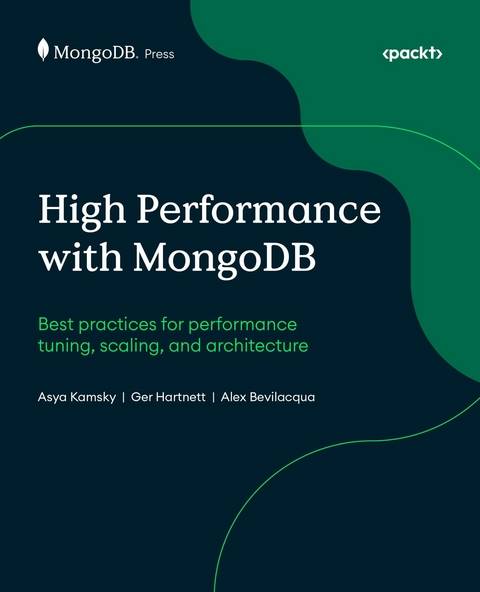
High Performance with MongoDB (eBook)
410 Seiten
Packt Publishing (Verlag)
9781837022625 (ISBN)
With data as the new competitive edge, performance has become the need of the hour. As applications handle exponentially growing data and user demand for speed and reliability rises, three industry experts distill their decades of experience to offer you guidance on designing, building, and operating databases that deliver fast, scalable, and resilient experiences.
MongoDB's document model and distributed architecture provide powerful tools for modern applications, but unlocking their full potential requires a deep understanding of architecture, operational patterns, and tuning best practices. This MongoDB book takes a hands-on approach to diagnosing common performance issues and applying proven optimization strategies from schema design and indexing to storage engine tuning and resource management.
Whether you're optimizing a single replica set or scaling a sharded cluster, this book provides the tools to maximize deployment performance. Its modular chapters let you explore query optimization, connection management, and monitoring or follow a complete learning path to build a rock-solid performance foundation. With real-world case studies, code examples, and proven best practices, you'll be ready to troubleshoot bottlenecks, scale efficiently, and keep MongoDB running at peak performance in even the most demanding production environments.
Practical strategies to help you design, optimize, and operate MongoDB deployments for performance, resilience, and growthKey FeaturesIdentify and fix performance bottlenecks with practical diagnostic and optimization strategiesOptimize schema design, indexing, storage, and system resources for real-world workloadsScale confidently with in-depth coverage of replication, sharding, and cluster management techniquesPurchase of the print or Kindle book includes a free PDF eBookBook DescriptionWith data as the new competitive edge, performance has become the need of the hour. As applications handle exponentially growing data and user demand for speed and reliability rises, three industry experts distill their decades of experience to offer you guidance on designing, building, and operating databases that deliver fast, scalable, and resilient experiences. MongoDB s document model and distributed architecture provide powerful tools for modern applications, but unlocking their full potential requires a deep understanding of architecture, operational patterns, and tuning best practices. This MongoDB book takes a hands-on approach to diagnosing common performance issues and applying proven optimization strategies from schema design and indexing to storage engine tuning and resource management. Whether you re optimizing a single replica set or scaling a sharded cluster, this book provides the tools to maximize deployment performance. Its modular chapters let you explore query optimization, connection management, and monitoring or follow a complete learning path to build a rock-solid performance foundation. With real-world case studies, code examples, and proven best practices, you ll be ready to troubleshoot bottlenecks, scale efficiently, and keep MongoDB running at peak performance in even the most demanding production environments.What you will learnDiagnose and resolve common performance bottlenecks in deploymentsDesign schemas and indexes that maximize throughput and efficiencyTune the WiredTiger storage engine and manage system resources for peak performanceLeverage sharding and replication to scale and ensure uptimeMonitor, debug, and maintain deployments proactively to prevent issuesImprove application responsiveness through client driver configurationWho this book is forThis book is for developers, database administrators, system architects, and DevOps engineers focused on performance optimization of MongoDB. Whether you re building high-throughput applications, managing deployments in production, or scaling distributed systems, you ll gain actionable insights. Basic knowledge of MongoDB is assumed, with chapters designed progressively to support learners at all levels.]]>
Contents
- Acknowledgements
- Preface
- Systems and MongoDB Architecture
- Schema Design for Performance
- Indexes
- Aggregations
- Replication
- Sharding
| Erscheint lt. Verlag | 5.9.2025 |
|---|---|
| Sprache | englisch |
| Themenwelt | Mathematik / Informatik ► Informatik ► Datenbanken |
| Mathematik / Informatik ► Informatik ► Software Entwicklung | |
| ISBN-13 | 9781837022625 / 9781837022625 |
| Informationen gemäß Produktsicherheitsverordnung (GPSR) | |
| Haben Sie eine Frage zum Produkt? |
 EPUB (Adobe DRM)
Größe: 3,3 MB
Kopierschutz: Adobe-DRM
Adobe-DRM ist ein Kopierschutz, der das eBook vor Mißbrauch schützen soll. Dabei wird das eBook bereits beim Download auf Ihre persönliche Adobe-ID autorisiert. Lesen können Sie das eBook dann nur auf den Geräten, welche ebenfalls auf Ihre Adobe-ID registriert sind.
Details zum Adobe-DRM
Dateiformat: EPUB (Electronic Publication)
EPUB ist ein offener Standard für eBooks und eignet sich besonders zur Darstellung von Belletristik und Sachbüchern. Der Fließtext wird dynamisch an die Display- und Schriftgröße angepasst. Auch für mobile Lesegeräte ist EPUB daher gut geeignet.
Systemvoraussetzungen:
PC/Mac: Mit einem PC oder Mac können Sie dieses eBook lesen. Sie benötigen eine
eReader: Dieses eBook kann mit (fast) allen eBook-Readern gelesen werden. Mit dem amazon-Kindle ist es aber nicht kompatibel.
Smartphone/Tablet: Egal ob Apple oder Android, dieses eBook können Sie lesen. Sie benötigen eine
Geräteliste und zusätzliche Hinweise
Buying eBooks from abroad
For tax law reasons we can sell eBooks just within Germany and Switzerland. Regrettably we cannot fulfill eBook-orders from other countries.
EPUB (Ohne DRM)Digital Rights Management: ohne DRM
Dieses eBook enthält kein DRM oder Kopierschutz. Eine Weitergabe an Dritte ist jedoch rechtlich nicht zulässig, weil Sie beim Kauf nur die Rechte an der persönlichen Nutzung erwerben.
Dateiformat: EPUB (Electronic Publication)
EPUB ist ein offener Standard für eBooks und eignet sich besonders zur Darstellung von Belletristik und Sachbüchern. Der Fließtext wird dynamisch an die Display- und Schriftgröße angepasst. Auch für mobile Lesegeräte ist EPUB daher gut geeignet.
Systemvoraussetzungen:
PC/Mac: Mit einem PC oder Mac können Sie dieses eBook lesen. Sie benötigen dafür die kostenlose Software Adobe Digital Editions.
eReader: Dieses eBook kann mit (fast) allen eBook-Readern gelesen werden. Mit dem amazon-Kindle ist es aber nicht kompatibel.
Smartphone/Tablet: Egal ob Apple oder Android, dieses eBook können Sie lesen. Sie benötigen dafür eine kostenlose App.
Geräteliste und zusätzliche Hinweise
Buying eBooks from abroad
For tax law reasons we can sell eBooks just within Germany and Switzerland. Regrettably we cannot fulfill eBook-orders from other countries.
aus dem Bereich


