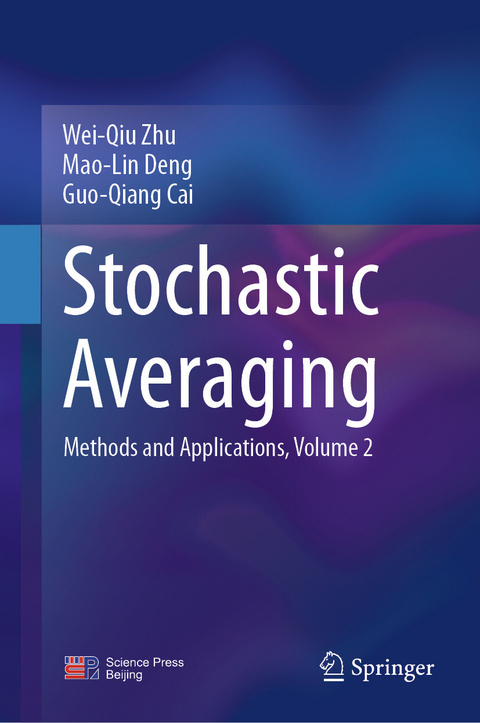
The stochastic averaging methods are among the most effective and widely applied approximate methods for studying nonlinear stochastic dynamics. Upon an overview of global research on the subject, the book highlights a comprehensive summary of research results obtained by the group led by Professor Weiqiu Zhu at Zhejiang University in China and the group led by Professors Y. K. Lin and G. Q. Cai at Florida Atlantic University in the USA over the past three decades. The books are structured to progress logically from foundational principles to simple problems and then to increasingly complex applications. To facilitate understanding and mastery of the methods, the books offer essential preliminary knowledge and a wealth of examples.
The book comprises two volumes. Volume 1 introduces the basic principles of stochastic averaging methods and their applications to single-degree-of-freedom systems under various random excitations. It also covers stochastic averaging methods for quasi-Hamiltonian systems subjected to different random excitations, including Gaussian white noise, combined Gaussian and Poisson white noises, and fractional Gaussian noise. Volume 2 explores stochastic averaging methods for quasi-integrable Hamiltonian systems under colored noise excitation, quasi-integrable Hamiltonian systems with genetic effects under Gaussian white noise and colored noise excitations, and quasi-generalized Hamiltonian systems under Gaussian white noise excitation. Additionally, it covers applications of these methods in ecosystems and some other natural science and engineering scenarios.
These books serve as both introductory texts and valuable reference resources for readers in higher education and research institutions who are interested in or actively engaged in research involving nonlinear stochastic dynamics. The fields covered include mechanics, physics, chemistry, biology, ecology, astronautics and aeronautics, oceanography, civil engineering, mechanical engineering, and electrical engineering.
The stochastic averaging methods are among the most effective and widely applied approximate methods for studying nonlinear stochastic dynamics. Upon an overview of global research on the subject, the book highlights a comprehensive summary of research results obtained by the group led by Professor Weiqiu Zhu at Zhejiang University in China and the group led by Professors Y. K. Lin and G. Q. Cai at Florida Atlantic University in the USA over the past three decades. The books are structured to progress logically from foundational principles to simple problems and then to increasingly complex applications. To facilitate understanding and mastery of the methods, the books offer essential preliminary knowledge and a wealth of examples.The book comprises two volumes. Volume 1 introduces the basic principles of stochastic averaging methods and their applications to single-degree-of-freedom systems under various random excitations. It also covers stochastic averaging methods for quasi-Hamiltonian systems subjected to different random excitations, including Gaussian white noise, combined Gaussian and Poisson white noises, and fractional Gaussian noise. Volume 2 explores stochastic averaging methods for quasi-integrable Hamiltonian systems under colored noise excitation, quasi-integrable Hamiltonian systems with genetic effects under Gaussian white noise and colored noise excitations, and quasi-generalized Hamiltonian systems under Gaussian white noise excitation. Additionally, it covers applications of these methods in ecosystems and some other natural science and engineering scenarios.These books serve as both introductory texts and valuable reference resources for readers in higher education and research institutions who are interested in or actively engaged in research involving nonlinear stochastic dynamics. The fields covered include mechanics, physics, chemistry, biology, ecology, astronautics and aeronautics, oceanography, civil engineering, mechanical engineering, and electrical engineering.
| Erscheint lt. Verlag | 9.8.2025 |
|---|---|
| Sprache | englisch |
| Themenwelt | Mathematik / Informatik ► Mathematik ► Angewandte Mathematik |
| Mathematik / Informatik ► Mathematik ► Wahrscheinlichkeit / Kombinatorik | |
| Naturwissenschaften ► Physik / Astronomie | |
| ISBN-10 | 981-96-3833-X / 981963833X |
| ISBN-13 | 978-981-96-3833-8 / 9789819638338 |
| Informationen gemäß Produktsicherheitsverordnung (GPSR) | |
| Haben Sie eine Frage zum Produkt? |
 PDF (Wasserzeichen)
Größe: 34,2 MB
DRM: Digitales Wasserzeichen
Dieses eBook enthält ein digitales Wasserzeichen und ist damit für Sie personalisiert. Bei einer missbräuchlichen Weitergabe des eBooks an Dritte ist eine Rückverfolgung an die Quelle möglich.
Dateiformat: PDF (Portable Document Format)
Mit einem festen Seitenlayout eignet sich die PDF besonders für Fachbücher mit Spalten, Tabellen und Abbildungen. Eine PDF kann auf fast allen Geräten angezeigt werden, ist aber für kleine Displays (Smartphone, eReader) nur eingeschränkt geeignet.
Systemvoraussetzungen:
PC/Mac: Mit einem PC oder Mac können Sie dieses eBook lesen. Sie benötigen dafür einen PDF-Viewer - z.B. den Adobe Reader oder Adobe Digital Editions.
eReader: Dieses eBook kann mit (fast) allen eBook-Readern gelesen werden. Mit dem amazon-Kindle ist es aber nicht kompatibel.
Smartphone/Tablet: Egal ob Apple oder Android, dieses eBook können Sie lesen. Sie benötigen dafür einen PDF-Viewer - z.B. die kostenlose Adobe Digital Editions-App.
Buying eBooks from abroad
For tax law reasons we can sell eBooks just within Germany and Switzerland. Regrettably we cannot fulfill eBook-orders from other countries.
 EPUB (Adobe DRM)
Kopierschutz: Adobe-DRM
Adobe-DRM ist ein Kopierschutz, der das eBook vor Mißbrauch schützen soll. Dabei wird das eBook bereits beim Download auf Ihre persönliche Adobe-ID autorisiert. Lesen können Sie das eBook dann nur auf den Geräten, welche ebenfalls auf Ihre Adobe-ID registriert sind.
Details zum Adobe-DRM
Dateiformat: EPUB (Electronic Publication)
EPUB ist ein offener Standard für eBooks und eignet sich besonders zur Darstellung von Belletristik und Sachbüchern. Der Fließtext wird dynamisch an die Display- und Schriftgröße angepasst. Auch für mobile Lesegeräte ist EPUB daher gut geeignet.
Systemvoraussetzungen:
PC/Mac: Mit einem PC oder Mac können Sie dieses eBook lesen. Sie benötigen eine
eReader: Dieses eBook kann mit (fast) allen eBook-Readern gelesen werden. Mit dem amazon-Kindle ist es aber nicht kompatibel.
Smartphone/Tablet: Egal ob Apple oder Android, dieses eBook können Sie lesen. Sie benötigen eine
Geräteliste und zusätzliche Hinweise
Buying eBooks from abroad
For tax law reasons we can sell eBooks just within Germany and Switzerland. Regrettably we cannot fulfill eBook-orders from other countries.
aus dem Bereich