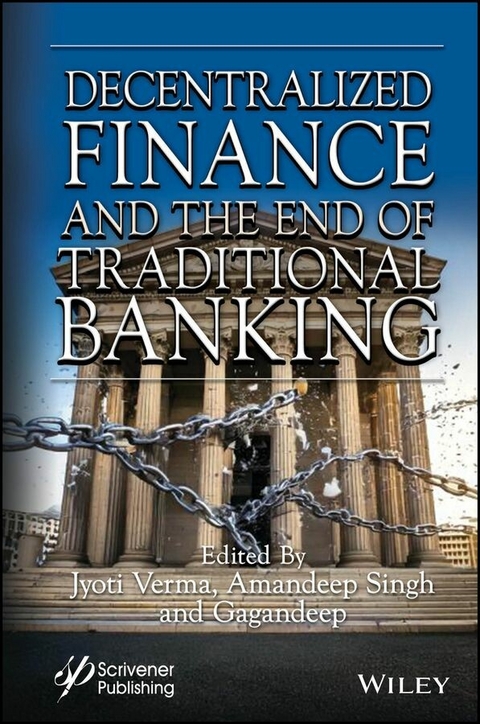
Decentralized Finance and the End of Traditional Banking (eBook)
540 Seiten
Wiley-Scrivener (Verlag)
978-1-394-27178-8 (ISBN)
This book provides the essential knowledge needed to navigate the revolutionary future of finance with confidence through its comprehensive and accessible exploration of decentralized finance.
This book is an in-depth exploration of the transformative power of decentralized finance (DeFi) and its potential to revolutionize the global financial system through in-depth analyses of the rise of DeFi, covering a wide range of topics such as cryptocurrencies, blockchain technology, smart contracts, decentralized exchanges, stablecoins, governance, and more. The volume offers readers a comprehensive understanding of the various aspects and components of the decentralized finance ecosystem. Adopting a forward-looking approach, the book examines the long-term implications for the financial industry, regulatory bodies, and the global economy. It explores the potential consequences of this paradigm shift, equipping readers with the knowledge to navigate the future of finance with confidence. By striking a balance between technical accuracy and accessibility, this book ensures that readers from various backgrounds will gain a comprehensive understanding of the complex concepts associated with DeFi.
Readers will find the book:
- Introduces the emerging DeFi ecosystem and its potential to transform the financial industry, providing a glimpse into the future of finance;
- Provides practical advice on how to invest in DeFi and navigate the rapidly evolving landscape, offering insights into the DeFi revolution and how to generate higher returns;
- Offers a comprehensive, in-depth exploration of the technologies driving DeFi, from blockchain technology to smart contracts;
- Explains how DeFi is challenging the traditional banking model and disrupting the financial industry, making it a must-read for anyone interested in the future of finance.
Audience
Academics, finance professionals, policymakers and regulators working with decentralized finance to revolutionize the world of banking.
Jyoti Verma, PhD is an associate professor in the Chitkara Business School at Chitkara University. She has authored one book, edited two books, numerous book chapters, and over 30 research papers in various national and international journals and conferences. Her core expertise is in the areas of service quality, blockchain, and behavioral finance.
Amandeep Singh, PhD is a professor in the Chitkara Business School at Chitkara University with over 16 years of teaching experience. He has published 48 research papers in various journals and conferences and edited over 10 books. His main areas of research are consumer sciences and business innovations.
Gagandeep, PhD is an assistant professor in marketing at Chitkara University with over 14 years of research and teaching experience. He has published over ten research papers. His areas of interest include marketing research, research methodology, management science, applied operations research, marketing management, and strategic management.
This book provides the essential knowledge needed to navigate the revolutionary future of finance with confidence through its comprehensive and accessible exploration of decentralized finance. This book is an in-depth exploration of the transformative power of decentralized finance (DeFi) and its potential to revolutionize the global financial system through in-depth analyses of the rise of DeFi, covering a wide range of topics such as cryptocurrencies, blockchain technology, smart contracts, decentralized exchanges, stablecoins, governance, and more. The volume offers readers a comprehensive understanding of the various aspects and components of the decentralized finance ecosystem. Adopting a forward-looking approach, the book examines the long-term implications for the financial industry, regulatory bodies, and the global economy. It explores the potential consequences of this paradigm shift, equipping readers with the knowledge to navigate the future of finance with confidence. By striking a balance between technical accuracy and accessibility, this book ensures that readers from various backgrounds will gain a comprehensive understanding of the complex concepts associated with DeFi. Readers will find the book: Introduces the emerging DeFi ecosystem and its potential to transform the financial industry, providing a glimpse into the future of finance; Provides practical advice on how to invest in DeFi and navigate the rapidly evolving landscape, offering insights into the DeFi revolution and how to generate higher returns; Offers a comprehensive, in-depth exploration of the technologies driving DeFi, from blockchain technology to smart contracts; Explains how DeFi is challenging the traditional banking model and disrupting the financial industry, making it a must-read for anyone interested in the future of finance. Audience Academics, finance professionals, policymakers and regulators working with decentralized finance to revolutionize the world of banking.
1
Introduction to Cryptocurrency and Blockchain
Vinita Choudhary1, Neha Kamboj2 and Sonal Trivedi3*
1School of Leadership and Management, Manav Rachna International Institute of Research and Studies, Faridabad, Haryana, India
2IILM School of Management, IILM University, Gurugram, Haryana, India
3VIT Business School, VIT Bhopal University, Kothrikalan, Sehore, Madhya Pradesh, India
Abstract
In current times, blockchain has come out as a groundbreaking technological innovation, particularly significant in sectors, such as banking, where trust plays a pivotal role. Concurrently, the cryptocurrency market has witnessed a surge in popularity. This surge has been accompanied by the availability of comprehensive information on cryptocurrency fluctuation of price across various exchanges. Utilizing statistical analysis, researchers aim to uncover the distinctive features of the crypto market in India. This chapter’s primary objective is to detect and examine the features of the crypto market and compare them with traditional secondary markets encompassing stocks, currencies, derivatives, commodities, and bonds in India. Throughout the chapter, the history and evolution of the crypto in India are elucidated shedding light on the operational aspects of cryptocurrency exchanges within the country. By presenting a comparative analysis, the chapter aims to illuminate the likenesses and variances between the cryptocurrency souq and traditional financial markets. It delves into the unique dynamics that set cryptocurrencies apart from conventional assets and financial instruments. Last, the chapter concludes by assessing potential opportunities for investors, such as arbitrage or hedging prospects, within the cryptocurrency market. This evaluation provides valuable insights for individuals looking to navigate the cryptocurrency landscape and make informed investment decisions.
Keywords: Blockchain, DLT, cryptocurrency market, bitcoin, finance, price fluctuation
1.1 Introduction
Blockchain technology is a decentralized form of Distributed Ledger Technology (DLT) that operates as a “chain of blocks.” Each block within the chain contains a hash and timestamped digital data serving as an inimitable identifier. Since its establishment, the utilization of blockchain technology within the finance industry has emerged as its primary application. The concept garnered substantial consideration when it was implemented for the cryptocurrency Bitcoin in 2009. The distinctive attributes of blockchain possess the potential to greatly enhance the finance industry [3].
The integration of blockchain technology in financial industry encompasses the application of this technology in diverse functions and operations associated with the financial services industry [26].
The development of blockchain technology offers numerous benefits to the financial services sector. Its utilization in finance industry has led to the advent of decentralized finance, commonly known as DeFi [14]. The establishment of blockchain technology to the world can be attributed to Bitcoin [24], initially limited to its use as a cryptographic method for facilitating Bitcoin transactions and related cryptocurrency activities [10, 29]. However, over the past 5 years, blockchain has gained popularity across various industries, including IoT and SCM [25].
Furthermore, according to Truby, the global blockchain market has seen rapid development in current years and is projected to arrive at a market worth of US$175 billion by 2025 and in surplus of US$3 trillion by 2030 [34]. This exponential growth can be attributed to the intrinsic distinctiveness of blockchain, such as trust, transparency, digital transactions, and its ability of serving as a platform for multiple stakeholders [35]. Researchers consider blockchain as a foundational technology [8] leading to various studies exploring its applications. The present study focuses on introducing blockchain technology and cryptocurrency. The chapter is structured into three sections as depicted in Figure 1.1: an opening Introduction, a subsequent Literature Review, and a concluding section known as the Conclusion. The Literature Review section is subsequently subdivided into the following:
Figure 1.1 Chapter flow.
Source: author compilation.
1.2 Introduction to Blockchain
1.2.1 Meaning of Blockchain Technology
The decentralized ledger that allows transactions to be recorded simultaneously on various computers is the fundamental characteristic of blockchain technology [2]. The foremost blockchain was designed, specified, and implemented by an individual using the pseudonym Satoshi Nakamoto [4].
Besides, a blockchain can be demarcated as a peer-to-peer (P2P) distributed database that employs a network idea. It consists of interconnected blocks, each of which contains timestamped transactions confirmed by network participants and safeguarded by a public-key infrastructure (PKI). When data are heaped on to the blockchain, they become immutable producing a permanent and unchangeable record of past transactions [15].
Additionally, blockchain is expected to catalyze a revolution in industry and commercial field. It drives global economic reform. It accomplishes this by generating a digital security code through encryption enabling users to confirm transactions without revealing personal data. Due to its immutability, blockchain records transactions automatically ensuring swift and distributed completion of each transaction [31].
Blockchain has been dubbed the “next-generation Internet” and a “foundational technology” due to its revolutionary impact on financial transactions, the economy, and the way people connect with one another [13]. It functions as a sheltered database and decentralized transaction system motorized by distributed nodes [6]. Blockchain, a groundbreaking technology, has captured the interest of businesses and administrations globally. The concept of “distributed ledger technology” pertains to a series of transactions and information that are systematically recorded and traced across a network of ledgers, which are decentralized [1].
In addition, blockchain is the underpinning technology behind cryptocurrencies operating as an append-only database where recording of transactions are done [16]. The entire information on a system of blockchain is freely readily available and subject to scrutiny by the system’s decentralized network of nodes.
A blockchain can also be described as an expanding list of interconnected blocks linked by encryption [31]. Blockchain play a vital role as transaction ledgers within cryptocurrency systems like Ethereum and Bitcoin. They serve as repositories for the current state of transactions and maintain a historical record of past transactions. A blockchain is essentially a chain of blocks, where each block uses hash functions for storing data and contains references to preceding blocks and timestamps [9].
Blockchain is essentially a distributed database, which makes it possible for the addition of new information alongside existing data [39]. As an outcome, the only choice is adding a block at the end of chain and a consensus process selects the information of a new block.
According to the descriptions above, blockchain is a distributed and peer-to-peer network-based record framework comprised of a sequence of recorded blocks containing validated transactions that become unchangeable upon addition and are secure by public-key infrastructure (PKI). The following part will go through the evolution of blockchain.
1.2.2 Development of Blockchain Technology
Blockchain technology development is split into three sections: Blockchain-1.0, Blockchain-2.0, and Blockchain-3.0 [19]. Based on the previously mentioned publications, this section will elucidate the three levels or phases of the technology’s development.
Blockchain technology has undergone significant developments across different generations:
Blockchain 1.0: Initially, the focus was on cryptocurrencies, like Bitcoin, and approximately 600 other cryptocurrencies emerged for use in Bitcoinbased applications. Ethereum, Monero, and Ripple gained popularity as alternative cryptocurrencies [7].
Blockchain 2.0: This phase expanded blockchain applications beyond monetary transactions to include bonds (promises), smart contracts, futures/ forwards, finances, and mortgages. Smart contracts, embedded code in the blockchain reacting to specific criteria, became a crucial feature [7].
Blockchain 3.0: In this generation, blockchain found universal applications across various sectors, such as government, research, medicine, culture, art, and education. Governments harnessed blockchain for transparency in operations and secure voting records [7].
The very first practice of blockchain was in encryption and decentralized networks [37]. The introduction of Ethereum in 2013 enabled blockchain development with contracts in a Turing-complete language allowing for versatile functions and automation [11].
Noteworthy blockchain applications include the launch of Linq in 2015, a decentralized platform for block trading, revolutionizing the global securities market. In 2016, the UK embraced Distributed Ledger Technology for governmental and financial...
| Erscheint lt. Verlag | 5.9.2025 |
|---|---|
| Sprache | englisch |
| Themenwelt | Mathematik / Informatik ► Informatik ► Netzwerke |
| Informatik ► Weitere Themen ► Hardware | |
| ISBN-10 | 1-394-27178-6 / 1394271786 |
| ISBN-13 | 978-1-394-27178-8 / 9781394271788 |
| Informationen gemäß Produktsicherheitsverordnung (GPSR) | |
| Haben Sie eine Frage zum Produkt? |
 EPUB (Adobe DRM)
Kopierschutz: Adobe-DRM
Adobe-DRM ist ein Kopierschutz, der das eBook vor Mißbrauch schützen soll. Dabei wird das eBook bereits beim Download auf Ihre persönliche Adobe-ID autorisiert. Lesen können Sie das eBook dann nur auf den Geräten, welche ebenfalls auf Ihre Adobe-ID registriert sind.
Details zum Adobe-DRM
Dateiformat: EPUB (Electronic Publication)
EPUB ist ein offener Standard für eBooks und eignet sich besonders zur Darstellung von Belletristik und Sachbüchern. Der Fließtext wird dynamisch an die Display- und Schriftgröße angepasst. Auch für mobile Lesegeräte ist EPUB daher gut geeignet.
Systemvoraussetzungen:
PC/Mac: Mit einem PC oder Mac können Sie dieses eBook lesen. Sie benötigen eine
eReader: Dieses eBook kann mit (fast) allen eBook-Readern gelesen werden. Mit dem amazon-Kindle ist es aber nicht kompatibel.
Smartphone/Tablet: Egal ob Apple oder Android, dieses eBook können Sie lesen. Sie benötigen eine
Geräteliste und zusätzliche Hinweise
Buying eBooks from abroad
For tax law reasons we can sell eBooks just within Germany and Switzerland. Regrettably we cannot fulfill eBook-orders from other countries.
aus dem Bereich