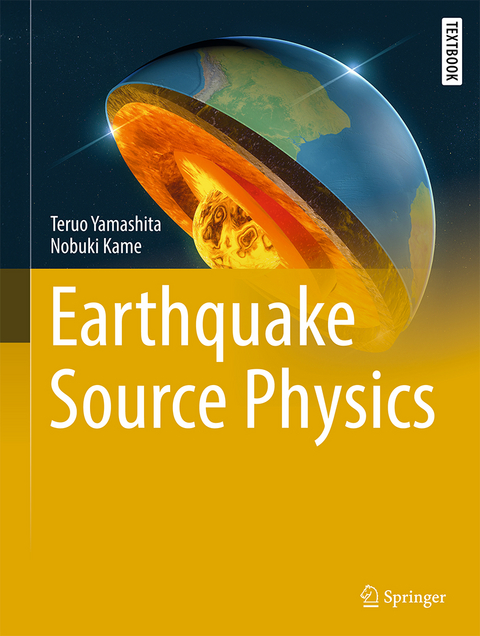
Earthquake Source Physics
Springer Verlag, Singapore
978-981-95-3508-8 (ISBN)
- Titel nicht im Sortiment
- Artikel merken
Teruo Yamashita is a professor emeritus at The University of Tokyo, Japan. For more than 35 years in the Earthquake Research Institute (ERI) affiliated with the university, he has led a brilliant career in both research and education. His most influential research contribution is a new theoretical and seismological understanding of earthquake seismicity and rupture. He brought new insights to how fault geometries and fault zones, through dynamic damage and fluid-enhanced dissipation processes, control earthquake rupture nucleation, propagation, and radiation. He is one of the authors of a comprehensive monograph on fluids in earthquake ruptures. He trained a selected group of brilliant graduate students with whom he developed his demanding research, and who have gone on to become leading scientists in first-rank Japanese universities. He has been the director of ERI for four years, the vice president of the Seismological Society of Japan, and an associate member of the Science Council of Japan. Nobuki Kame is an associate professor in the Theoretical Geoscience Division of the Earthquake Research Institute, The University of Tokyo, Japan. His research interests include earthquake source physics; slip-rupture propagation with a dynamically self-chosen faulting path; fault interaction with potential bend paths; and rupture propagation in heterogeneous media. For these, he has developed the new Boundary Integral Equation Methods (BIEM) for non-coplanar faults and Extended BIEM (XBIEM) in heterogeneous media, which have become reference points in seismology and seismic engineering. He has been awarded the Young Scientist’s Prize; The Commendation for Science and Technology by the Minister of Education, Culture, Sports, Science and Technology, Japan; the Research Award of the Seismological Society of Japan for Young Scientists; and the Inoue Prize for Young Research Scientists. He has participated in the Japanese translation of the textbook Quantitative Seismology, 2nd edition, by Aki and Richards.
Development of Mathematical Models of Earthquake Sources and Macroscopic Features of Earthquake Ruptures.- Fundamental Elements of Linear Elasticity Theory.- Mathematical Representation for Earthquake Sources.- Fundamental Elements of Linear Elastic Fracture Mechanics.
| Erscheinungsdatum | 29.11.2025 |
|---|---|
| Reihe/Serie | Springer Textbooks in Earth Sciences, Geography and Environment |
| Zusatzinfo | 52 Illustrations, color; 110 Illustrations, black and white |
| Verlagsort | Singapore |
| Sprache | englisch |
| Maße | 210 x 279 mm |
| Themenwelt | Mathematik / Informatik ► Mathematik ► Analysis |
| Naturwissenschaften ► Biologie ► Ökologie / Naturschutz | |
| Naturwissenschaften ► Geowissenschaften ► Geologie | |
| Naturwissenschaften ► Geowissenschaften ► Geophysik | |
| Schlagworte | Boundary Integral Equation Method • dynamic rupture • earthquake source physics • Fault rock friction • Seismology |
| ISBN-10 | 981-95-3508-5 / 9819535085 |
| ISBN-13 | 978-981-95-3508-8 / 9789819535088 |
| Zustand | Neuware |
| Informationen gemäß Produktsicherheitsverordnung (GPSR) | |
| Haben Sie eine Frage zum Produkt? |
aus dem Bereich