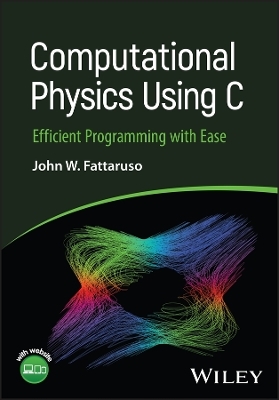
Computational Physics Using C
John Wiley & Sons Inc (Verlag)
978-1-394-31853-7 (ISBN)
- Noch nicht erschienen (ca. Juni 2026)
- Versandkostenfrei
- Auch auf Rechnung
- Artikel merken
1 INTRODUCTION 1.1 What is Computational Physics?
1.2 Modularizing and Reusing Code
1.3 Introduction to Computational Efficiency
1.4 Taylor’s Theorem
2 PRECISION LIMITS OF NUMERICAL COMPUTATION
2.1 Computer Numerical Representation
2.2 Roundoff Errors
2.3 Loss of Precision Errors
2.4 Truncation Errors
3 C PROGRAMMING DETAILS
3.1 Structures and Pointers
3.1.1 Pointers
3.1.2 Custom Data Types
3.1.3 Dynamic Memory Allocation
3.1.4 Structures for Tables, Vectors, and Matrices
3.2 Modularizing Code and Encapsulating Data in C
3.3 Common Coding Traps
3.3.1 Type Conversions
3.3.2 Mixed-Type Expressions
3.3.3 Floating Point Comparisons
3.3.4 Floating Point Loop Indexing
3.3.5 The Fence Post Problem 3.3.6 Library Function Domains
4 VISUALIZATION OF NUMERICAL MODELS
4.1 Function Stepper Tool
4.2 Damped Harmonic Oscillator
4.3 The gnuplot Plotting Tool
4.4 The Helmholtz Coil
4.5 Rainbows
4.6 Diffraction Patterns
4.7 Collisions
4.8 Quantum Wave Packets
4.9 Field Vectors
4.10 Exercises
5 ROOTS OF NONLINEAR FUNCTIONS
5.1 Root Finding Algorithms
5.1.1 The Newton-Raphson Method
5.1.2 Secant Method
5.1.3 Regula Falsi Method
5.1.4 Bisection Method
5.2 The Root Solver Tool
5.3 Kepler’s Equation
5.4 The Catenary
5.5 Kirchoff’s Voltage Law
5.6 Gravitational Lagrange Points
5.7 Finding Multiple Roots with Stepping
5.8 Quantum Energy Levels of Bound Particles
5.9 Exercises
6 SYSTEMS OF LINEAR EQUATIONS
6.1 Gaussian Elimination
6.2 Pivoting
6.3 The Systems of Linear Equations Tool
6.4 Modes of Coupled Oscillators
6.5 Kirchoff’s Current Law
6.6 Determinate Structures
6.7 Indeterminate Structures
6.8 Exercises
7 SYSTEMS OF NONLINEAR EQUATIONS
7.1 Newton-Raphson Algorithm
7.2 The Systems of Nonlinear Equations Tool
7.3 Mechanics Problems
7.4 Statics Problems
7.5 Nonlinear Circuits
7.6 Numerical Estimates of the Jacobian Partial Derivatives
7.7 The Covalent Bond
7.8 Exercises
8 MONTE CARLO SIMULATION
8.1 Applications of Pseudorandom Numbers
8.2 Linear Congruential Method
8.3 The Pseudorandom Number Generator Tool
8.4 Random Walks
8.5 Radioactive Decay
8.6 Classical Scattering
8.7 Olbers’ Paradox
8.8 Ideal Gas Simulation
8.9 Integration of Gauss’ Law
8.10 Exercises
9 INTERPOLATION OF SPARSE DATA POINTS
9.1 Interpolation Algorithms
9.1.1 Newton Polynomial
9.1.2 Lagrange Polynomial
9.2 The Interpolation Tool
9.3 Interpolation of Sparse Experimental Data
9.4 Interpolation of Sparse Astronomical Data
9.5 Interpolation of Expensive Simulated Data
9.6 Inverse Interpolation
9.7 Interpolation of Troublesome Numerical Data
10 NUMERICAL INTEGRATION
10.1 Integration Algorithms
10.1.1 Trapezoidal Rule
10.1.2 Simpson’s Rule
10.2 The Integration Tool
10.3 Orbital Circumference
10.4 The Helmholtz Coil Revisited
10.5 Practical Solenoids
11 FUNCTION MINIMIZATION
11.1 Single Variable Functions
11.2 Multiple Variable Functions
11.3 Optimizing the Helmholtz Coil
11.4 Nonlinear Fitting
11.5 Exercises
12 EXPLICIT METHODS FOR ORDINARY DIFFERENTIAL EQUATIONS
12.1 Vector Fields
12.2 Explicit Algorithms for Differential Equation
12.2.1 Euler’s Method
12.2.2 Heun’s Method
12.2.3 Modified Euler Method
12.2.4 Runge-Kutta Methods
12.2.5 Adams-Bashforth-Moulton Method
12.3 Solving Higher Order Equations and Systems of Differential Equations
12.4 The Differential Equation Solver Tool
12.5 Large-Angle Pendulum
12.6 Ballistics
12.7 Forced and Damped Pendulum
12.8 Inverted Pendulum
12.9 Synchronized Oscillators
12.10 Double Pendulum
12.11 Chaotic Dynamics
12.12 n-Body Collisions
12.13 Classical Field Lines
12.14 Playground Swing
12.15 Deflecting Charges in Magnetic Fields
12.16 Solid State Physics
12.17 Quantum Scattering
12.18 Exercises
13 IMPLICIT METHODS FOR ORDINARY DIFFERENTIAL EQUATIONS
13.1 Explicit Algorithm Instability
13.1.1 Backward Euler Method
13.1.2 Trapezoidal Method
13.2 The Implicit Differential Equation Solver Tool
13.3 Waves
13.4 n-Body Gravitational Systems
13.5 Magnetic Confinement
13.6 The Ionosphere
13.7 Exercises Bibliography Index
| Erscheint lt. Verlag | 8.6.2026 |
|---|---|
| Verlagsort | New York |
| Sprache | englisch |
| Themenwelt | Informatik ► Theorie / Studium ► Algorithmen |
| Informatik ► Theorie / Studium ► Künstliche Intelligenz / Robotik | |
| Naturwissenschaften ► Physik / Astronomie | |
| ISBN-10 | 1-394-31853-7 / 1394318537 |
| ISBN-13 | 978-1-394-31853-7 / 9781394318537 |
| Zustand | Neuware |
| Informationen gemäß Produktsicherheitsverordnung (GPSR) | |
| Haben Sie eine Frage zum Produkt? |
aus dem Bereich