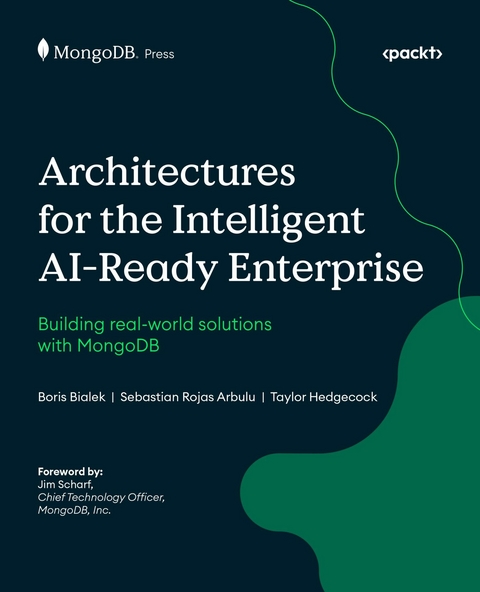
Architectures for the Intelligent AI-Ready Enterprise (eBook)
510 Seiten
Packt Publishing (Verlag)
978-1-80611-714-7 (ISBN)
AI is reshaping industries, yet most organizations struggle to scale beyond pilots. Architectures for the Intelligent AI-Ready Enterprise bridges this gap with practical frameworks for building AI-ready architectures that deliver lasting business value.
The book helps you explore System of Action databases and see why they're revolutionizing real-time decision-making. Through real-world applications across industries, from manufacturing and healthcare to financial services and retail, you'll discover how leading organizations transform their operations. You'll learn semantic data protection techniques that enable AI in regulated industries, as well as master advanced patterns including agentic AI and multi-agent orchestration.
Written by MongoDB and industry practitioners, this book combines strategy with technical depth and proven business value. You'll modernize by enabling AI innovation while preserving existing investments, implement trustworthy AI with governance frameworks, and build scalable solutions using a unified data platform like MongoDB that delivers measurable ROI and transformation.
Whether you're architecting next-generation systems or modernizing legacy infrastructure, this book provides the patterns, case studies, and expert guidance to build enterprises that'll thrive in an intelligent future.
Create AI-ready enterprise solutions with MongoDB and discover how to design intelligent architectures that transform data into innovation, efficiency, and real business valueKey FeaturesComplete guide covering GenAI to agentic AI, semantic protection to multi-agent systems25+ proven AI use cases delivering measurable impact across 6+ industries15+ real enterprise case studies from Novo Nordisk, Base 39, and morePurchase of the print or Kindle book includes a free PDF eBookBook DescriptionAI is reshaping industries, yet most organizations struggle to scale beyond pilots. Architectures for the Intelligent AI-Ready Enterprise bridges this gap with practical frameworks for building AI-ready architectures that deliver lasting business value. The book helps you explore System of Action databases and see why they're revolutionizing real-time decision-making. Through real-world applications across industries, from manufacturing and healthcare to financial services and retail, you'll discover how leading organizations transform their operations. You'll learn semantic data protection techniques that enable AI in regulated industries, as well as master advanced patterns including agentic AI and multi-agent orchestration. Written by MongoDB and industry practitioners, this book combines strategy with technical depth and proven business value. You ll modernize by enabling AI innovation while preserving existing investments, implement trustworthy AI with governance frameworks, and build scalable solutions using a unified data platform like MongoDB that delivers measurable ROI and transformation. Whether you're architecting next-generation systems or modernizing legacy infrastructure, this book provides the patterns, case studies, and expert guidance to build enterprises that ll thrive in an intelligent future.What you will learnDesign AI-ready data architectures that scale in productionDefine systems of action and explain why they matter for enterprisesModernize legacy systems for AI-ready, unified architecturesImplement governance, privacy, and compliance frameworks for AIExplore real-world AI implementations for over six industriesDeploy production RAG and agentic systems with MongoDBApply semantic data protection in regulated industriesBuild domain-specific AI agents and intelligent copilotsApply MCP, causal AI, and multi-agent systems for future-ready architecturesWho this book is forThis book is for IT leaders, enterprise architects, solution designers, and innovators ready to transform AI potential into production reality. Whether you're modernizing legacy systems, implementing scalable AI solutions, or translating AI concepts into measurable business outcomes, this book provides practical frameworks and industry-proven patterns. Basic familiarity with enterprise systems and data architecture is helpful, but deep AI expertise isn't required.]]>
Contents
- Note from the author
- Acknowledgements
- Preface
- Part 1: AI and Key Concepts
- AI Modernization to Innovation
- What Sets GenAI, RAG, and Agentic AI Apart
- The System of Action
- Trustworthy AI, Compliance, and Data Governance
- Why ethical AI matters
- Bridging principles and implementation
- Navigating the regulatory landscape
- Building trustworthy and responsible AI
- The road ahead: Emerging trends and future directions
- Summary
- References
- Modernization Using AI
- Part 2: Real-World Case Studies and Implementations
- Practical Applications of Agentic and GenAI in Manufacturing – Part 1
| Erscheint lt. Verlag | 5.9.2025 |
|---|---|
| Vorwort | Jim Scharf |
| Sprache | englisch |
| Themenwelt | Mathematik / Informatik ► Informatik ► Datenbanken |
| Informatik ► Office Programme ► Outlook | |
| Mathematik / Informatik ► Informatik ► Theorie / Studium | |
| ISBN-10 | 1-80611-714-2 / 1806117142 |
| ISBN-13 | 978-1-80611-714-7 / 9781806117147 |
| Informationen gemäß Produktsicherheitsverordnung (GPSR) | |
| Haben Sie eine Frage zum Produkt? |
 EPUB (Ohne DRM)
Digital Rights Management: ohne DRM
Dieses eBook enthält kein DRM oder Kopierschutz. Eine Weitergabe an Dritte ist jedoch rechtlich nicht zulässig, weil Sie beim Kauf nur die Rechte an der persönlichen Nutzung erwerben.
Dateiformat: EPUB (Electronic Publication)
EPUB ist ein offener Standard für eBooks und eignet sich besonders zur Darstellung von Belletristik und Sachbüchern. Der Fließtext wird dynamisch an die Display- und Schriftgröße angepasst. Auch für mobile Lesegeräte ist EPUB daher gut geeignet.
Systemvoraussetzungen:
PC/Mac: Mit einem PC oder Mac können Sie dieses eBook lesen. Sie benötigen dafür die kostenlose Software Adobe Digital Editions.
eReader: Dieses eBook kann mit (fast) allen eBook-Readern gelesen werden. Mit dem amazon-Kindle ist es aber nicht kompatibel.
Smartphone/Tablet: Egal ob Apple oder Android, dieses eBook können Sie lesen. Sie benötigen dafür eine kostenlose App.
Geräteliste und zusätzliche Hinweise
Buying eBooks from abroad
For tax law reasons we can sell eBooks just within Germany and Switzerland. Regrettably we cannot fulfill eBook-orders from other countries.
aus dem Bereich