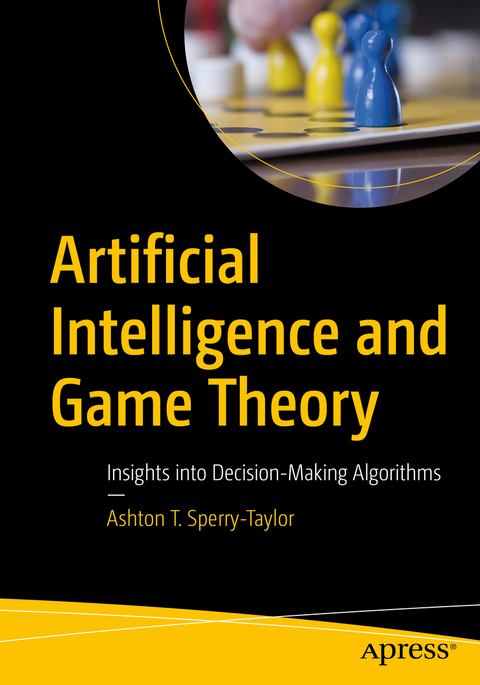
Artificial Intelligence and Game Theory
Apress (Verlag)
979-8-8688-2119-6 (ISBN)
- Titel nicht im Sortiment
- Artikel merken
Readers will find in-depth yet accessible discussions of essential ideas, complemented by a practical coding component in Jupyter Notebooks. This hands-on approach lets you experiment directly with Python-based models, guaranteeing that theoretical insights translate into concrete, problem-solving techniques.
Ideal for AI practitioners seeking to incorporate game theory into their work, this book is also an invaluable resource for students of computer science, economics, and philosophy. Game theorists aiming to expand into artificial intelligence will likewise find it indispensable. By blending an approachable style with rigorous content, Artificial Intelligence and Game Theory helps readers elevate their AI systems through strategic game-theoretic insights.
What you will learn:
Key Game Theory Concepts: Delve into Nash Equilibrium, evolutionary game theory, adversarial dynamics, cooperative strategies, and more.
Practical AI Applications: Apply game-theoretic models to real-world scenarios—autonomous vehicles, optimization tasks, multi-agent systems, and beyond.
Hands-On Coding: Experiment with Jupyter Notebooks for Python-based implementations of game-theoretic strategies.
Strategic AI Development: Elevate algorithmic decision-making in dynamic, competitive environments by integrating game theory into AI workflows.
Who This Book Is For
Data scientists, and machine learning/deep learning engineers who seek to integrate game theory into their work to enhance decision-making processes. It also targets AI practitioners and developers looking to optimize decision-making algorithms through game theory principles.
Dr. Ashton T. Sperry-Taylor holds a B.A. in Mathematics and Philosophy (with honors) from Franklin & Marshall College and a Ph.D. in Philosophy from the University of Missouri–Columbia. His expertise encompasses artificial intelligence, decision and game theory, and the philosophy of science. In his commercial endeavors, he develops algorithms to analyze and forecast in-home behavioral patterns, detect anomalies, identify falls, and employ computer vision to assess mobility. His algorithms offer long-term, in-home support for caregivers of the elderly and individuals with cognitive disabilities. His research centers on using reinforcement learning to model dynamic belief revision in game theory, examining the explanatory power of equilibrium models in the social sciences, and exploring how agent-based computational models tackle the complexity of social behavior. His work appears in peer-reviewed journals and is presented at conferences throughout North America and internationally.
Chapter 1: Agent-Based Models: Dancing Chaos into Order.- Chapter 2: Between Chatbots and Cogwheels: What is AI?.- Chapter 3: Multi-Armed Bandits: When Lady Luck Meets Learning Algorithms.- Chapter 4: Bargaining Games and the Nash Bargaining Solution.- Chapter 5: Bayesian Belief: The Mathematics of Learning from Experience.- Chapter 6: The Beauty Contest Game: Mirrors Within Mirrors of Strategic Reasoning.- Chapter 7: Beyond Turing's Teatime Chat: Susan Schneider's Quest for Truly Conscious AI.- Chapter 8: Let Them Slice Cake: Divide‑the‑Cake from Nash to Neural Nets.- Chapter 9: Cellular Automata: The Neighborhood Watch: How Simple Rules Create Complex Universes.- Chapter 10: The Centipede Game: When Perfect Logic Meets Imperfect Learning.- Chapter 11: Chatty Bots and Large Language Models: Why They Are Brilliant and Dumb at the Same Time.- Chapter 12: The Church-Turing Thesis: The Computational Bedrock of Multi-Agent Reasoning.- Chapter 13: Decision Theory: From Napkin Sketches to AI Algorithms: The Foundations and Future of Decision Theory.- Chapter 14: Property Dualism: The Mind's Property Portfolio.- Chapter 15: Substance Dualism: The Odd Couple of Mind and Body.- Chapter 16: Economists in the Grass: Ant Colonies, Decision-Making, and the Algorithmic Art of Coordination.- Chapter 17: Epistemic Game Theory: Knowledge, Belief, and Strategic Reasoning.- Chapter 18: Equilibrium Concepts: The Mathematical Foundations of Strategic Stability.- Chapter 19: Evolutionary Game Theory: How Strategies Evolve and Persist.- Chapter 20: El Farol Bar Problem: When Everyone Thinks They're the Only One Who Knows About the Cool Bar.- Chapter 21: Functionalism: The Mind as Software.- Chapter 22: Generative Adversarial Networks (GANs).- Chapter 23: Hawk-Dove Game: The Evolution of Aggression and Restraint.- Chapter 24: Hotelling Model: Competition in Space and Strategy.- Chapter 25: Hurwicz Criterion: Balancing Hope and Fear in Strategic Uncertainty.- Chapter 26: Swarm Intelligence: When the Collective Mind Outsmarts Individual Genius.- Chapter 27: (Condorcet's) Jury Theorem.- Chapter 28: Kripke's Functionalism Fiasco: When Even Calculators Can't Add Right.- Chapter 29: Robots, Minds, and the Henrietta Problem: Lycan's Case for Machine Consciousness.- Chapter 30: Materialism, Brains, and Brawn: The Case for Thinking Meat.- Chapter 31: The Nature of the Mind—Could Machines Ever Think Like Us?.- Chapter 32: Multi-Agent Reinforcement Learning: Learning in Strategic Environments.- Chapter 33: Network Games: Strategic Interactions in Connected Worlds.- Chapter 34: Newcomb's Problem: The Ultimate Decision-Making Paradox.- Chapter 35: Optimization or Equilibrium: When to Maximize and When to Stabilize.- Chapter 36: Modal Logic & Possible Worlds: The Multiverse of Reasoning in AI Systems.- Chapter 37: Prisoner's Dilemma: The Paradox of Rational Self-Interest.- Chapter 38: Q-Learning: When Algorithms Learn to Play Games They Don't Know They're Playing.- Chapter 39: Racial Segregation: When Good Intentions Meet Emergent Mathematics.- Chapter 40: Syntax Without Semantics? Searle, the Chinese Room, and the AI Conundrum.- Chapter 41: Stackelberg Games and Security: Leading from the Front (While the Follower Lurks).- Chapter 42: Venison à la Coordination: The Stag Hunt from Rousseau to Reinforcement Learning.- Chapter 43: Stochastic Games: When Game Theory Learns to Dance Through Time.- Chapter 44: Synthetic Societies & Digital Twins: When Pixels Become People and Villages Become Laboratories.- Chapter 45: The Great Mind Mimicry: Turing and His Imitation Game.- Chapter 46: The Ultimatum Game: The Laboratory of Human Fairness.- Chapter 47: Shapley Values: The Art of Fair Division in AI.- Chapter 48: War of Attrition: When Time Becomes the Ultimate Weapon: Or: How Patience, Persistence, and Strategic Timing Shape Everything from Fly Contests to Financial Markets.- Chapter 49: eXtensive Trees: When Strategy Meets Time: The Mathematical Architecture for Sequential Strategic Interactions in AI.- Chapter 50: Yao's Principle: When Randomness Becomes Your Best Defense.- Chapter 51: Constant/Zero-Sum Games: The Elegance of Pure Competition.
| Erscheinungsdatum | 29.11.2025 |
|---|---|
| Zusatzinfo | Approx. 400 p. |
| Verlagsort | Berkley |
| Sprache | englisch |
| Maße | 178 x 254 mm |
| Themenwelt | Informatik ► Theorie / Studium ► Künstliche Intelligenz / Robotik |
| Mathematik / Informatik ► Mathematik ► Angewandte Mathematik | |
| Mathematik / Informatik ► Mathematik ► Finanz- / Wirtschaftsmathematik | |
| Schlagworte | Artificial Intelligence • Autonomous Vehicles • decision-making algorithms • Game Theory • Generative Adversarial Networks (GANs) • Reinforcement Learning • stochastic games |
| ISBN-13 | 979-8-8688-2119-6 / 9798868821196 |
| Zustand | Neuware |
| Informationen gemäß Produktsicherheitsverordnung (GPSR) | |
| Haben Sie eine Frage zum Produkt? |
aus dem Bereich