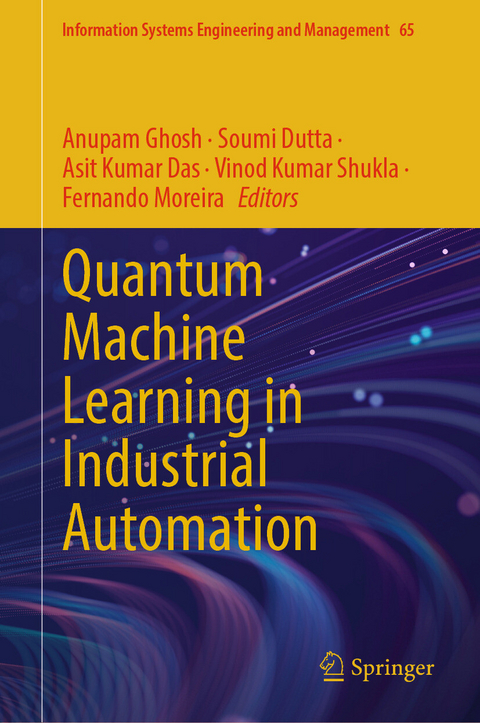
This book focuses on quantum machine learning that harnesses the collective properties of quantum states, such as superposition, interference, and entanglement, uses algorithms run on quantum devices, such as quantum computers, to supplement, expedite, or support the work performed by a classical machine learning program. The devices that perform quantum computations are known as quantum computers. Quantum computers have the potential to revolutionize computation by making certain types of classically intractable problems solvable. A few large companies and small start-ups now have functioning non-error-corrected quantum computers composed of several tens of qubits, and some of these are even accessible to the public through the cloud. Additionally, quantum simulators are making strides in fields varying from molecular energetics to many-body physics. Most known use cases fit into four archetypes: quantum simulation, quantum linear algebra for AI and machine learning, quantum optimization and search, and quantum factorization. Advantages of quantum computing are many and to list a few, first, they’re fast. Ultimately, quantum computers have the potential to provide computational power on a scale that traditional computers cannot ever match. In 2019, for example, Google claimed to carry out a calculation in about 200 seconds that would take a classical supercomputer around 10,000 years. Second, they can solve complex problems. The more complex a problem, the harder it is for even a supercomputer to solve. When a classical computer fails, it’s usually because of a huge degree of complexity and many interacting variables. However, due to the concepts of superposition and entanglement, quantum computers can account for all these variables and complexities to reach a solution. Last but not the least, they can run complex simulations. The speed and complexity that quantum computing can achieve means that, in theory, a quantum computer could simulate many intricate systems.
| Erscheint lt. Verlag | 3.10.2025 |
|---|---|
| Reihe/Serie | Information Systems Engineering and Management |
| Zusatzinfo | X, 456 p. 82 illus., 67 illus. in color. |
| Sprache | englisch |
| Themenwelt | Informatik ► Theorie / Studium ► Künstliche Intelligenz / Robotik |
| Technik ► Bauwesen | |
| Schlagworte | Automation • Computational Intelligence Quantum Machine Learning • Quantum devices • Quantum optimization • Quantum Support Vector Machines |
| ISBN-13 | 9783031997860 / 9783031997860 |
| Informationen gemäß Produktsicherheitsverordnung (GPSR) | |
| Haben Sie eine Frage zum Produkt? |
 PDF (Wasserzeichen)
DRM: Digitales Wasserzeichen
Dieses eBook enthält ein digitales Wasserzeichen und ist damit für Sie personalisiert. Bei einer missbräuchlichen Weitergabe des eBooks an Dritte ist eine Rückverfolgung an die Quelle möglich.
Dateiformat: PDF (Portable Document Format)
Mit einem festen Seitenlayout eignet sich die PDF besonders für Fachbücher mit Spalten, Tabellen und Abbildungen. Eine PDF kann auf fast allen Geräten angezeigt werden, ist aber für kleine Displays (Smartphone, eReader) nur eingeschränkt geeignet.
Systemvoraussetzungen:
PC/Mac: Mit einem PC oder Mac können Sie dieses eBook lesen. Sie benötigen dafür einen PDF-Viewer - z.B. den Adobe Reader oder Adobe Digital Editions.
eReader: Dieses eBook kann mit (fast) allen eBook-Readern gelesen werden. Mit dem amazon-Kindle ist es aber nicht kompatibel.
Smartphone/Tablet: Egal ob Apple oder Android, dieses eBook können Sie lesen. Sie benötigen dafür einen PDF-Viewer - z.B. die kostenlose Adobe Digital Editions-App.
Buying eBooks from abroad
For tax law reasons we can sell eBooks just within Germany and Switzerland. Regrettably we cannot fulfill eBook-orders from other countries.
aus dem Bereich