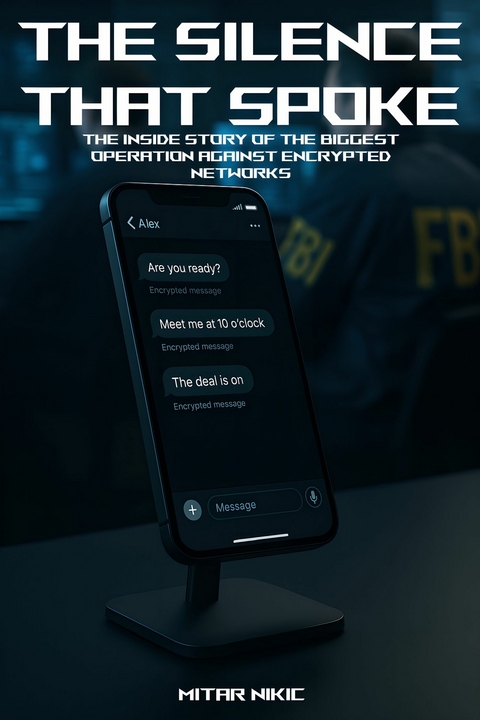
The Silence That Spoke (eBook)
60 Seiten
Publishdrive (Verlag)
978-0-00-104307-7 (ISBN)
When encrypted networks promised unbreakable privacy, thousands of users believed they were untouchable. Then came the coordinated global operations that exposed millions of hidden conversations, toppled entire communication empires, and shattered trust forever.
From EncroChat and Sky ECC to the FBI's ANOM sting, this book takes you deep inside the largest international crackdown on secure messaging platforms. Based on official reports, court documents, and insider accounts, it reveals how law enforcement outsmarted the systems designed to be unbreakable and what this means for the future of privacy.
A must-read for anyone interested in cybersecurity, digital freedom, and the hidden battles shaping our connected world.
Chapter 1
The Golden Age of Silence
There was a moment when it seemed that complete silence was possible again.
The world was still recovering from the shock of 2013.
Snowden’s revelations shattered the illusion of privacy.
Suddenly it became clear that almost every conversation, email, photo, and message could be stored somewhere, on someone’s server, beyond our control.
While most people continued using the same apps and phones, one part of the world would never be the same again.
For lawyers, investigators, business negotiators, and those operating on the edge of the law, every message carried potential risk.
A single sentence could mean the loss of a contract, a client, millions, or even freedom itself.
Out of this silence of distrust, a new industry began to emerge.
Invisible. Expensive. And deeply attractive to those who had the most to lose.
The First Clean Phones
The first generations of closed devices looked completely ordinary.
On a table they resembled standard Samsung Galaxy, Google Pixel, or BlackBerry phones, with all cameras and microphones in place.
At first glance, nothing suggested that an entirely different world was hidden inside.
The essence of protection was not in the hardware but in the software.
Google services and the Play Store were removed, the system was locked, and access was limited only to pre-installed applications.
In most cases, there was just a single communication app, hidden behind a neutral icon.
The interface of these apps was extremely simple.
A black background, white messages, minimal settings, and almost no visual details.
Messages were often deleted automatically after twenty-four or forty-eight hours, and there was no conversation history.
Minimalism was not a matter of aesthetics but of practicality.
The simpler the system, the lower the risk that something could go wrong.
People began changing their habits.
Messages became shorter, more direct, and colder.
Anything unnecessary disappeared from communication.
It was the language of silence a way of speaking built on the belief that every word carried weight and every mistake carried a price.
Entering the Network
You could not get these devices by accident.
There were no ads, no online promotions, no stores where you could simply buy one.
There was only a chain of recommendations.
If you knew the right person, you got the number.
If you didn’t, you simply didn’t exist.
In one small office in Antwerp, for example, meetings often started quickly and without introductions.
The distributor would place a phone on the table and simply say,
“This erases everything. After this, nothing exists.”
The device would be switched on, a message sent to you, you would reply, and then together you would watch the text disappear right before your eyes.
Nothing stayed in the app, nothing on the server.
That short demonstration was enough.
No one asked about algorithms, encryption, or code.
People trusted the person, not the technology.
It was this network of trust that sold the devices not ads, not specifications, but the feeling of belonging to a closed circle.
The Psychology of the User
Everyone had their own reasons, but they all shared the same need to disappear from the eyes of others.
For business people, it meant the ability to negotiate far from prying eyes.
For lawyers, it was the assurance that confidential information would never leave the office.
For networks operating outside the law, it was a tool for survival.
At one point, these devices also became status symbols.
In private clubs, if you placed a closed phone on the table, that alone was enough.
You did not have to say a single word the device spoke for you.
The culture of closed circles was what fueled these networks.
The fact that devices were available only through personal recommendations made them even more valuable.
The longer the path to get one, the greater the trust it created.
But that very culture became their greatest weakness.
People trusted the distributor, the company, the network and no one questioned how any of it actually worked.
The Explosion of the Market
By 2018, this industry was valued at more than one billion dollars a year.
Devices were sold at prices ranging from 1,500 to 5,000 euros, and monthly subscriptions reached up to 1,000 euros.
Users saw them as an investment, not an expense.
For a lawyer, it was the price of silence between them and the client.
For a financier, it was the guarantee that no offer would end up in someone else’s inbox.
For smuggling networks, it was the only way to make sure the next shipment reached its destination.
Sky ECC, EncroChat, Phantom Secure, Ciphr, names that meant nothing to ordinary users but served as a guarantee of invisibility in the world of closed networks.
At the time, it seemed nothing could threaten them.
Everyone believed there was technology stronger than the system.
But the system was watching.
Silently.
Patiently.
For years.
The Myth of Unbreakability
By the end of 2019, the reputation of these networks had reached almost mythical status.
At private meetings, phones without cameras were a sign of belonging to an elite that claimed to know better.
People would say that the police had no chance, that there was no system capable of breaking ECC encryption.
What no one knew was that, behind closed doors, the largest international digital surveillance operations in Europe’s history had already begun.
The police were listening.
Messages had already started to leak.
And none of the users had any idea.
The First Cracks
On the surface, everything seemed perfect.
You turned on the phone, sent a message, and it disappeared.
Users were assured that servers stored nothing, that the encryption was unbreakable, and that even the company itself had no access to the content.
For years, those promises were the foundation of trust.
But by 2019, behind the scenes, the authorities had begun to move.
In France, as part of joint investigations into European smuggling networks, analysts started monitoring communication patterns.
Some criminal groups were using phones that seemed to exist nowhere else.
They had no common apps, no connections to popular services, everything flowed through closed networks.
This was not unusual, but the sheer volume of data passing through these channels was staggering.
One of these networks was called EncroChat.
On the surface, it appeared unbreakable.
At first, French engineers only watched, for days and then months, trying to understand what was really happening.
And then they found the first clue.
The updates sent to the devices passed through a single point in the network that could be exploited.
That was the moment when the largest covert digital wiretapping operation in Europe’s history began.
EncroChat The Year Silence Spoke
French police and the Gendarmerie Nationale developed a special piece of malware designed to be implanted directly onto EncroChat phones.
The device looked the same, the interface did not change, and messages disappeared just as they always had.
But now there was another layer silent, invisible, almost elegant.
The moment you sent a message, it first appeared on the investigators’ screens.
From June 2020, tens of thousands of EncroChat users across Europe continued their conversations as...
| Erscheint lt. Verlag | 31.8.2025 |
|---|---|
| Sprache | englisch |
| Themenwelt | Informatik ► Netzwerke ► Sicherheit / Firewall |
| ISBN-10 | 0-00-104307-2 / 0001043072 |
| ISBN-13 | 978-0-00-104307-7 / 9780001043077 |
| Informationen gemäß Produktsicherheitsverordnung (GPSR) | |
| Haben Sie eine Frage zum Produkt? |
 EPUB (Adobe DRM)
Größe: 951 KB
Kopierschutz: Adobe-DRM
Adobe-DRM ist ein Kopierschutz, der das eBook vor Mißbrauch schützen soll. Dabei wird das eBook bereits beim Download auf Ihre persönliche Adobe-ID autorisiert. Lesen können Sie das eBook dann nur auf den Geräten, welche ebenfalls auf Ihre Adobe-ID registriert sind.
Details zum Adobe-DRM
Dateiformat: EPUB (Electronic Publication)
EPUB ist ein offener Standard für eBooks und eignet sich besonders zur Darstellung von Belletristik und Sachbüchern. Der Fließtext wird dynamisch an die Display- und Schriftgröße angepasst. Auch für mobile Lesegeräte ist EPUB daher gut geeignet.
Systemvoraussetzungen:
PC/Mac: Mit einem PC oder Mac können Sie dieses eBook lesen. Sie benötigen eine
eReader: Dieses eBook kann mit (fast) allen eBook-Readern gelesen werden. Mit dem amazon-Kindle ist es aber nicht kompatibel.
Smartphone/Tablet: Egal ob Apple oder Android, dieses eBook können Sie lesen. Sie benötigen eine
Geräteliste und zusätzliche Hinweise
Buying eBooks from abroad
For tax law reasons we can sell eBooks just within Germany and Switzerland. Regrettably we cannot fulfill eBook-orders from other countries.
aus dem Bereich