


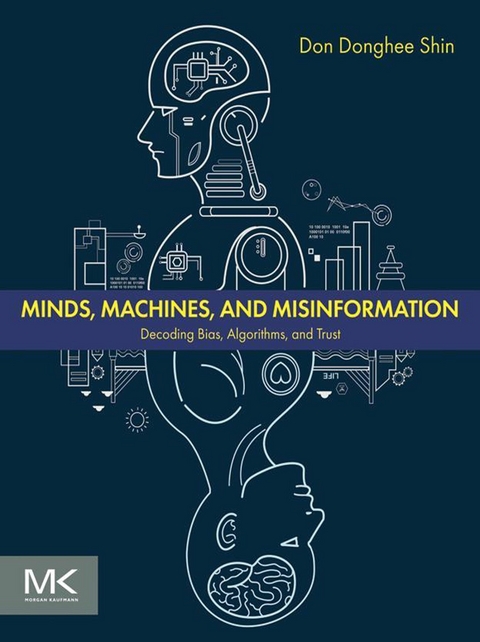
Minds, Machines, and Misinformation (eBook)
200 Seiten
Elsevier Science (Verlag)
978-0-443-16105-6 (ISBN)
Dr. Don Donghee Shin is a Full Professor of Digital Media at the College of Communication and Media Sciences at Zayed University and a Distinguished Endowed Professor by the Korean Ministry of Education in the Department of Interactive Media at Sungkyukywan (Samsung) University, Seoul, South Korea. His research explores the impact of algorithmic platforms, combining topics in ethics, algorithms, human-computer interaction, and media studies. In his current research, he has researched mechanisms to investigate users' behavior around opaque algorithmic systems, redesign these systems to communicate opaque algorithmic processes to users, and provide them with a more informed, satisfying, and engaging interaction. His research is supported by the public sector and the private sector. Dr. Shin has been ranked among the top 2% of most-cited scientists in the world by Stanford University
Algorithms have become the key organizer through which power is enacted in our society. A huge amount of data regarding our daily routines are monitored and analyzed to make recommendations that manage, control, and lead our behaviors in everyday life. AI, Humans, and Misinformation: How Does AI Alter Human Behavior and How Do Humans Influence Algorithmic Misinformation? is a guide to understanding the dynamics of AI and misinformation in human contexts by addressing meaningful questions-How does AI alter human behavior and how do humans influence algorithmic decision-making? In answering these questions, this book examines the role of misinformation, disinformation, and fake news, and shows readers how to develop AI methods and algorithms that combat misinformation by using AI design choices that provide users and developers alike with meaningful control over AI. This book brings together various perspectives on algorithms into an integrated conceptual framework, and provides a broad socio-technical analysis, addressing critical and ethical issues of misinformation and fake news. The book offers a compelling insight into the misinformation phenomenon and the future of AI-based society. Readers will find an integrated technical analysis of the logic and social implications of algorithmic processes. Reporting from the cutting edge of critical technical methods and research, the result is useful and constructive for developing the relations between algorithms and humans. This is an imperative methodology for understanding what is at stake as industry and government use AI to reshape the world. - Provides a comprehensive examination of the technical foundations and social effects of algorithmic processes and how they are used to purvey and combat misinformation- Includes deep technical models for AI and ML algorithm developers who seek to alleviate the impacts of misinformation, including credibility assessment models, trust heuristics, and Information Processing Theory- Provides detailed technical understanding of computational approaches to combat misinformation such as automated deception detectors, clickbait detectors, satirical fake detectors, rumor debunkers, and computational fact-checking tools- Focuses on the human aspects of AI and misinformation, and the multidisciplinary study of trends, problems, and algorithmic functions
| Erscheint lt. Verlag | 11.8.2025 |
|---|---|
| Sprache | englisch |
| Themenwelt | Informatik ► Theorie / Studium ► Algorithmen |
| Mathematik / Informatik ► Mathematik | |
| ISBN-10 | 0-443-16105-4 / 0443161054 |
| ISBN-13 | 978-0-443-16105-6 / 9780443161056 |
| Informationen gemäß Produktsicherheitsverordnung (GPSR) | |
| Haben Sie eine Frage zum Produkt? |
 EPUB (Adobe DRM)
Kopierschutz: Adobe-DRM
Adobe-DRM ist ein Kopierschutz, der das eBook vor Mißbrauch schützen soll. Dabei wird das eBook bereits beim Download auf Ihre persönliche Adobe-ID autorisiert. Lesen können Sie das eBook dann nur auf den Geräten, welche ebenfalls auf Ihre Adobe-ID registriert sind.
Details zum Adobe-DRM
Dateiformat: EPUB (Electronic Publication)
EPUB ist ein offener Standard für eBooks und eignet sich besonders zur Darstellung von Belletristik und Sachbüchern. Der Fließtext wird dynamisch an die Display- und Schriftgröße angepasst. Auch für mobile Lesegeräte ist EPUB daher gut geeignet.
Systemvoraussetzungen:
PC/Mac: Mit einem PC oder Mac können Sie dieses eBook lesen. Sie benötigen eine
eReader: Dieses eBook kann mit (fast) allen eBook-Readern gelesen werden. Mit dem amazon-Kindle ist es aber nicht kompatibel.
Smartphone/Tablet: Egal ob Apple oder Android, dieses eBook können Sie lesen. Sie benötigen eine
Geräteliste und zusätzliche Hinweise
Buying eBooks from abroad
For tax law reasons we can sell eBooks just within Germany and Switzerland. Regrettably we cannot fulfill eBook-orders from other countries.
aus dem Bereich


