


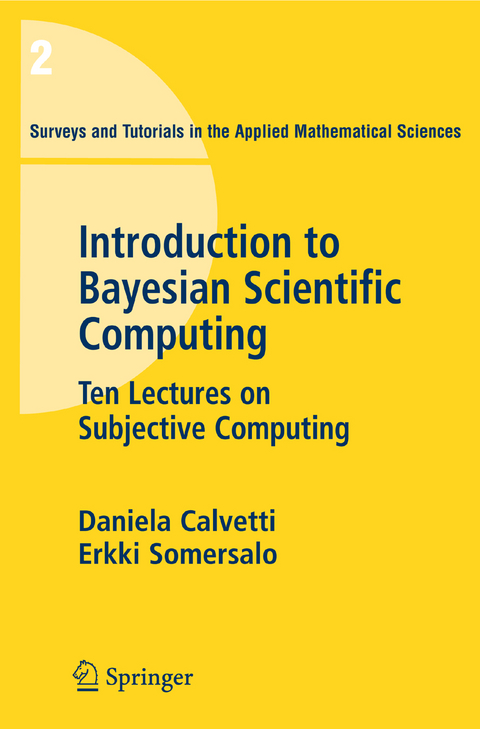
An Introduction to Bayesian Scientific Computing
Ten Lectures on Subjective Computing
Seiten
2007
|
2007 ed.
Springer-Verlag New York Inc.
978-0-387-73393-7 (ISBN)
Springer-Verlag New York Inc.
978-0-387-73393-7 (ISBN)
The book of nature, according to Galilei, is written in the language of mat- matics. The nature of mathematics is being exact, and its exactness is und- lined by the formalism used by mathematicians to write it. This formalism, characterized by theorems and proofs, and syncopated with occasional l- mas, remarks and corollaries, is so deeply ingrained that mathematicians feel uncomfortable when the pattern is broken, to the point of giving the - pression that the attitude of mathematicians towards the way mathematics should be written is almost moralistic. There is a de?nition often quoted, “A mathematician is a person who proves theorems”, and a similar, more alchemistic one, credited to Paul Erd? os, but more likely going back to Alfr´ ed R´ enyi,statingthat“Amathematicianisamachinethattransformsco?eeinto 1 theorems ”. Therefore it seems to be the form, not the content, that char- terizes mathematics, similarly to what happens in any formal moralistic code wherein form takes precedence over content. This book is deliberately written in a very di?erent manner, without a single theorem or proof. Since morality has its subjective component, to pa- phrase Manuel Vasquez Montalban, we could call it Ten Immoral Mathemat- 2 ical Recipes . Does the lack of theorems and proofs mean that the book is more inaccurate than traditional books of mathematics? Or is it possibly just a sign of lack of co?ee? This is our ?rst open question. Exactness is an interesting concept.
Inverse problems and subjective computing.- Basic problem of statistical inference.- The praise of ignorance: randomness as lack of information.- Basic problem in numerical linear algebra.- Sampling: first encounter.- Statistically inspired preconditioners.- Conditional Gaussian densities and predictive envelopes.- More applications of the Gaussian conditioning.- Sampling: the real thing.- Wrapping up: hypermodels, dynamic priorconditioners and Bayesian learning.
| Reihe/Serie | Surveys and Tutorials in the Applied Mathematical Sciences ; 2 |
|---|---|
| Zusatzinfo | XIV, 202 p. |
| Verlagsort | New York, NY |
| Sprache | englisch |
| Maße | 155 x 235 mm |
| Themenwelt | Mathematik / Informatik ► Informatik ► Theorie / Studium |
| ISBN-10 | 0-387-73393-0 / 0387733930 |
| ISBN-13 | 978-0-387-73393-7 / 9780387733937 |
| Zustand | Neuware |
| Informationen gemäß Produktsicherheitsverordnung (GPSR) | |
| Haben Sie eine Frage zum Produkt? |
Mehr entdecken
aus dem Bereich



aus dem Bereich
was jeder über Informatik wissen sollte
Buch | Softcover (2024)
Springer Vieweg (Verlag)
CHF 53,15
Grundlagen – Anwendungen – Perspektiven
Buch | Softcover (2022)
Springer Vieweg (Verlag)
CHF 53,15
Teil 2 der gestreckten Abschlussprüfung Fachinformatiker/-in …
Buch | Softcover (2025)
Europa-Lehrmittel (Verlag)
CHF 37,90


