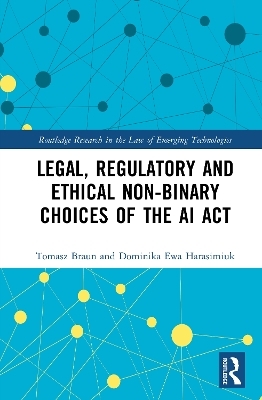
Legal, Regulatory and Ethical Non-binary Choices of the AI Act
Routledge (Verlag)
978-1-032-58350-1 (ISBN)
This book investigates the complex ethical dilemmas underpinning AI regulation, analysing the EU Artificial Intelligence Act in the context of the fundamental values and ambitious expectations that have accompanied it initially.
This book posits a pioneering regulatory framework to ensure the ethical development and equitable deployment of AI technologies for societal benefit. The expanding integration of AI and its deepening interaction with humans raise profound ethical dilemmas. As legislators endeavour to address these rapid developments and ensure AI serves the public good and does not cause harm, this book discusses the ethical complexities which pose a significant challenge for the EU and beyond. The book posits the discussion on AI regulation in a broader global background and refers to human agency, trustworthiness, risk classifications, the attribution of liability for deficiencies arising from its improper implementation, and other problems that the AI-based systems may cause. Additionally, it seeks to familiarise the reader with the AI Act and critically expands on the burdens the new law may impose on subjects.
This book will be of interest to researchers, policymakers, students and practitioners with an interest in the legal and ethical dimensions of technology law, governance, EU law, and artificial intelligence.
The Open Access version of this book, available at http://www.taylorfrancis.com, has been made available under a Creative Commons Attribution-Non Commercial-No Derivatives (CC BY-NC-ND) 4.0 license.
Tomasz Braun, PhD is a legal scholar, Assistant Professor at the Faculty of Law and Vice-rector for International Relations at Lazarski University, author of numerous books and articles about the theories of law and normative ethics, artificial intelligence and sustainable development regulations and legal compliance. Dominika Ewa Harasimiuk is Assistant Professor at the Faculty of Political Sciences and International Studies of the University of Warsaw, Department of EU Law and Institutions, Poland.
1. Introduction 2. AI Act – The Single Market Instrument 3. Future-proof Difficulty 4. Risk-based Approach versus Principle-based approach 5. Delegation of powers and governance structures 6. Debatable Efficiency of Soft Laws 7. Ex ante and ex Post Procedures and Controls 8. The Ethical and Value-based Matrix 9. Conclusions
| Erscheinungsdatum | 04.12.2025 |
|---|---|
| Reihe/Serie | Routledge Research in the Law of Emerging Technologies |
| Verlagsort | London |
| Sprache | englisch |
| Maße | 156 x 234 mm |
| Gewicht | 580 g |
| Themenwelt | Informatik ► Theorie / Studium ► Künstliche Intelligenz / Robotik |
| Recht / Steuern ► Allgemeines / Lexika | |
| Recht / Steuern ► EU / Internationales Recht | |
| Recht / Steuern ► Privatrecht / Bürgerliches Recht ► IT-Recht | |
| ISBN-10 | 1-032-58350-9 / 1032583509 |
| ISBN-13 | 978-1-032-58350-1 / 9781032583501 |
| Zustand | Neuware |
| Informationen gemäß Produktsicherheitsverordnung (GPSR) | |
| Haben Sie eine Frage zum Produkt? |
aus dem Bereich