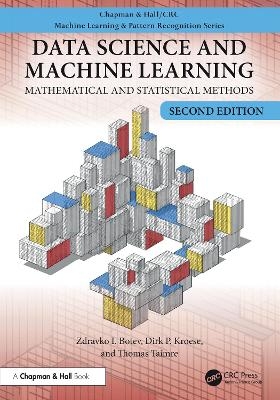
Data Science and Machine Learning
Chapman & Hall/CRC (Verlag)
978-1-032-48868-4 (ISBN)
Praise for the first edition:
“In nine succinct but information-packed chapters, the authors provide a logically structured and robust introduction to the mathematical and statistical methods underpinning the still-evolving field of AI and data science.”
- Joacim Rocklöv and Albert A. Gayle, International Journal of Epidemiology, Volume 49, Issue 6
“This book organizes the algorithms clearly and cleverly. The way the Python code was written follows the algorithm closely—very useful for readers who wish to understand the rationale and flow of the background knowledge.”
- Yin-Ju Lai and Chuhsing Kate Hsiao, Biometrics, Volume 77, Issue 4
The purpose of Data Science and Machine Learning: Mathematical and Statistical Methods is to provide an accessible, yet comprehensive textbook intended for students interested in gaining a better understanding of the mathematics and statistics that underpin the rich variety of ideas and machine learning algorithms in data science.
New in the Second Edition
This expanded edition provides updates across key areas of statistical learning:
Monte Carlo Methods: A new section introducing regenerative rejection sampling - a simpler alternative to MCMC.
Unsupervised Learning: Inclusion of two multidimensional diffusion kernel density estimators, as well as the bandwidth perturbation matching method for the optimal data-driven bandwidth selection.
Regression: New automatic bandwidth selection for local linear regression.
Feature Selection and Shrinkage: A new chapter introducing the klimax method for model selection in high-dimensions.
Reinforcement Learning: A new chapter on contemporary topics such as policy iteration, temporal difference learning, and policy gradient methods, all complete with Python code.
Appendices: Expanded treatment of linear algebra, functional analysis, and optimization that includes the coordinate-descent method and the novel Majorization–Minimization method for constrained optimization.
Key Features:
Focuses on mathematical understanding.
Presentation is self-contained, accessible, and comprehensive.
Extensive list of exercises and worked-out examples.
Many concrete algorithms with Python code.
Full color throughout and extensive indexing.
A single-counter consecutive numbering of all theorems, definitions, equations, etc., for easier text searches.
Zdravko I. Botev, PhD, is the pioneer of several modern statistical methodologies, including the diffusion kernel density estimator, the generalized splitting method for rare-event simulation, the bandwidth perturbation matching method, the regenerative rejection sampling method, and the klimax method for feature selection. His contributions to computational statistics and data science have been recognized with honours such as the Christopher Heyde Medal from the Australian Academy of Science and the Gavin Brown Prize from the Australian Mathematical Society. Dirk P. Kroese, PhD, is an Emeritus Professor in Mathematics and Statistics at the University of Queensland. He is known for his significant contributions to the fields of applied probability, mathematical statistics, machine learning, and Monte Carlo methods. He has published over 140 articles and 7 books. He is a pioneer of the well-known Cross-Entropy (CE) method, which is being used around the world to help solve difficult estimation and optimization problems in science, engineering, and finance. Thomas Taimre, PhD, is a Senior Lecturer of Mathematics and Statistics at The University of Queensland. His research interests range from applied probability and Monte Carlo methods to applied physics and the remarkably universal self-mixing effect in lasers. He has published over 100 articles, holds a patent, and is the coauthor of Handbook of Monte Carlo Methods (Wiley).
Preface Notation 1. Importing, Summarizing, and Visualizing Data 2. Statistical Learning 3. Monte Carlo Methods 4. Unsupervised Learning 5. Regression 6. Feature Selection and Shrinkage 7. Reproducing Kernel Methods 8. Classification 9. Decision Trees and Ensemble Methods 10. Deep Learning 11. Reinforcement Learning Appendix A. Linear Algebra Appendix B. Functional Analysis Appendix C. Multivariate Differentiation and Optimization Appendix D. Probability and Statistics Appendix E. Python Primer Bibliography Index
| Erscheinungsdatum | 01.11.2025 |
|---|---|
| Reihe/Serie | Chapman & Hall/CRC Machine Learning & Pattern Recognition |
| Zusatzinfo | 45 Tables, black and white; 138 Line drawings, color; 7 Line drawings, black and white; 6 Halftones, color; 2 Halftones, black and white; 144 Illustrations, color; 9 Illustrations, black and white |
| Sprache | englisch |
| Maße | 178 x 254 mm |
| Gewicht | 1560 g |
| Themenwelt | Informatik ► Theorie / Studium ► Künstliche Intelligenz / Robotik |
| Mathematik / Informatik ► Mathematik ► Computerprogramme / Computeralgebra | |
| ISBN-10 | 1-032-48868-9 / 1032488689 |
| ISBN-13 | 978-1-032-48868-4 / 9781032488684 |
| Zustand | Neuware |
| Informationen gemäß Produktsicherheitsverordnung (GPSR) | |
| Haben Sie eine Frage zum Produkt? |
aus dem Bereich