


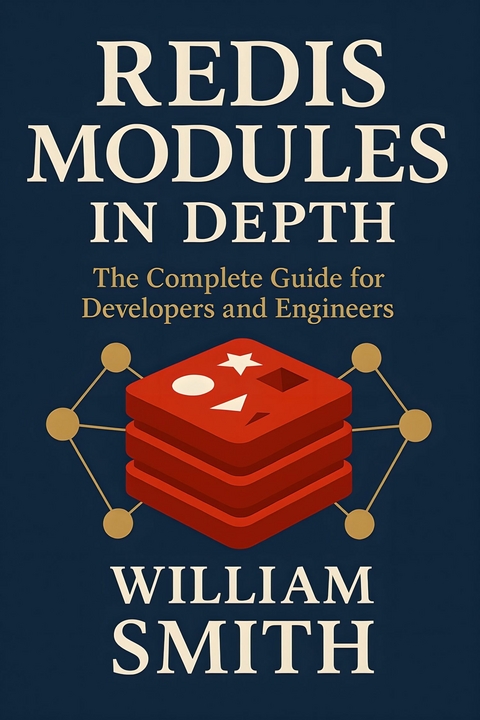
Redis Modules in Depth (eBook)
250 Seiten
HiTeX Press (Verlag)
978-0-00-103037-4 (ISBN)
'Redis Modules in Depth'
'Redis Modules in Depth' is the definitive guide for developers and architects seeking to unleash the full potential of Redis's extensibility through its powerful module system. Beginning with a deep exploration of Redis core architecture, this book unpacks the constraints of native functionality and demonstrates how the module API brings unprecedented flexibility to in-memory data management. Readers are immersed in foundational concepts-covering everything from threading and memory management to security and advanced use cases-laying the groundwork for designing, building, and deploying sophisticated Redis modules.
The heart of the book provides a hands-on, comprehensive dive into module API mechanics, guiding readers through module lifecycle management, custom command definitions, event hooks, persistence strategies, and inter-module communication in distributed Redis clusters. Practical coverage extends to designing efficient, robust, and secure modules: threading, memory safety, atomic operations, failover, cross-command context, error reporting, and integrating with external systems are all examined through best practices and real-world patterns. Special attention is given to security, sandboxing, auditing, and ensuring regulatory compliance in module development.
Rounding out the guide, 'Redis Modules in Depth' presents detailed architecture dissections of industry-leading modules like RediSearch, RedisGraph, and RedisAI, sharing implementation insights and reusable engineering patterns. A forward-looking final section surveys emerging trends such as serverless execution, WebAssembly integration, and evolving research opportunities. With pragmatic advice on testing, CI/CD, observability, and versioning, this book equips Redis professionals to craft secure, performant, and future-proof modules in today's evolving data landscape.
Chapter 2
Redis Module API Deep Dive
Beyond the command line and server configs lies Redis’s true engine of innovation: the Module API. In this chapter, we journey into the intricate, powerful, and sometimes treacherous territory that empowers developers to bend Redis to their will. From the choreography of module lifecycles to the nuances of command orchestration and data structure hacking, we pull apart the gears that make modular extensibility not only possible but practical for advanced workloads.
2.1 Module Initialization and Lifecycle
Redis modules extend the core server capabilities through a defined API that governs their initialization, registration, management, and unloading. Understanding these lifecycle protocols is vital to ensuring stability, maintainability, and seamless upgrade paths in production deployments.
The entry point of any Redis module is the RedisModule_OnLoad function, which the server invokes upon loading the module binary. This function serves both as an initialization hook and as an opportunity to declare metadata and register functionalities. It is defined with the signature:
Here, ctx provides the context for API calls, while argv and argc expose the module arguments supplied upon loading. Returning REDISMODULE_OK affirms successful initialization, whereas any non-zero return signals failure, causing Redis to abort the module load sequence.
Within OnLoad, modules must first declare their API version compatibility via:
return REDISMODULE_ERR;
This call registers the module name, version, and API version. The API version constant, such as REDISMODULE_APIVER_1, is critical to enforce compatibility with the Redis server’s supported API set, enabling future Redis releases to maintain backward compatibility or gracefully reject incompatible modules.
Following initialization, modules register commands, data types, event listeners, or other features. Command registration is performed by:
Arguments specify command name, handler function, flags (such as "write" to indicate data modification), and key position heuristics for Redis cluster support.
Beyond OnLoad, Redis modules can manage lifecycle events through hooks to enhance resource management and responsiveness. Although Redis itself lacks a comprehensive dynamic unloading mechanism, recent API additions such as RedisModule_OnUnload provide a graceful shutdown hook. Implementing OnUnload allows modules to cleanly release long-lived resources, including memory allocations, background threads, or file descriptors:
// Cleanup code here
}
Proper cleanup is paramount for modules that maintain state beyond the request scope, especially those managing custom data types. For example, a module implementing a novel data structure type must unregister the type and free all associated memory during unload to prevent leaks and undefined behavior.
Stateful modules often allocate resources such as persistent memory contexts, background job systems, or OS handles during initialization or runtime. Encapsulating resource lifetimes within these lifecycle hooks ensures robustness under restart, upgrade, or failover scenarios. Note that persistent data structures registered through module data types participate in Redis persistence mechanisms (RDB/AOF), requiring careful design to maintain consistency and recovery guarantees.
Versioning plays a dual role by facilitating compatibility and enabling modules to evolve without breaking dependent applications. Through explicit API version constants and module version numbers, Redis supports:
- Detection of incompatible API changes preventing unsafe loads.
- Conditional logic within modules to adapt to available API features.
- Smooth upgrades allowing coexistence of multiple module versions across server restarts.
Consider the following idiomatic initialization contract excerpt illustrating version checking and command registration:
if (RedisModule_Init(ctx, "examplemod", 2, REDISMODULE_APIVER_1) == REDISMODULE_ERR)
return REDISMODULE_ERR;
...
| Erscheint lt. Verlag | 15.8.2025 |
|---|---|
| Sprache | englisch |
| Themenwelt | Mathematik / Informatik ► Informatik ► Programmiersprachen / -werkzeuge |
| ISBN-10 | 0-00-103037-X / 000103037X |
| ISBN-13 | 978-0-00-103037-4 / 9780001030374 |
| Informationen gemäß Produktsicherheitsverordnung (GPSR) | |
| Haben Sie eine Frage zum Produkt? |
 EPUB (Adobe DRM)
Größe: 744 KB
Kopierschutz: Adobe-DRM
Adobe-DRM ist ein Kopierschutz, der das eBook vor Mißbrauch schützen soll. Dabei wird das eBook bereits beim Download auf Ihre persönliche Adobe-ID autorisiert. Lesen können Sie das eBook dann nur auf den Geräten, welche ebenfalls auf Ihre Adobe-ID registriert sind.
Details zum Adobe-DRM
Dateiformat: EPUB (Electronic Publication)
EPUB ist ein offener Standard für eBooks und eignet sich besonders zur Darstellung von Belletristik und Sachbüchern. Der Fließtext wird dynamisch an die Display- und Schriftgröße angepasst. Auch für mobile Lesegeräte ist EPUB daher gut geeignet.
Systemvoraussetzungen:
PC/Mac: Mit einem PC oder Mac können Sie dieses eBook lesen. Sie benötigen eine
eReader: Dieses eBook kann mit (fast) allen eBook-Readern gelesen werden. Mit dem amazon-Kindle ist es aber nicht kompatibel.
Smartphone/Tablet: Egal ob Apple oder Android, dieses eBook können Sie lesen. Sie benötigen eine
Geräteliste und zusätzliche Hinweise
Buying eBooks from abroad
For tax law reasons we can sell eBooks just within Germany and Switzerland. Regrettably we cannot fulfill eBook-orders from other countries.
aus dem Bereich


