


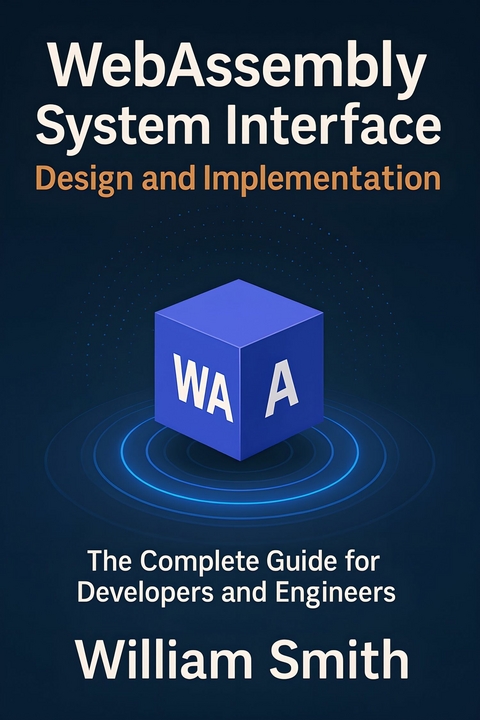
WebAssembly System Interface Design and Implementation (eBook)
250 Seiten
HiTeX Press (Verlag)
978-0-00-103030-5 (ISBN)
'WebAssembly System Interface Design and Implementation'
'WebAssembly System Interface Design and Implementation' is an authoritative guide to the foundational principles, technical architecture, and real-world application of WASI-the WebAssembly System Interface. Beginning with a deep dive into WebAssembly fundamentals, the book systematically unpacks the virtual machine's architecture, execution model, type system, and the mechanics of module interaction. It provides clear, practical insights into topics such as linear memory management, sandboxing, and the security model at the host-guest boundary, as well as detailed comparisons of leading language toolchains and runtime implementations.
The book progresses to explore the historical context and driving motivations behind WASI, contrasting its capability-based security approach with traditional POSIX systems. Readers learn how WASI's unique abstraction reshapes system primitives, emphasizing modularity, explicit capability granting, and secure sandboxing. The core WASI specification is dissected in detail, including the design and extension of system calls, virtualized I/O, process management, error handling, and type-safe multi-language interface bindings, providing architects and system implementers with actionable guidance for robust and extensible WASI deployments.
In its advanced chapters, the book examines implementation strategies for hosts and runtimes, techniques for performance optimization, debugging, and emerging models for multithreading, networking, and device access. A dedicated focus to security, privacy, formal verification, and cross-platform portability ensures that developers understand how to build resilient and future-proof WebAssembly applications. Through real-world case studies-spanning serverless computing, IoT, browser environments, and more-the book illustrates best practices and pragmatic lessons, while concluding with forward-looking insights into WASI's evolving ecosystem, research frontiers, and opportunities for open-source and community-driven innovation.
Chapter 2
Historical and Architectural Context for WASI
To understand WASI’s transformative impact on modern system design, we must first untangle the intertwined histories of operating system interfaces, security models, and the rise of WebAssembly. This chapter unveils why traditional paradigms proved insufficient for Wasm’s ambitions and how WASI’s unique architectural choices address deep-rooted challenges of portability, safety, and scalability. Through a nuanced exploration of legacy interfaces, capability-oriented thinking, and community-driven standardization, you will discover the principles and trade-offs at the heart of WASI’s design.
2.1 Evolution of System Interfaces in Wasm
The inception of WebAssembly (Wasm) marked a significant advancement in web technology, enabling near-native performance for applications within browser environments. However, this leap forward introduced a fundamental challenge: how to facilitate secure, efficient interaction between Wasm modules and their host environments. Early Wasm deployments illustrated acute difficulties stemming from the absence of a standardized system interface, forcing developers to devise various improvised solutions. These initial constraints and their subsequent evolutions underpin the formation of the WebAssembly System Interface (WASI).
In its earliest iterations, Wasm was primarily designed as a low-level bytecode tailored for sandboxed execution within JavaScript engines. This design inherently separated Wasm modules from direct access to underlying system resources such as files, networking, or clocks. Communication was predominantly mediated through JavaScript shims acting as adapters or proxies. These shims exposed host functionality as JavaScript functions callable from Wasm, effectively bridging the boundary but at the cost of multiple significant drawbacks.
Firstly, reliance on JavaScript to facilitate system interactions imposed performance penalties due to costly context switches and serialization overheads between Wasm and JavaScript. Secondly, the lack of standardized API semantics across different hosting environments led to an ad-hoc and often incompatible ecosystem. Developers creating Wasm applications required bespoke bindings tailored to specific runtime environments, complicating portability and increasing maintenance effort. In addition, these JavaScript-based interfaces offered limited expressiveness and were inherently constrained by the capabilities and security policies of the JavaScript environment itself.
Several restrictive constraints further exacerbated these difficulties. The sandboxed nature of Wasm prohibited direct system calls, so modules could not natively perform operations common in system programming, such as opening files, reading from sockets, or accessing environment variables. The only practical approach involved defining import functions that encapsulated such operations in the host. However, these were often loosely specified, with inconsistent parameter passing conventions and error handling semantics, preventing reliable cross-platform execution.
The early workarounds adopted by the developer community included embedded JavaScript “shims” that provided file system abstractions by mapping virtual file operations onto IndexedDB or in-memory structures. Some projects experimented with custom syscall interfaces modeled after POSIX, but these were inconsistent and lacked consensus. Additionally, frameworks such as Emscripten introduced their own runtime layers to simulate standard OS calls, but these implementations were tightly coupled to web environments and insufficient for broader use cases beyond browsers.
The limitations encountered catalyzed recognition of the necessity for a unified, portable system interface standard explicitly designed for Wasm. This realization crystallized around several critical inflection points. One such milestone was the identification of WebAssembly’s potential beyond browser contexts, notably in server and edge computing environments. These expanded use cases demanded a more general interface capable of safe operation with sandboxed modules, while affording access to essential system resources in a controlled manner.
Another key driver was the emerging ecosystem of WebAssembly runtimes, such as Wasmtime and Wasmer, which operated outside browsers and sought to provide consistent execution semantics. These runtimes needed a stable ABI for system calls to enable Wasm modules to run across diverse platforms without recompilation or environment-specific adaptation.
In response, the WebAssembly community initiated efforts to design the WebAssembly System Interface (WASI), a modular system interface tailored to Wasm’s security and portability requirements. WASI aimed to define a minimal, secure, and cross-platform syscall API that abstracts common operating system features such as file and network I/O, clocks, process arguments, and environment variables.
Central to WASI’s architecture is its capability-based security model, which limits module privileges by granting explicit rights to capabilities like file descriptors and network sockets. This design preserves the sandboxing principles while enabling safe interaction with system resources. WASI also places emphasis on backward compatibility and extensibility, enabling incremental adoption and future growth.
Furthermore, WASI departed from prior JavaScript-mediated interaction by specifying these syscalls at the ABI level, eliminating performance overheads from boundary crossings through foreign function interfaces directly in Wasm runtimes. By providing a canonical set of import functions with well-defined data types, error codes, and semantics, WASI has established a standardized baseline upon which developers can build portable and efficient Wasm applications across heterogeneous platforms.
The transition to WASI represents a pivotal evolution in Wasm’s ecosystem. From the constraints of early ad-hoc shims and environment-specific libraries, the emergence of a canonical system interface has facilitated Wasm’s migration from a browser-centric innovation to a general-purpose runtime model. WASI’s embodiment of secure capability-based design principles and formalized syscall semantics has resolved the core challenges of host interaction, positioning WebAssembly for broader adoption in cloud, edge, and embedded domains.
In summation, the evolution of Wasm system interfaces chronicles a trajectory from fragile, shim-dependent integrations toward a robust, standardized contract articulated by WASI. This progression, driven by performance, portability, and security imperatives, addresses the longstanding friction points that early Wasm adopters faced. The WASI initiative not only reconciles these challenges but also establishes a foundation for continuous innovation in sandboxed, high-performance computing.
2.2 POSIX, Capabilities, and Capability-Oriented Design
The Portable Operating System Interface (POSIX) standard has long served as the de facto interface for Unix-like operating systems, defining a collection of system calls and APIs that provide file, process, and interprocess communication abstractions. Despite its ubiquity, POSIX-based interfaces embody design choices that introduce fundamental challenges when applied to contemporary security requirements, particularly in the context of sandboxed and cross-platform software execution. Analyzing these challenges through the lens of capability-based security reveals the intrinsic limitations of POSIX abstractions and motivates the movement towards explicit capability granting and capability-oriented design.
At its core, POSIX presents a model of global namespaces and ambient authorities. For instance, file accesses are mediated primarily through filesystem path strings provided to system calls such as open(), stat(), or unlink(). This model implicitly assumes that a process has uniform ambient access rights that can be exercised at any time by specifying appropriate global identifiers. As a consequence, possession of the appropriate global namespace identifier (e.g., a pathname) and ambient privileges determines the ability to perform actions independent of any explicit reference-passing mechanism. This paradigm leads to several security drawbacks.
From a theoretical standpoint, POSIX’s ambient authority model violates the principle of least privilege. Since processes can access resources by globally shared names, they must rely on external policy enforcement (e.g., discretionary access control enforced by the kernel) to restrict actions. However, an application or sandbox may only be able to constrain the privileges it explicitly requests or configures, leaving the system vulnerable to confused deputy problems, where a less privileged component inadvertently misuses a more privileged resource due to ambient access rights. Additionally, the tight coupling to global namespaces hinders fine-grained delegation and revocation of privileges, as these are not explicitly modeled in the APIs.
The capability-based security paradigm offers a strikingly different approach. Here, a capability is an unforgeable, communicable token of authority that pairs a reference to an object with the rights to perform...
| Erscheint lt. Verlag | 19.8.2025 |
|---|---|
| Sprache | englisch |
| Themenwelt | Mathematik / Informatik ► Informatik ► Programmiersprachen / -werkzeuge |
| ISBN-10 | 0-00-103030-2 / 0001030302 |
| ISBN-13 | 978-0-00-103030-5 / 9780001030305 |
| Informationen gemäß Produktsicherheitsverordnung (GPSR) | |
| Haben Sie eine Frage zum Produkt? |
 EPUB (Adobe DRM)
Größe: 601 KB
Kopierschutz: Adobe-DRM
Adobe-DRM ist ein Kopierschutz, der das eBook vor Mißbrauch schützen soll. Dabei wird das eBook bereits beim Download auf Ihre persönliche Adobe-ID autorisiert. Lesen können Sie das eBook dann nur auf den Geräten, welche ebenfalls auf Ihre Adobe-ID registriert sind.
Details zum Adobe-DRM
Dateiformat: EPUB (Electronic Publication)
EPUB ist ein offener Standard für eBooks und eignet sich besonders zur Darstellung von Belletristik und Sachbüchern. Der Fließtext wird dynamisch an die Display- und Schriftgröße angepasst. Auch für mobile Lesegeräte ist EPUB daher gut geeignet.
Systemvoraussetzungen:
PC/Mac: Mit einem PC oder Mac können Sie dieses eBook lesen. Sie benötigen eine
eReader: Dieses eBook kann mit (fast) allen eBook-Readern gelesen werden. Mit dem amazon-Kindle ist es aber nicht kompatibel.
Smartphone/Tablet: Egal ob Apple oder Android, dieses eBook können Sie lesen. Sie benötigen eine
Geräteliste und zusätzliche Hinweise
Buying eBooks from abroad
For tax law reasons we can sell eBooks just within Germany and Switzerland. Regrettably we cannot fulfill eBook-orders from other countries.
aus dem Bereich


