


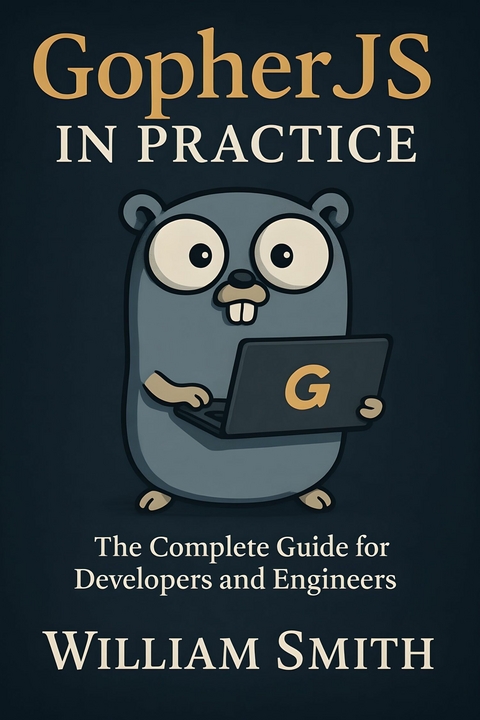
GopherJS in Practice (eBook)
250 Seiten
HiTeX Press (Verlag)
978-0-00-103013-8 (ISBN)
'GopherJS in Practice'
'GopherJS in Practice' is an essential resource for Go developers seeking to leverage their expertise in modern web development. This comprehensive guide begins by establishing GopherJS's unique role in translating robust Go code into browser-ready JavaScript, equipping readers with foundational knowledge of its compiler internals, language compatibility, and the broader ecosystem. Readers are expertly guided through the process of setting up their development environment across platforms, integrating Go modules and npm workflows, and optimizing build and debugging processes for seamless web application development.
Delving deeply into interoperability, the book demystifies the js package, empowering developers to bridge Go and JavaScript in real-world scenarios, including DOM manipulation, asynchronous workflows, and advanced web API usage. Application architecture is explored in detail, from component system design to state management and single-page applications, with practical advice on integrating with established frameworks, ensuring accessibility, and fine-tuning performance. Thorough chapters on testing, profiling, and security provide actionable strategies to deliver resilient, high-performing browser applications.
Moving beyond the basics, 'GopherJS in Practice' addresses sophisticated production and deployment concerns, including code splitting, asset management, and runtime optimization. Cloud and backend integration techniques are explored, featuring REST, GraphQL, authentication, type safety, and real-time patterns tailored for modern distributed systems. The book concludes with advanced topics and real-world case studies, demonstrating the flexibility of GopherJS, comparing it with WebAssembly, and surveying the open-source landscape, making it an indispensable companion for professionals building the next generation of Go-powered web solutions.
Chapter 1
Foundations of GopherJS
What if you could bring Go’s concurrency, safety, and structural rigor to the browser? This chapter unmasks GopherJS as not just a cross-compilation tool, but a bridge between two programming worlds rarely intertwined. We expose the principles, technical innovations, and real-world forces that position GopherJS as a gateway for backend engineers and systems programmers eager to reshape frontend development on their terms.
1.1 The Role of GopherJS in Modern Web Development
Modern web development is characterized by a complex interplay of diverse technologies, where seamless integration between backend and frontend components is paramount. In this context, GopherJS emerges as a compelling solution that enables the compilation of Go code into JavaScript, thereby bridging the paradigmatic and runtime gap between traditionally server-centric Go applications and browser-based client interfaces. The relevance of GopherJS today is best understood by examining the evolving demands in web development, the significance of WebAssembly as a coexisting technology, and JavaScript’s entrenched role as the de facto language of the browser.
A fundamental driver behind the adoption of GopherJS is the increasing necessity for robust code sharing and reuse between backend and frontend domains. Enterprises and developers leverage Go for backend services due to its performance, simplicity, and powerful concurrency primitives. Traditionally, frontend development relies heavily on JavaScript or languages transpiled into JavaScript, resulting in a bifurcation of logic and duplication of effort. GopherJS mitigates this fragmentation by allowing developers to write code once in Go, sharing business logic, validation routines, or models across the client-server boundary without reimplementation. This approach not only streamlines development processes but also reduces bugs and inconsistencies caused by divergent language paradigms or runtime behaviors.
The ascendancy of WebAssembly (Wasm) introduces a parallel narrative in frontend technology. WebAssembly provides a high-performance, low-level binary instruction format designed as a compilation target for languages like C, C++, and Rust, enabling near-native execution speeds within browsers. While Go has introduced experimental support for WebAssembly, GopherJS maintains a unique niche by compiling Go directly into idiomatic JavaScript, offering greater compatibility with existing JavaScript ecosystems, tooling, and debugging facilities. This compatibility facilitates smoother integration with JavaScript libraries and frameworks, which are indispensable in the web development landscape. WebAssembly’s current Go support also suffers from certain limitations such as larger binary sizes and immature runtime support, making GopherJS an attractive alternative for Go developers prioritizing smaller payloads and seamless interoperation with JavaScript.
JavaScript’s dominance in browser environments remains unchallenged due to historical momentum, ecosystem maturity, and comprehensive standardization. Consequently, any alternative or complementary approach must coexist with JavaScript’s runtime constraints and development paradigms. GopherJS addresses this by producing optimized JavaScript code rather than aiming for a new runtime. This design allows Go applications to be executed in any modern browser without requiring additional plugins or host environments, preserving the universal accessibility cornerstone of web applications. By leveraging source maps and producing readable JavaScript, GopherJS also makes debugging and profiling more accessible to developers familiar with JavaScript tools, lowering the barrier to adoption.
From the perspective of experienced Go developers, GopherJS offers several intrinsic strengths that enhance the client-side development experience. Foremost among these is the preservation of Go’s strong static type system, which provides compile-time guarantees and reduces runtime errors commonly encountered in dynamic languages like JavaScript. Static typing enhances code maintainability and facilitates safer refactorings, which is critical for large-scale or long-lived projects. Additionally, Go’s rich standard library and support for concurrency through goroutines and channels are retained to a significant extent. Although true parallelism is restricted by the single-threaded nature of JavaScript, asynchronous operations can be modeled idiomatically using Go’s concurrency constructs with GopherJS, improving the expressiveness and clarity of client-side code compared to conventional callback-based or promise-based JavaScript patterns.
Nevertheless, it is important to contextualize GopherJS’s niche relative to alternative frontend strategies. Frameworks and transpilers such as TypeScript, Dart with Flutter Web, and Elm offer varying trade-offs concerning type safety, developer ergonomics, and ecosystem integration. Similarly, emerging WebAssembly-centric toolchains gradually erode the performance gap with native code and allow direct compilation from several languages. GopherJS differentiates itself by targeting Go developers who prefer to utilize a single language ecosystem across the full stack, capitalizing on Go’s features and tooling without sacrificing browser compatibility or requiring significant changes in deployment pipelines. As such, GopherJS is particularly suited for projects where strong backend-frontend cohesion, type safety, and incremental adoption within a JavaScript-dominated environment are strategic priorities.
In sum, GopherJS occupies a distinctive position within the modern web development landscape by enabling Go to serve as a versatile, full-stack language. It balances the pragmatic needs for compatibility, code reuse, and developer productivity against the backdrop of evolving web standards and the enduring predominance of JavaScript. This duality of strengths-bridging backend and frontend, while embracing the JavaScript ecosystem-underpins GopherJS’s continuing relevance and its increasing adoption among seasoned Go practitioners.
1.2 Architecture and Compiler Internals
The GopherJS compiler functions as a sophisticated bridge that converts Go source code into efficient and idiomatic JavaScript, enabling Go programs to execute natively within web browsers. At its core, the compiler pipeline is a multifaceted process comprising several stages: parsing, abstract syntax tree (AST) manipulation, translation, runtime emulation, and final code generation. Each of these stages reflects deliberate architectural decisions aimed at preserving Go’s semantics while optimizing for the constraints and idioms of JavaScript environments.
The initial phase mirrors the traditional Go compiler frontend. It begins with the lexical analysis and parsing of Go source files, leveraging the standard Go parser libraries to construct a detailed AST representation. This step ensures that GopherJS benefits from up-to-date language compliance and parser stability. Crucially, the AST generated at this point is a faithful syntactic representation of the input Go program, preserving node information necessary for subsequent semantic checks and code transformation.
Following parsing, the compiler engages in intensive AST manipulation. This manipulation includes type-checking and symbol resolution, which is performed using core components of the Go toolchain to maintain consistency with the standard Go compiler behavior. Such reuse ensures that GopherJS supports the entirety of Go’s type system, including interface satisfaction and method sets. Once types are resolved, the AST is transformed to a form better suited for JavaScript translation: logical blocks are reordered, unexported identifiers are renamed, and closures or goroutines are lowered into explicit state machines or asynchronous functions. These transformations accommodate JavaScript’s single-threaded event loop and prototype-based object model.
The translation phase is characterized by the systematic conversion of Go constructs into equivalent JavaScript code snippets while retaining the high-level program structure. Control flow constructs such as loops, conditionals, and switch statements are directly mapped to their JavaScript counterparts. Complex Go features such as pointers, defer statements, and panic/recover semantics require nuanced translation:
- Pointers are emulated as references to memory buffers or wrapper objects.
- defer is compiled into stack-like structures that schedule function calls upon scope exit.
- panic and recover mechanisms leverage asynchronous control flow to simulate Go’s error handling in JavaScript’s event-driven model.
A pivotal challenge in GopherJS architecture is its runtime emulation strategy. The runtime system is implemented as a JavaScript library that replicates Go’s runtime environment, including goroutine scheduling, garbage collection approximations, and concurrency primitives. Goroutines are emulated by translating Go’s synchronous code into JavaScript generator functions or leveraging Promises and callback mechanisms to simulate concurrency cooperatively. The runtime also provides implementations of Go’s standard library features not...
| Erscheint lt. Verlag | 19.8.2025 |
|---|---|
| Sprache | englisch |
| Themenwelt | Mathematik / Informatik ► Informatik ► Programmiersprachen / -werkzeuge |
| ISBN-10 | 0-00-103013-2 / 0001030132 |
| ISBN-13 | 978-0-00-103013-8 / 9780001030138 |
| Informationen gemäß Produktsicherheitsverordnung (GPSR) | |
| Haben Sie eine Frage zum Produkt? |
 EPUB (Adobe DRM)
Größe: 912 KB
Kopierschutz: Adobe-DRM
Adobe-DRM ist ein Kopierschutz, der das eBook vor Mißbrauch schützen soll. Dabei wird das eBook bereits beim Download auf Ihre persönliche Adobe-ID autorisiert. Lesen können Sie das eBook dann nur auf den Geräten, welche ebenfalls auf Ihre Adobe-ID registriert sind.
Details zum Adobe-DRM
Dateiformat: EPUB (Electronic Publication)
EPUB ist ein offener Standard für eBooks und eignet sich besonders zur Darstellung von Belletristik und Sachbüchern. Der Fließtext wird dynamisch an die Display- und Schriftgröße angepasst. Auch für mobile Lesegeräte ist EPUB daher gut geeignet.
Systemvoraussetzungen:
PC/Mac: Mit einem PC oder Mac können Sie dieses eBook lesen. Sie benötigen eine
eReader: Dieses eBook kann mit (fast) allen eBook-Readern gelesen werden. Mit dem amazon-Kindle ist es aber nicht kompatibel.
Smartphone/Tablet: Egal ob Apple oder Android, dieses eBook können Sie lesen. Sie benötigen eine
Geräteliste und zusätzliche Hinweise
Buying eBooks from abroad
For tax law reasons we can sell eBooks just within Germany and Switzerland. Regrettably we cannot fulfill eBook-orders from other countries.
aus dem Bereich


