


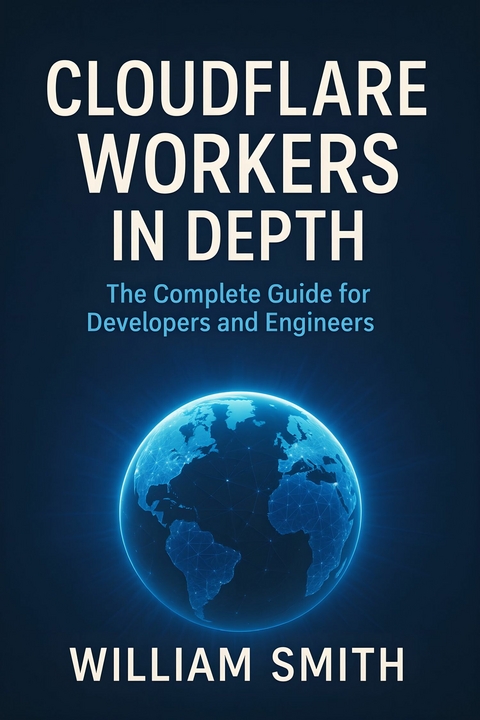
Cloudflare Workers in Depth (eBook)
250 Seiten
HiTeX Press (Verlag)
978-0-00-103011-4 (ISBN)
'Cloudflare Workers in Depth'
'Cloudflare Workers in Depth' provides a comprehensive exploration of one of the most advanced serverless platforms for edge computing today. Beginning with the architectural principles and technical foundations of Cloudflare Workers, the book demystifies the edge computing paradigm. Readers are guided through the intricacies of V8 isolates, secure multi-tenant environments, and the global infrastructure that powers ultra-low latency computation at the network edge. Through clear, authoritative explanations, the book establishes the technical context required to harness Workers for robust, scalable, and secure distributed workloads.
Moving beyond architecture, the text delves into the essential APIs, programming models, and state management techniques. Detailed chapters address event-driven development, request/response transformations, streaming data, and secure manipulation of environment bindings. Readers learn to integrate Workers with powerful storage solutions like Workers KV, Durable Objects, and R2, mastering both stateless and stateful paradigms. Special emphasis is placed on interoperability with native web APIs, advanced error handling, and the challenging task of managing consistency, concurrency, and sensitive data compliance at a global scale.
The book culminates with practical guidance on networking, security, performance optimization, and operational excellence. In-depth discussions cover everything from building secure API gateways and implementing zero trust architectures to monitoring deployments, optimizing performance, and responding to incidents. Real-world design patterns and advanced use cases-ranging from IoT ingestion to machine learning inference-are accompanied by case studies and insights on ecosystem integrations. Whether you are architecting enterprise-grade systems or adopting serverless for the first time, 'Cloudflare Workers in Depth' is an indispensable resource for building, scaling, and securing cutting-edge applications at the edge.
Chapter 2
Worker API and Programming Model
Beneath the simplicity of Cloudflare Workers lies a sophisticated execution model and API surface, designed for power and expressiveness at massive scale. This chapter dissects the event-driven underpinnings and the nuanced request/response lifecycles that empower edge-native applications. We unveil the best practices, advanced patterns, and pitfalls encountered by seasoned practitioners who push serverless JavaScript to its limits.
2.1 The Event-driven Model
Cloudflare Workers utilize a finely tuned event-driven architecture that enables JavaScript code to execute at the network edge with minimal latency and remarkable scalability. The fundamental construct driving this architecture is the FetchEvent, joined by scheduled events that collectively orchestrate the lifecycle of each worker instance and its interactions with incoming requests. Understanding this event-driven model requires a detailed examination of the worker activation sequence, event listener registration and invocation, and the nuanced differences compared to conventional serverless functions and standard web platform eventing.
At its core, the Cloudflare Workers environment is initialized upon the reception of a triggering event, typically an HTTP request encapsulated as a FetchEvent. This model embraces the service worker pattern established in web browsers, adapting it for cloud edge execution. When an HTTP request arrives at the Cloudflare edge, the runtime instantiates a FetchEvent object, which encapsulates the original Request and provides asynchronous methods such as respondWith to control the response. The developer’s code registers one or more event listeners on the global self context, listening specifically for fetch events. The invocation pattern is declarative: the runtime listens for incoming fetch events and executes the corresponding listeners in a predictable, non-blocking manner.
The worker activation sequence begins with the cold start phase-an ephemeral environment is provisioned for the worker, CPU and memory are allocated, and the worker script is parsed and compiled. Following this, the environment remains resident and processes incoming FetchEvent instances through the registered listeners. This persistence contrasts with many traditional serverless platforms where function containers are often short-lived with heavier cold start penalties. Cloudflare Workers leverage the V8 engine’s isolate model to maintain rapid spin-up times, enabling near-instantaneous activation on subsequent requests and effectively reducing latency.
Event listeners in Cloudflare Workers are registered via the standard addEventListener API. A typical pattern is as follows:
event.respondWith(handleRequest(event.request));
});
async function handleRequest(request) {
return new Response(’Hello from Cloudflare Workers!’, {
headers: { ’content-type’: ’text/plain’ },
});
}
This paradigm separates concerns cleanly: event listener registration is declarative and occurs once per worker instantiation, while the event handler logic executes asynchronously for each request. The respondWith method ensures the fetch promises are properly awaited, preventing premature worker termination and aligning with web standards for service workers.
Scheduled events, introduced as part of the Cloudflare Workers Cron Triggers feature, extend this event-driven architecture beyond HTTP requests. These ScheduledEvent instances are dispatched on configured time intervals and invoke registered listeners for the scheduled event type, enabling background tasks, maintenance, and off-peak computations. The model for scheduled events follows a pattern similar to FetchEvent:
event.waitUntil(doBackgroundTask());
});
async function doBackgroundTask() {
// Perform periodic maintenance or data fetching here
}
The waitUntil method in the ScheduledEvent interface signals the runtime to keep the worker alive until the asynchronous task resolves, offering precise control over lifecycle management for time-based operations.
Contrasting Cloudflare Workers’ event-driven model with traditional serverless architectures reveals several distinctive traits. Conventional serverless platforms (e.g., AWS Lambda, Azure Functions) bind code execution predominantly to trigger-based invocations that instantiate isolated environments per request or batch, often incurring notable overhead due to container initialization and teardown. In contrast, Cloudflare Workers operate on a lightweight isolate model with event listeners persisting across multiple requests, affording both a lower latency profile and a higher degree of concurrency within the same runtime instance.
Moreover, the Workers environment adopts familiar web platform semantics, inheriting from the service worker specification used in browsers. This alignment unlocks a more uniform programming model across client, edge, and server contexts. The event-driven model here is explicit and managed at the JavaScript level without reliance on external triggers or non-standard hooks, enhancing developer productivity and code portability.
The request lifecycle within a Cloudflare Worker begins when a request is...
| Erscheint lt. Verlag | 19.8.2025 |
|---|---|
| Sprache | englisch |
| Themenwelt | Mathematik / Informatik ► Informatik ► Programmiersprachen / -werkzeuge |
| ISBN-10 | 0-00-103011-6 / 0001030116 |
| ISBN-13 | 978-0-00-103011-4 / 9780001030114 |
| Informationen gemäß Produktsicherheitsverordnung (GPSR) | |
| Haben Sie eine Frage zum Produkt? |
 EPUB (Adobe DRM)
Größe: 570 KB
Kopierschutz: Adobe-DRM
Adobe-DRM ist ein Kopierschutz, der das eBook vor Mißbrauch schützen soll. Dabei wird das eBook bereits beim Download auf Ihre persönliche Adobe-ID autorisiert. Lesen können Sie das eBook dann nur auf den Geräten, welche ebenfalls auf Ihre Adobe-ID registriert sind.
Details zum Adobe-DRM
Dateiformat: EPUB (Electronic Publication)
EPUB ist ein offener Standard für eBooks und eignet sich besonders zur Darstellung von Belletristik und Sachbüchern. Der Fließtext wird dynamisch an die Display- und Schriftgröße angepasst. Auch für mobile Lesegeräte ist EPUB daher gut geeignet.
Systemvoraussetzungen:
PC/Mac: Mit einem PC oder Mac können Sie dieses eBook lesen. Sie benötigen eine
eReader: Dieses eBook kann mit (fast) allen eBook-Readern gelesen werden. Mit dem amazon-Kindle ist es aber nicht kompatibel.
Smartphone/Tablet: Egal ob Apple oder Android, dieses eBook können Sie lesen. Sie benötigen eine
Geräteliste und zusätzliche Hinweise
Buying eBooks from abroad
For tax law reasons we can sell eBooks just within Germany and Switzerland. Regrettably we cannot fulfill eBook-orders from other countries.
aus dem Bereich


