


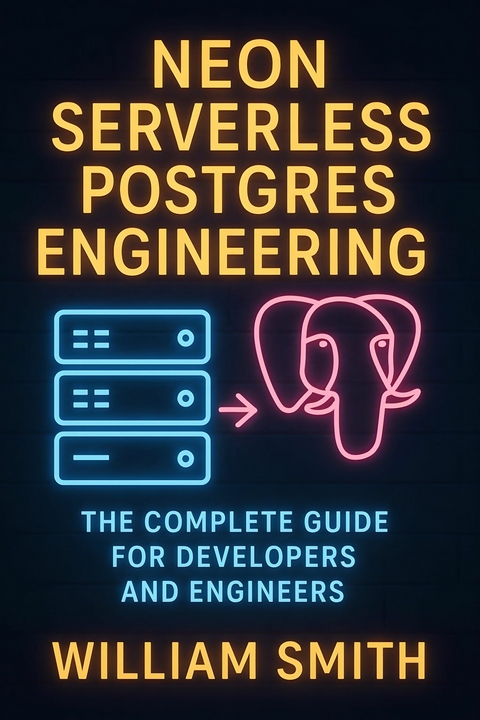
Neon Serverless Postgres Engineering (eBook)
250 Seiten
HiTeX Press (Verlag)
978-0-00-103010-7 (ISBN)
'Neon Serverless Postgres Engineering'
'Neon Serverless Postgres Engineering' offers an authoritative guide to the emerging paradigm of serverless PostgreSQL, with a sharp focus on the groundbreaking Neon platform. The book opens with a comprehensive foundation, tracing PostgreSQL's journey in cloud environments and examining how serverless architectures transform fundamental principles of database management. By elucidating key concepts such as the decoupling of storage and compute, the detailed lifecycle of serverless requests, and Neon's architectural innovations, the first chapter positions readers to fully understand the distinctive advantages and challenges of modern, cloud-native database deployments.
Delving into the technical heart of Neon, the work meticulously unpacks its internal architecture-exploring stateless compute layers, resilient storage engines, and advanced orchestration techniques. The narrative spans essential operational topics, from API-driven automation and efficient data lineage management to robust backup strategies and cost governance. Special attention is given to transactional guarantees, performance optimization, and the unique requirements of security, isolation, and compliance in multi-tenant, elastically-scaled environments. Each chapter weaves real-world practices with conceptual depth, empowering engineers and architects to harness Neon's potential within demanding, production-grade workloads.
Broadening its perspective in the later chapters, the book addresses modern DevOps and SRE practices, seamless integrations with application ecosystems, and strategies for benchmarking and observability. Looking forward, it identifies major trends-such as edge deployments, machine learning integrations, and open-source community momentum-while sharing insights and case studies from large-scale Neon deployments. 'Neon Serverless Postgres Engineering' stands as an essential reference for professionals striving to innovate at the intersection of serverless computing, database reliability, and operational excellence.
Chapter 1
Serverless PostgreSQL Fundamentals
Discover how serverless paradigms are reshaping the relational database landscape-a transformation rooted in the evolution of PostgreSQL’s architecture. This chapter journeys from the historic foundations of Postgres in the cloud to the breakthrough principles of serverless design, highlighting Neon’s disruptive innovations and the deep implications of decoupling storage from compute. Prepare to dissect the technical nuances that enable seamless scale, efficiency, and manageability, and to see firsthand how these foundations set the stage for the next generation of resilient, dynamic, and cost-effective data systems.
1.1 Historical Context of PostgreSQL in the Cloud
PostgreSQL’s journey into cloud environments reflects both the evolution of infrastructure paradigms and the database’s intrinsic adaptability. Initially conceived as a robust open-source relational database system, PostgreSQL found its earliest cloud deployments grounded firmly in Infrastructure as a Service (IaaS). Early adopters leveraged virtual machines to deploy traditional PostgreSQL instances virtually identical to on-premises installations. This approach benefited from the flexibility of cloud infrastructure but exposed several inherent technical and operational challenges driven by the traditional hosting model.
One pivotal challenge lay in resource management and elasticity. On-premises and IaaS-based PostgreSQL deployments typically required manual provisioning of compute, storage, and networking resources. Scaling vertically demanded downtime, intricate reconfiguration, and capacity planning, while horizontal scaling remained difficult due to PostgreSQL’s monolithic architecture and the limitations of synchronous replication and clustering technologies of the period. These restrictions constrained the ability to dynamically respond to fluctuating workloads, impacting both performance and cost efficiency.
Operational complexity constituted another limiting factor. Database administrators (DBAs) and operations teams faced the burden of routine maintenance tasks such as patching, backups, replication configuration, failover management, and capacity adjustments. These tasks, although well-understood within traditional data center contexts, became more complicated when executed within virtualized and multi-tenant cloud environments. The challenge was compounded by the need to secure instances, optimize storage to avoid unnecessary I/O bottlenecks, and ensure high availability distributed across disparate data centers. Consequently, organizations experienced significant operational overhead and required specialized expertise, which ran counter to cloud’s promise of simplification.
From a cost perspective, traditional PostgreSQL hosting in the cloud often translated legacy purchasing and provisioning models directly into the virtualized domain. Resources were allocated based on peak demand estimates, leading to underutilization and cost inefficiencies during periods of low activity. Cloud providers charged primarily on resource reservation and uptime, rather than actual consumption, reducing the agility of cost management relative to application demands.
The combined pressure of these technical limitations and cost inefficiencies galvanized the emergence of a new generation of database deployment methodologies centered around managed services. Cloud providers began offering PostgreSQL as a managed service, abstracting much of the operational complexity away from end users. These services automated provisioning, patching, backups, replication, failover, and monitoring, dramatically lowering the expertise barrier and operational risk. Managed PostgreSQL also integrated elasticity features, allowing users to scale compute and storage resources with reduced downtime and improved responsiveness. Cost models evolved from fixed-instance billing toward usage-based pricing that correlated more closely with actual consumption patterns.
Managed PostgreSQL services also addressed architectural limitations through innovations such as read replicas and more sophisticated clustering mechanisms. Although these improvements enhanced availability and read scalability, write scalability and multi-tenant efficiency remained subjects of ongoing development. Nonetheless, managed services represented a transformative shift, democratizing PostgreSQL deployment and accelerating adoption across a broader range of applications and industries.
The continual drive for operational simplicity, elasticity, and cost optimization further catalyzed the development of serverless PostgreSQL offerings. Serverless database platforms encapsulate the promise of automatic scaling, pay-per-use billing, and near-zero operational burden. These platforms abstract infrastructure and operational concerns completely, allowing developers to interact with PostgreSQL through standard interfaces but with enhanced elasticity across transactional and analytical workloads.
Serverless PostgreSQL implementations overcome traditional limitations by employing innovative storage and compute separation, stateless compute nodes, and fine-grained auto-scaling mechanisms. Underlying these features are advances in storage systems optimized for cloud object storage and networking, which enable instant scaling without the typical penalties of cold starts or data movement. Additionally, serverless services integrate sophisticated caching layers, connection pooling, and query routing to maintain performance and availability despite the inherently ephemeral nature of serverless compute.
This evolution from raw IaaS deployments to fully managed, and finally serverless, PostgreSQL services has been driven by several fundamental forces: the increasing demand for elasticity to accommodate unpredictable workloads; the imperative to reduce operational complexity and reliance on specialized DBA resources; and the constant pressure to optimize cost efficiency in highly competitive cloud markets. Together, these dynamics have reshaped database infrastructure design, fostering a new class of cloud-native PostgreSQL offerings that balance flexibility, performance, and total cost of ownership in unprecedented ways.
Thus, PostgreSQL’s historical context in the cloud is emblematic of the broader trends defining modern cloud-native infrastructure: progressive abstraction, continuous automation, and resource elasticity. Each stage—from manual IaaS deployments to managed services and serverless solutions—represents an iterative response to the evolving requirements of cloud users and the constraints imposed by earlier paradigms. This trajectory not only underscores PostgreSQL’s adaptability but also illuminates the fundamental drivers shaping the future of database technologies in cloud ecosystems.
1.2 Principles of Serverless Database Systems
Serverless database systems constitute a paradigm shift in data management that revolutionizes how resources are allocated, consumed, and billed. At their core, these systems abstract resource management away from users, allowing dynamic and automatic scaling that responds directly to workload demands. This abstraction contrasts sharply with traditional managed database services, where explicit provisioning, configuration, and capacity planning remain deeply involved. Understanding the foundational principles governing serverless databases-namely, resource management abstraction, event-driven activation, consumption-based billing, and statelessness-provides insight into the architectural nuances and operational trade-offs inherent in this emerging technology, especially within the context of relational workloads.
Abstraction of Resource Management
Traditional database services require users or administrators to manage resource allocation explicitly. This entails selecting instance sizes, tuning memory and CPU capacities, and scaling hardware either vertically or horizontally to accommodate workload changes. Serverless database systems mask these complexities by virtualizing the underlying infrastructure, presenting the database as a fully managed service with no upfront resource provisioning. Resource allocation becomes dynamic and elastic, driven by real-time demand and orchestrated entirely by the platform.
This abstraction employs microservice-like containerization or lightweight virtualization techniques, enabling fine-grained and rapid scaling. Users interact with an endpoint that abstracts a pool of shared physical or virtual resources. Behind the scenes, the system continuously monitors query volume, throughput, and transactional load, adjusting resource assignment within fractions of a second. This design reduces operational overhead and helps eliminate common issues like idle capacity or under-provisioning but demands sophisticated orchestration to maintain performance guarantees.
Event-Driven Activation
Serverless databases operate on an event-driven model where compute and storage components awaken in response to query requests or transaction submissions. Unlike always-on managed databases, serverless systems remain dormant or at minimal resource utilization during periods of inactivity, only “spinning up” relevant resources on demand. This event-triggered behavior...
| Erscheint lt. Verlag | 19.8.2025 |
|---|---|
| Sprache | englisch |
| Themenwelt | Mathematik / Informatik ► Informatik ► Programmiersprachen / -werkzeuge |
| ISBN-10 | 0-00-103010-8 / 0001030108 |
| ISBN-13 | 978-0-00-103010-7 / 9780001030107 |
| Informationen gemäß Produktsicherheitsverordnung (GPSR) | |
| Haben Sie eine Frage zum Produkt? |
 EPUB (Adobe DRM)
Größe: 823 KB
Kopierschutz: Adobe-DRM
Adobe-DRM ist ein Kopierschutz, der das eBook vor Mißbrauch schützen soll. Dabei wird das eBook bereits beim Download auf Ihre persönliche Adobe-ID autorisiert. Lesen können Sie das eBook dann nur auf den Geräten, welche ebenfalls auf Ihre Adobe-ID registriert sind.
Details zum Adobe-DRM
Dateiformat: EPUB (Electronic Publication)
EPUB ist ein offener Standard für eBooks und eignet sich besonders zur Darstellung von Belletristik und Sachbüchern. Der Fließtext wird dynamisch an die Display- und Schriftgröße angepasst. Auch für mobile Lesegeräte ist EPUB daher gut geeignet.
Systemvoraussetzungen:
PC/Mac: Mit einem PC oder Mac können Sie dieses eBook lesen. Sie benötigen eine
eReader: Dieses eBook kann mit (fast) allen eBook-Readern gelesen werden. Mit dem amazon-Kindle ist es aber nicht kompatibel.
Smartphone/Tablet: Egal ob Apple oder Android, dieses eBook können Sie lesen. Sie benötigen eine
Geräteliste und zusätzliche Hinweise
Buying eBooks from abroad
For tax law reasons we can sell eBooks just within Germany and Switzerland. Regrettably we cannot fulfill eBook-orders from other countries.
aus dem Bereich


