


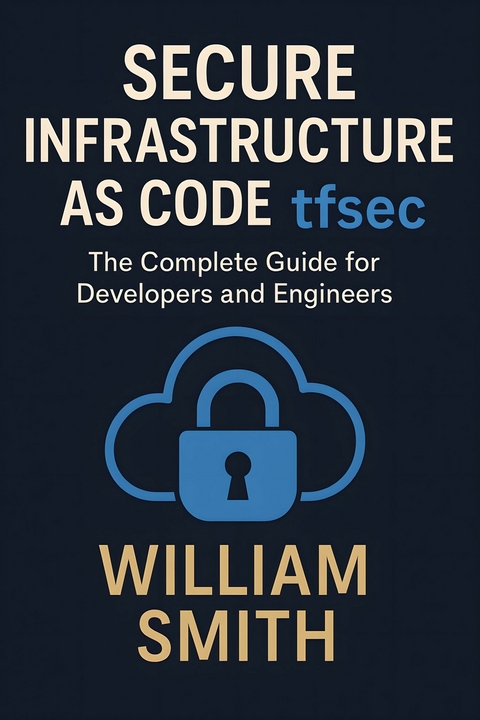
Secure Infrastructure as Code with tfsec (eBook)
250 Seiten
HiTeX Press (Verlag)
978-0-00-102996-5 (ISBN)
'Secure Infrastructure as Code with tfsec'
Secure Infrastructure as Code with tfsec is an indispensable guide for cloud architects, DevOps professionals, and security engineers who seek to manage infrastructure through code without sacrificing safety or compliance. The book meticulously unveils the evolution of Infrastructure as Code (IaC), highlighting the heightened security risks and complexities that come with automated cloud provisioning. Readers will gain a comprehensive understanding of IaC-specific threat models, best practices for safe deployments, and the mapping of industry-leading compliance frameworks directly into code-based infrastructure.
The text delves deeply into the technical underpinnings of Terraform and tfsec, presenting advanced analyses of Terraform constructs, state management, and provider risks, while offering practical methodologies for sealing vulnerabilities at scale. With a detailed exploration of tfsec's architecture, rule sets, and extensibility, the book empowers practitioners to tailor security automation to both organizational requirements and regulatory mandates. Through hands-on guidance, readers learn to integrate tfsec into developer workflows, continuous integration pipelines, and enterprise environments, ensuring robust IaC security across multiple cloud platforms.
Case studies and real-world scenarios enrich the narrative, illustrating effective incident response, compliance enablement, and DevSecOps transformations achieved with tfsec. The final chapters look forward, assessing emerging threats, AI-driven analysis, and the future of policy as code, while underscoring the vital role of community and open standards. Whether you are implementing secure workflows, authoring custom rules, or scaling security across global teams, this book offers the strategies and insight needed to build resilient, compliant, and future-proof cloud infrastructures.
Chapter 1
Infrastructure as Code Security Fundamentals
Modern infrastructure is codified, versioned, and deployed at machine speed-but with this power comes uniquely complex risks. This chapter exposes the hidden perils and transformative security paradigms faced when machines become the primary architects of cloud environments. From threat modeling and risk landscapes to actionable best practices, you will uncover the core principles and real challenges at the intersection of automation, cloud, and security governance.
1.1 Evolution of IaC and Security Paradigms
The progression from manual infrastructure provisioning to automated Infrastructure as Code (IaC) represents a profound transformation in how IT environments are managed and secured. Traditionally, infrastructure was configured through manual processes involving physical interaction with hardware and configuration of software settings, a method inherently slow and prone to human error. This antiquated approach, although cumbersome, implicitly limited the scale and rapidity of change, thereby constraining the scope and velocity of security threats. With the advent of IaC, infrastructure setup became subject to software engineering principles-versioning, testing, and automated deployment-initiating a paradigm wherein infrastructure itself is treated as mutable code.
Central to this evolution is the acceleration of deployment cycles and the expansion of the attack surface. IaC enables near-instantaneous provisioning of resources through declarative or imperative definitions in code, eliminating manual configuration drift and fostering reproducibility. However, this velocity presents a dual-edged sword: while development teams can deploy new features and environments rapidly, the window for introducing and detecting security flaws simultaneously compresses. Misconfigurations, which historically propagated slowly through manual oversight, can now be duplicated and propagated across entire environments at unprecedented speeds. This rapid proliferation magnifies the impact of any single error, necessitating a refocus on pre-deployment validation and continuous enforcement mechanisms.
The historical security paradigm, centered around perimeter defense and reactive patching, proves insufficient in this new context. The shift from static, manually managed systems to dynamic, code-defined infrastructures introduces an elevated risk complexity. The attack surface transforms from a fixed set of physical and logical endpoints to a mutable, ephemeral collection of instances, networks, and permissions defined by code. These elements, codified in templates or scripts, can expose sensitive information such as credentials or keys, or instantiate overly permissive access controls if guardrails are absent. Consequently, the traditional boundary-based security model yields to a need for integrated, codified security controls embedded within the IaC lifecycle.
Another critical dimension of this evolution lies in the redistribution of responsibilities between development, operations, and security teams. The earlier dichotomy-with security teams operating primarily as gatekeepers during post-provisioning audits-gives way to shared ownership frameworks. Developers tasked with writing IaC scripts must internalize security best practices and incorporate security checks directly into the code. Simultaneously, security teams pivot towards enabling developer-centric tooling, such as static analysis and automated policy enforcement within CI/CD pipelines. This collaborative model, often dubbed DevSecOps, emphasizes shift-left security, where potential vulnerabilities are identified and remediated earlier in the lifecycle, reducing resolution costs and exposure times.
Empirical studies and industry reports corroborate this shift. For example, the proliferation of misconfigurations in IaC manifests as a leading cause of cloud security incidents, outpacing vulnerabilities in traditional application code. Common patterns include misconfigured storage buckets, overly broad role-based access permissions, and unsecured network ingress rules. As IaC templates are often reused and shared across teams and organizations, the risk of propagating insecure templates elevates the requirement for robust template repositories with enforced security policies and provenance tracking.
On the technological front, the rise of specialized IaC security tools reflects the industry’s response to evolving threats. These tools perform static code analysis to detect insecure configurations, enforce compliance with security frameworks, and integrate seamlessly into automated pipelines. They leverage domain-specific knowledge to interpret resource definitions and permissions, providing contextualized alerts beyond generic code scanning capabilities. The maturation of these tools parallels the maturity of IaC methodologies, demonstrating the inseparability of infrastructure automation and security innovation.
The evolution toward IaC has precipitated a fundamental shift in security paradigms. The increased velocity of infrastructure deployment introduces new vulnerabilities and necessitates real-time, automated security validation. The attack surface expands into code repositories, requiring integrated security controls throughout the development lifecycle. Furthermore, responsibility for security becomes distributed within cross-functional teams, establishing a culture of collective accountability. Understanding this historic and emergent landscape is crucial for developing secure, scalable infrastructure architectures that harness the advantages of automation while mitigating inherent risks.
1.2 Threat Models for Cloud-Native IaC
Infrastructure as Code (IaC) fundamentally transforms how infrastructure is provisioned, managed, and scaled, embedding critical operational logic within declarative or imperative code artifacts. This codification introduces distinctive threat vectors that diverge significantly from traditional infrastructure security paradigms. A thorough understanding of these vectors is imperative for constructing comprehensive threat models that anticipate and mitigate risks specific to cloud-native IaC contexts.
A primary risk dimension is privilege escalation within the IaC environment. IaC scripts, templates, and configuration files frequently encapsulate privileged operations such as creating virtual machines, configuring network policies, or managing identity and access management (IAM) roles. Compromise or manipulation of these IaC artifacts can enable an adversary to escalate privileges both horizontally and vertically across the infrastructure. For example, injection of malicious code into an IaC repository or pipeline can result in unauthorized role bindings or elevation of access for attacker-controlled identities. This vector mandates rigorous validation and least-privilege principles at the IaC source code level, combined with runtime enforcement mechanisms in continuous integration and continuous deployment (CI/CD) pipelines.
Closely related is the threat of secret proliferation. IaC environments often require the use of sensitive data-API keys, credentials, cryptographic tokens-that, if improperly handled, risk widespread exposure. Secrets may inadvertently be hardcoded in IaC code, embedded in environment variables, or logged during pipeline executions. Such leakage not only compromises individual services but can cascade into broader infrastructure compromise due to the interconnected nature of cloud resources. Threat models must thus incorporate secret detection tools integrated within the IaC development lifecycle, secret management solutions that utilize dynamic retrieval and ephemeral credentials, and strict audit trails of secret access and usage.
Lateral movement within cloud-native environments also gains new vectors when viewed through the IaC lens. Traditional lateral movement involves the exploitation of network trust relationships post-compromise. In IaC-driven systems, attackers may exploit misconfigurations codified in the infrastructure templates-such as overly permissive network security groups, misconfigured service accounts, or embedded trust relationships between components-to traverse the environment programmatically. Moreover, the automated and reproducible nature of IaC deployment means that flawed configurations can be quickly propagated at scale. Threat modeling must therefore scrutinize defined inter-service dependencies and network policies as represented in IaC manifests, highlighting areas where an adversary might leverage IaC-induced trust boundaries.
The risk of CI/CD pipeline abuse is another critical IaC-specific threat vector. These pipelines serve as the automated highways for delivering infrastructure changes from code to production and thus represent a highly privileged attack surface. An adversary who gains access to source control or pipeline configurations may inject malicious code, bypass approval gates, or modify deployment parameters to introduce vulnerabilities or backdoors. Furthermore, compromised pipeline agents can manipulate build artifacts or secret provisioning processes. Effective threat models account for the pipeline’s multi-stage nature, emphasizing strong authentication mechanisms, role...
| Erscheint lt. Verlag | 19.8.2025 |
|---|---|
| Sprache | englisch |
| Themenwelt | Mathematik / Informatik ► Informatik ► Programmiersprachen / -werkzeuge |
| ISBN-10 | 0-00-102996-7 / 0001029967 |
| ISBN-13 | 978-0-00-102996-5 / 9780001029965 |
| Informationen gemäß Produktsicherheitsverordnung (GPSR) | |
| Haben Sie eine Frage zum Produkt? |
 EPUB (Adobe DRM)
Größe: 625 KB
Kopierschutz: Adobe-DRM
Adobe-DRM ist ein Kopierschutz, der das eBook vor Mißbrauch schützen soll. Dabei wird das eBook bereits beim Download auf Ihre persönliche Adobe-ID autorisiert. Lesen können Sie das eBook dann nur auf den Geräten, welche ebenfalls auf Ihre Adobe-ID registriert sind.
Details zum Adobe-DRM
Dateiformat: EPUB (Electronic Publication)
EPUB ist ein offener Standard für eBooks und eignet sich besonders zur Darstellung von Belletristik und Sachbüchern. Der Fließtext wird dynamisch an die Display- und Schriftgröße angepasst. Auch für mobile Lesegeräte ist EPUB daher gut geeignet.
Systemvoraussetzungen:
PC/Mac: Mit einem PC oder Mac können Sie dieses eBook lesen. Sie benötigen eine
eReader: Dieses eBook kann mit (fast) allen eBook-Readern gelesen werden. Mit dem amazon-Kindle ist es aber nicht kompatibel.
Smartphone/Tablet: Egal ob Apple oder Android, dieses eBook können Sie lesen. Sie benötigen eine
Geräteliste und zusätzliche Hinweise
Buying eBooks from abroad
For tax law reasons we can sell eBooks just within Germany and Switzerland. Regrettably we cannot fulfill eBook-orders from other countries.
aus dem Bereich


