


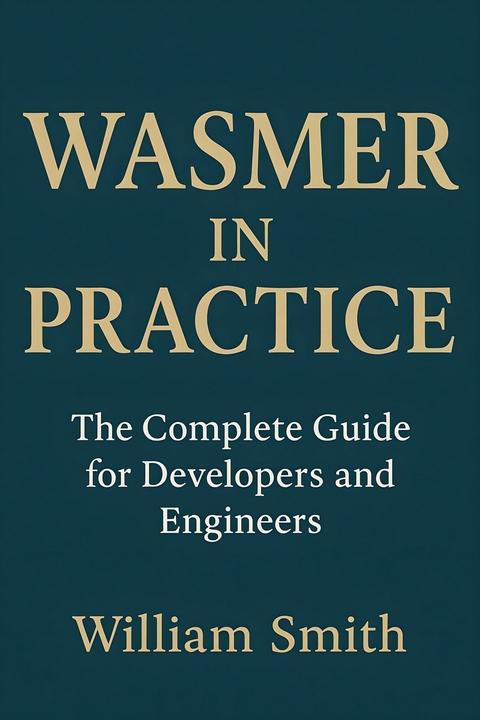
Wasmer in Practice (eBook)
250 Seiten
HiTeX Press (Verlag)
978-0-00-102992-7 (ISBN)
'Wasmer in Practice'
'Wasmer in Practice' delivers an in-depth, comprehensive guide to harnessing the power of WebAssembly and the Wasmer runtime in modern software engineering. The book begins with foundational coverage detailing WebAssembly's design, execution model, and its transformative approach to system portability. You'll explore Wasmer's modular architecture, its integration with host environments, and best practices for installation and project organization, setting a strong technical base for both newcomers and seasoned developers working with Wasm ecosystems.
Moving beyond the basics, 'Wasmer in Practice' delves into the internal mechanics of Wasmer-including its compiler infrastructure, memory and resource management, and rigorous security model. Dedicated chapters provide advanced technical insights into host language integration (Rust, Go, Python, Node.js), WASI system interface extension, and scalable deployment strategies across cloud, edge, and containerized environments. Detailed treatment of module composition, versioning, embedding patterns, CI/CD automation, and startup performance enables readers to architect robust, production-grade applications.
The book is enriched with practical case studies and real-world scenarios, demonstrating Wasmer's application across SaaS architectures, machine learning deployments, blockchain runtimes, and legacy system modernization. Emphasis on performance profiling, security compliance, observability, and future extensibility empowers readers not only to adopt Wasmer but also to innovate at the forefront of distributed compute. With clarity, depth, and forward-looking perspective, 'Wasmer in Practice' stands as the authoritative resource for mastering WebAssembly in professional contexts.
Chapter 1
Fundamentals of WebAssembly and Wasmer
Dive into the essential building blocks of modern decentralized application execution. This chapter unveils how WebAssembly redefines the boundaries of portability, efficiency, and security while exploring Wasmer’s distinctive approach to running Wasm across diverse environments. Whether embedding Wasm in existing systems or constructing future-proof services, understanding this foundation is key to leveraging the full power of next-generation software stacks.
1.1 WebAssembly: A Systems-Level Runtime
WebAssembly (Wasm) emerged as a portable, low-level bytecode designed to serve as a compilation target for a wide variety of high-level languages, with the explicit goal of executing code safely and efficiently across diverse computational platforms. Unlike earlier web-centric execution models relying heavily on JavaScript, Wasm introduces a compact, binary instruction format optimized for fast download, decoding, and execution, harnessing modern hardware capabilities while preserving a strict sandboxed security model.
The genesis of WebAssembly dates back to the need for a common runtime capable of extending the web’s reach beyond traditional scripting paradigms, accommodating system-level applications and near-native performance. It addresses the limitations of existing approaches by defining a standard instruction set and runtime semantics that enable deterministic execution and low overhead. By offering a compilation target for languages such as C, C++, and Rust, Wasm allows the reuse of vast codebases and facilitates a broad ecosystem of cross-platform applications, from web browsers to standalone runtimes.
At its core, WebAssembly is a stack-based virtual machine, drawing inspiration from classical concepts but tailored for modern constraints. The instruction set is minimalist and orthogonal, emphasizing simplicity to enable fast decoding and efficient implementation. Instructions operate on a virtual value stack and include primitives for numeric operations (integer and floating point), control flow (blocks, loops, conditional branches), memory manipulation, and function calls. The type system is strongly statically typed, enabling ahead-of-time validation and optimization.
Memory access in Wasm is linear and sandboxed; modules expose a contiguous, byte-addressable memory array that can be dynamically resized but is strictly isolated from the host and from other modules. This linear memory model facilitates efficient compilation to native code and straightforward reasoning about data layout. Wasm also defines tables for indirect function calls, supporting dynamic dispatch and enabling features like virtual method calls used in object-oriented programming languages.
i32.add ;; Add two 32-bit integers
f64.mul ;; Multiply two 64-bit floats
;; Control flow
block ;; Begin a sequence of instructions
loop ;; Begin a loop construct
br_if ;; Conditional branch
;; Memory operations
i32.load ;; Load 4 bytes from linear memory
i32.store ;; Store 4 bytes to linear memory
;; Calls
call ;; Direct function call
call_indirect;; Indirect function call via table
WebAssembly implementations typically employ a combination of ahead-of-time (AOT) and just-in-time (JIT) compilation techniques to optimize runtime performance. The well-defined binary format and static typing facilitate rapid decoding and validation. Once validated, Wasm bytecode can be translated into native machine instructions using low-level code generators that exploit platform-specific features such as SIMD instructions and advanced memory management schemes.
The deterministic execution model of Wasm ensures consistent behavior across platforms and executions. This determinism arises from the absence of undefined behaviors common in low-level languages; for example, out-of-bounds memory access triggers traps rather than undefined results. Consequently, Wasm supports reliable debugging, reproducible builds, and safe sandboxing.
Security and isolation are fundamental to the WebAssembly runtime’s architecture. The sandbox is enforced by strictly partitioning module code and data from...
| Erscheint lt. Verlag | 19.8.2025 |
|---|---|
| Sprache | englisch |
| Themenwelt | Mathematik / Informatik ► Informatik ► Programmiersprachen / -werkzeuge |
| ISBN-10 | 0-00-102992-4 / 0001029924 |
| ISBN-13 | 978-0-00-102992-7 / 9780001029927 |
| Informationen gemäß Produktsicherheitsverordnung (GPSR) | |
| Haben Sie eine Frage zum Produkt? |
 EPUB (Adobe DRM)
Größe: 871 KB
Kopierschutz: Adobe-DRM
Adobe-DRM ist ein Kopierschutz, der das eBook vor Mißbrauch schützen soll. Dabei wird das eBook bereits beim Download auf Ihre persönliche Adobe-ID autorisiert. Lesen können Sie das eBook dann nur auf den Geräten, welche ebenfalls auf Ihre Adobe-ID registriert sind.
Details zum Adobe-DRM
Dateiformat: EPUB (Electronic Publication)
EPUB ist ein offener Standard für eBooks und eignet sich besonders zur Darstellung von Belletristik und Sachbüchern. Der Fließtext wird dynamisch an die Display- und Schriftgröße angepasst. Auch für mobile Lesegeräte ist EPUB daher gut geeignet.
Systemvoraussetzungen:
PC/Mac: Mit einem PC oder Mac können Sie dieses eBook lesen. Sie benötigen eine
eReader: Dieses eBook kann mit (fast) allen eBook-Readern gelesen werden. Mit dem amazon-Kindle ist es aber nicht kompatibel.
Smartphone/Tablet: Egal ob Apple oder Android, dieses eBook können Sie lesen. Sie benötigen eine
Geräteliste und zusätzliche Hinweise
Buying eBooks from abroad
For tax law reasons we can sell eBooks just within Germany and Switzerland. Regrettably we cannot fulfill eBook-orders from other countries.
aus dem Bereich


